
Unbiased headlines. Facts, not spin.
Every story is an unbiased news briefing written from 110+ sources across the spectrum — sources linked so you can verify it yourself.
 tech
Major Story (8/10)
July 10, 2026 at 06:13 AM
tech
Major Story (8/10)
July 10, 2026 at 06:13 AM
OpenAI Launches GPT-5.6 to the Public, Kills Its Browser App, and Rolls Out ChatGPT Work as an Enterprise Automation Platform
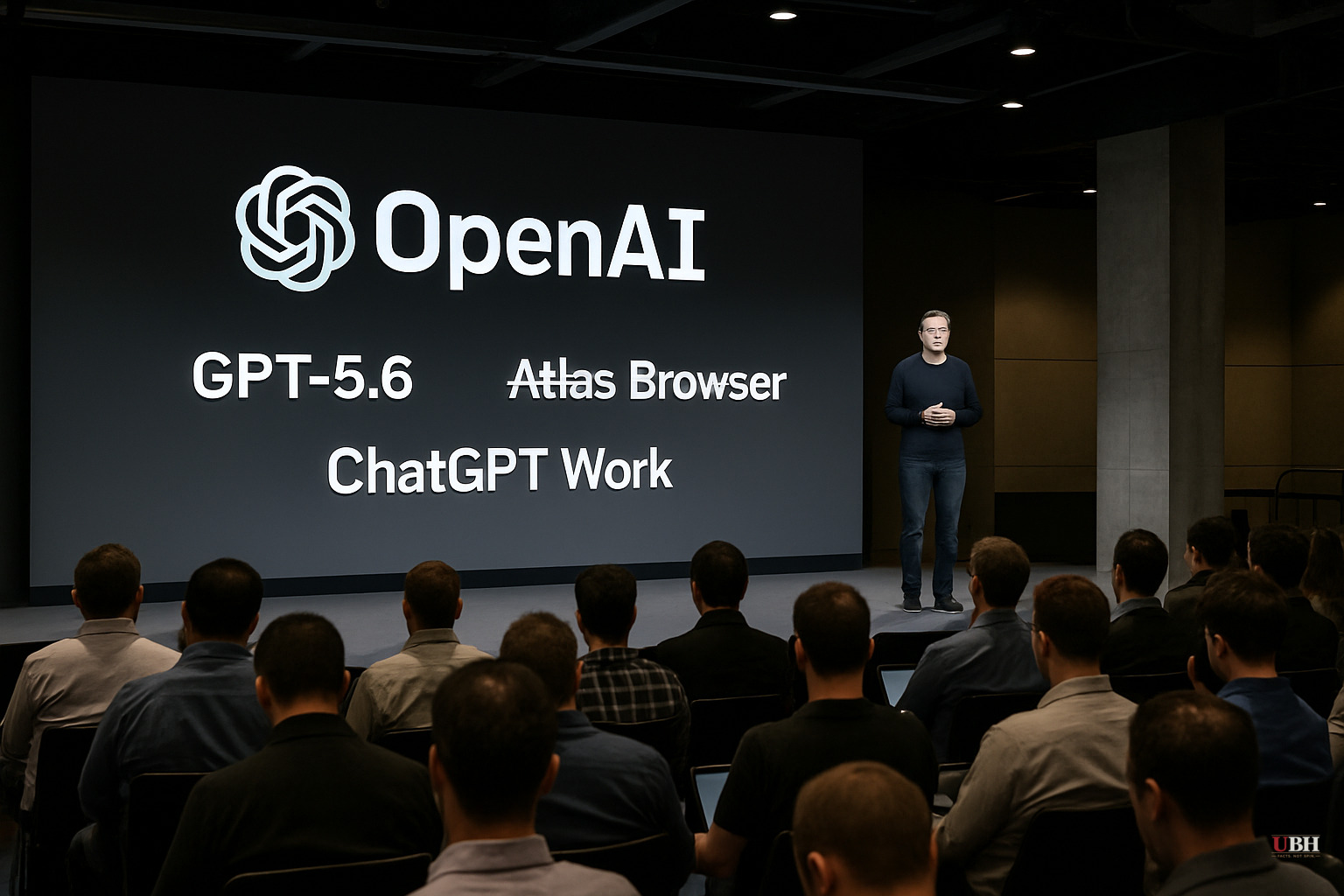
Since the June 26 limited preview restricted to invited partners, GPT-5.6 reached general availability on July 9 across ChatGPT, Codex, and the OpenAI API, rolling out globally over roughly 24 hours, according to OpenAI's announcement page.
What Actually Shipped
The GPT-5.6 family has three tiers. Sol is the flagship, Terra is a mid-range option, and Luna is the budget model. Pricing on the API: Sol runs $5 input / $30 output per million tokens, Terra is $2.50 input / $15 output, and Luna is $1 input / $6 output, per OpenAI's published pricing page.
OpenAI CEO Sam Altman told CNBC that Sol is 54% more token-efficient on coding tasks than prior versions. On the Artificial Analysis Coding Agent Index, OpenAI claims Sol scores 80, placing it 2.8 points above Anthropic's top competing model, while using less than half the output tokens, in less than half the time, at roughly one-third the cost. On OpenAI's own benchmark tables, though, Claude models still lead several rows, according to Digital Applied.
OpenAI also touts a new "ultra" setting that coordinates multiple agents across parallel workstreams for its most demanding tasks. The company calls GPT-5.6 its strongest cybersecurity model yet, citing support for threat modeling, code review, patching, and blue teaming.
ChatGPT Work Replaces the Basic Chat App
Alongside the model launch, OpenAI released ChatGPT Work, a workplace automation tool built to run for hours on complex multi-step tasks, according to Ars Technica. It integrates with Slack, Microsoft Teams, Google Drive, and SharePoint through plugins. A built-in Scheduled Tasks feature handles recurring jobs on a timer or when monitored events trigger them.
The existing ChatGPT desktop app is being rebranded as "ChatGPT Classic" and pushed to a secondary "quick chat" mode. Codex, OpenAI's coding tool, is now folded into ChatGPT Work as a built-in capability while remaining accessible as a separate view. ChatGPT Work usage is billed on the same structure as Codex, with subscription plans ranging up to $100 per month.
Atlas Is Dead, Chrome Gets the Features
OpenAI is sunsetting Atlas, the AI-powered browser it launched in October 2025, less than nine months after launch, according to TechCrunch. The decision follows OpenAI CEO of Applications Fidji Simo's earlier directive to cut back on "side quests," which previously led to the shutdown of at least one prior standalone product.
Rather than maintaining a standalone browser, OpenAI is redistributing Atlas's agentic browsing capabilities into the ChatGPT desktop app and a new Google Chrome extension. The Chrome extension gives ChatGPT access to the context of whatever page a user is viewing and lets them start longer tasks without leaving the browser, directly competing with Google's Gemini Side Panel.
The Microsoft Partnership Question
Earlier this week, Bloomberg reported that Microsoft was replacing some OpenAI software with its own in-house MAI models in apps like Word and Excel to cut costs. Thursday, OpenAI announced that GPT-5.6 Sol is the "preferred model" powering Microsoft 365 Copilot, covering Word, Excel, PowerPoint, and Cowork.
TechCrunch noted a real problem with that framing: it was never reported that OpenAI would stop powering Microsoft's apps entirely, only that Microsoft was leaning on its own models more. The "preferred model" announcement doesn't contradict Bloomberg's reporting that Microsoft is diversifying away from OpenAI where it can save money. Both things can be true simultaneously.
The Government Review Process: Nobody Knows How It Works
GPT-5.6's rollout followed a government-reviewed preview period triggered by White House cybersecurity concerns. The Trump administration had also temporarily restricted Anthropic's most recent Claude model before clearing it. According to The Guardian, the Department of Commerce's Center for AI Standards and Innovation conducted additional testing before the wider release was approved.
Sam Altman told CNBC the process involved conversations with Commerce Secretary Howard Lutnick, Treasury Secretary Scott Bessent, and national cyber director Sean Cairncross. Who actually tested the models and by what methodology remains undisclosed. OpenAI declined to share details on the government's process with TechCrunch, pointing instead to external evaluations by U.K. AISI, SecureBio, and Irregular in the model's published safety card.
Mina Narayanan, a senior research analyst at Georgetown's Center for Security and Emerging Technology, told TechCrunch plainly: "I don't feel like I have enough information to say whether they're adequate or not." Dean W. Ball, a former Trump policy advisor now working at OpenAI, wrote in his newsletter that "nobody knows what the requirements are to get licensed." Andy Konwinski, computer scientist and co-founder of Databricks, told TechCrunch he's never spoken to anyone who understands the process, including employees at frontier labs.
The strongest case for the current approach is that the administration is deliberately avoiding heavy-handed regulation that could slow U.S. AI development relative to China, and that voluntary review with external safety evaluators is more agile than a rigid regulatory body. Sriram Krishnan, former senior White House AI advisor, told the Financial Times flatly: "There will not be an FDA for AI."
That position has logic. Heavy pre-market approval regimes can calcify incumbents and strangle innovation. The counterargument, equally grounded, is that the U.S. is now shipping models with acknowledged cybersecurity capabilities through a process where the criteria, evaluators, and standards are all undisclosed to the public. A Trump executive order published last month created a roadmap for evaluating frontier models but left the specifics to six cabinet agencies, with a final process due by early August. Until that deadline passes and the agencies publish something concrete, "ad hoc" is the accurate description of what exists right now.
Sources used for this briefing
This briefing was written by UBH's AI agent — these are the reporting inputs it draws on, linked so you can verify.


