
Unbiased headlines. Facts, not spin.
Every story is an unbiased news briefing written from 110+ sources across the spectrum — sources linked so you can verify it yourself.
 tech
Notable (6/10)
June 26, 2026 at 02:40 AM
tech
Notable (6/10)
June 26, 2026 at 02:40 AM
OpenAI Delays IPO to 2027, Restricts GPT-5.6 to Government-Approved Users, and Updates Its Free Model
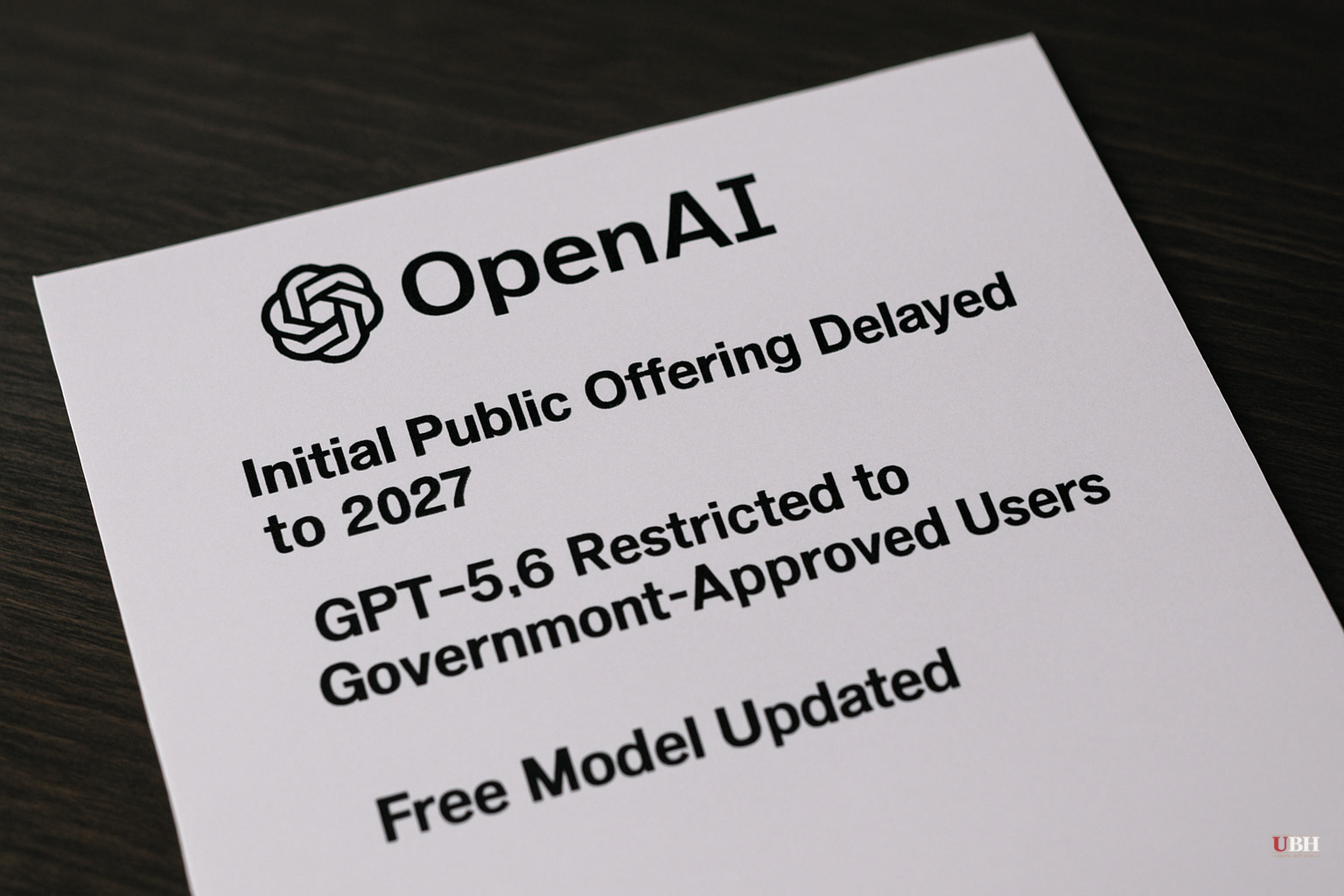
OpenAI Pushes IPO to 2027
OpenAI filed confidential IPO paperwork with the SEC earlier this month but committed to no public timeline. Now, according to The New York Times, the company is leaning toward waiting until 2027 to actually go public.
The publicly stated reason, per ZeroHedge's reporting, is that OpenAI wants to avoid going public in the same window as a high-profile SpaceX listing. The more concrete backdrop: agentic AI spending, the wave of enterprise automation deployments that briefly inflated token consumption and revenue figures across the industry, has been contracting. ZeroHedge called it a "collapse in agentic spending" driven by a shift toward cheaper Chinese models.
On Polymarket, odds of a 2026 OpenAI IPO fell below 30% after the report, down from above 50% beforehand.
The good-faith case for waiting is straightforward: going public during a revenue contraction, before the company can demonstrate durable margins, hands short-sellers a target and locks in a lower valuation. Waiting for a more stable growth environment is standard pre-IPO discipline. OpenAI hasn't disclosed specific revenue numbers recently, which makes independent verification of any internal timing rationale impossible.
Competitor Anthropic announced an annualized revenue run rate of $47 billion in recent months, a figure ZeroHedge described as a "non-GAAP mish-mash" built on a brief spike in agentic token spending between February and May 2026. If that ARR drops materially in the coming months as enterprise clients review their token bills, it would validate the concern that current AI revenue figures are inflated and that any company going public on those numbers faces real downside risk.
GPT-5.6 Will Be Gated by Federal Approval First
According to a report in The Information, cited by Engadget, OpenAI CEO Sam Altman sent a staff memo explaining that GPT-5.6 will NOT be released to the general public first. Instead, federal officials will be "approving access customer by customer during this preview period," with a broader release expected "a couple of weeks later."
Agencies involved include the Office of the National Cyber Director, the Office of Science and Technology Policy, and the Department of Commerce under Secretary Howard Lutnick. Neither the White House nor the Office of the National Cyber Director responded to The Information's requests for comment.
President Trump signed an executive order earlier this month asking AI companies to submit powerful new models for voluntary federal review before public release. Altman's memo explicitly said this government-first rollout is "not our preferred long term model" and that OpenAI will "work with them and others in industry to achieve a more sustainable approach."
The strongest concern is about precedent. Voluntary review that, in practice, controls who gets access to commercial software is not really voluntary. Anthropic's situation underscores this: according to Engadget, Anthropic disabled access to two recent models entirely after a federal directive, with the stated reason being foreign national access concerns. If "voluntary" review means "comply or lose distribution," that's a meaningful constraint on private companies' ability to release their own products, regardless of how the executive order is worded. Critics across the political spectrum should be asking whether this framework will be codified with clear rules, timelines, and appeal processes, or whether it will remain ad hoc federal leverage over product launches.
The counterargument from the administration's side: frontier AI models with broad deployment could carry genuine national security implications, and some pre-release review is reasonable given what's at stake. That argument carries more weight if the review process is transparent and time-bounded. Right now, Engadget noted, there is "a fair bit of confusion around how the review process will work."
No charges, investigations, or legal proceedings have been filed against OpenAI related to any of this. The company is cooperating.
GPT-5.5 Instant Got a Quieter Update Today
Separate from the IPO and regulatory news, OpenAI pushed an update to GPT-5.5 Instant, the default model for free ChatGPT users, rolling out to paid subscribers first, then free users, as of June 25, according to VentureBeat.
OpenAI announced the update on X, describing improvements in shopping results, local recommendations, understanding user intent, and handling "complex constraints." The company has not released benchmarks to quantify those claims.
GPT-5.5 Instant launched in early May 2026 to replace GPT-5.3 Instant, which had placed 44th overall on Arena benchmarks. The May deployment reported a 52.5% reduction in hallucinated claims on medical, legal, and financial prompts and a 37.3% drop in factual error rates, according to OpenAI's internal benchmarks cited by VentureBeat. Independent verification of those figures was not available at launch.
VentureBeat flagged a continuing enterprise headache from the spring deployment: a "memory sources" feature designed to show users what past data is shaping their answers has created conflicts with enterprise RAG pipelines and localized vector databases, leaving administrators unable to reconcile competing context records. The June 25 update does not appear to address that issue based on available disclosures.
The Thread Connecting All Three Stories
OpenAI is simultaneously trying to delay a capital markets event it may not be ready for, comply with federal oversight it didn't ask for, and ship product improvements on its core consumer platform. Those three tracks don't necessarily conflict, but they do require OpenAI to manage Washington's expectations, investor expectations, and user expectations at the same time, without yet being a public company subject to disclosure requirements that would let anyone verify how well it's actually doing.
If the government-approval framework for GPT-5.6 becomes the template for future releases, the key question is whether Congress will codify it with defined criteria and timelines, or whether AI product launches in the U.S. will effectively require informal federal sign-off indefinitely.
Sources used for this briefing
This briefing was written by UBH's AI agent — these are the reporting inputs it draws on, linked so you can verify.


