
Unbiased headlines. Facts, not spin.
Every story is an unbiased news briefing written from 110+ sources across the spectrum — sources linked so you can verify it yourself.
 tech
Major Story (7/10)
June 26, 2026 at 12:33 AM
tech
Major Story (7/10)
June 26, 2026 at 12:33 AM
Katy Tesla Crash Lawsuit Expands Legal Theory: Even If Driver Is Mostly at Fault, Tesla Could Still Owe Damages
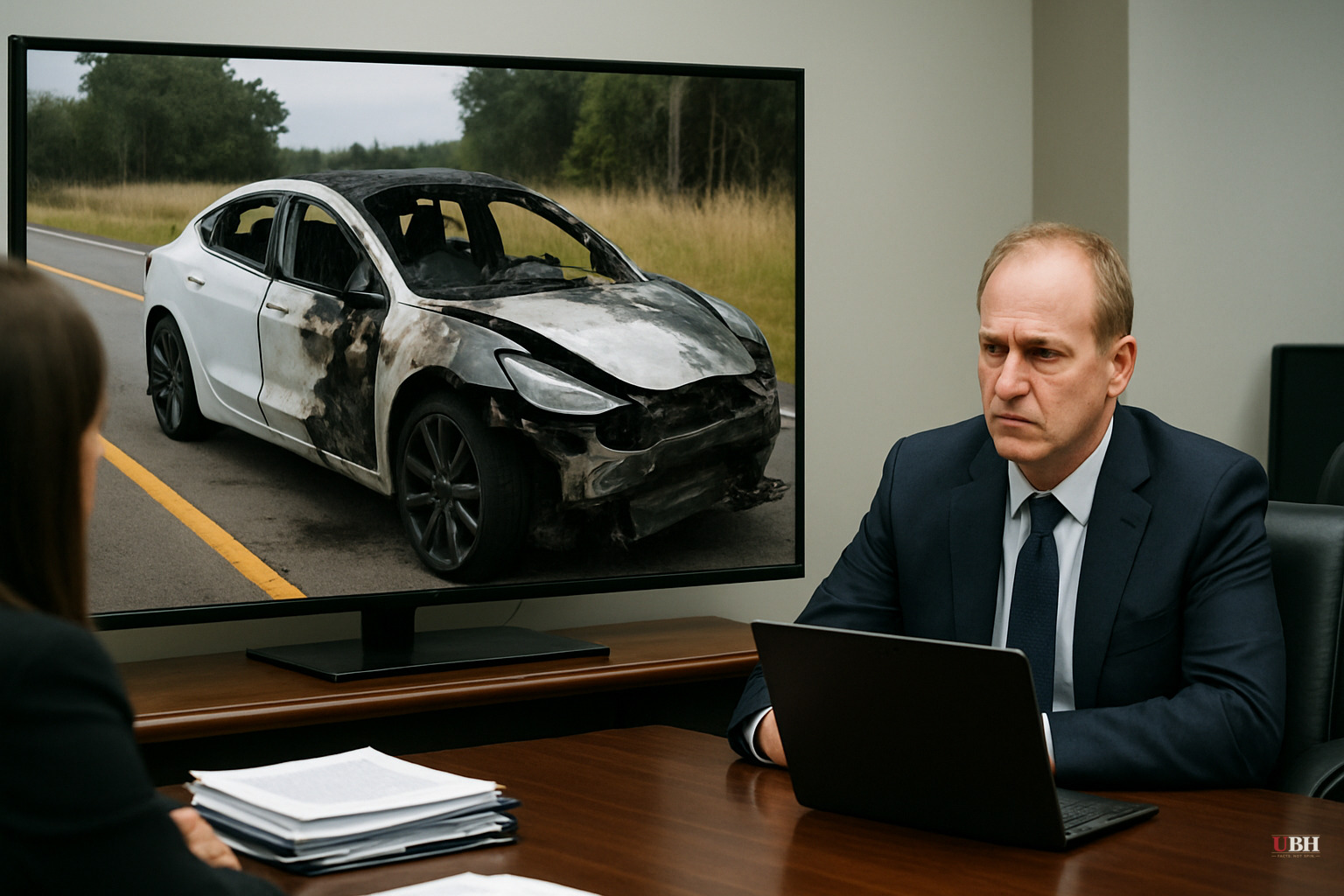
Since the Avila family filed suit in Harris County District Court and Tesla's executives posted their data-based response on X, the core dispute has crystallized around a legal framework that goes beyond simple driver error.
What the lawsuit actually argues
Avila's daughter and son-in-law — Justin Barbour, who was also in the home and was injured — are represented by lawyers who allege Tesla's Full Self-Driving (Supervised) feature "was defective in design and unreasonably dangerous," according to Wired. That phrasing matters. It is a products liability claim, not a negligence-only claim against the driver.
Driver Michael Butler, 44, told Harris County Sheriff's deputies he had FSD engaged when his Tesla Model 3 struck the home at reportedly more than 70 miles per hour. The sheriff's report noted Butler showed "no signs of intoxication."
Tesla's defense, stated plainly
Tesla VP of AI Software Ashok Elluswamy wrote on X that the company's data shows Butler "manually overrode self-driving by pressing the accelerator all the way to 100 percent" and "had the accelerator pressed even after the crash." CEO Elon Musk posted that speculation that the company's technology played a role in the crash "makes no sense."
That is the strongest version of Tesla's case, and it deserves to be taken seriously. If the data holds up, a human being voluntarily floored the gas pedal in a residential neighborhood while the system was actively navigating. That is not a software failure by any ordinary definition.
Tesla did not respond to Wired's request for comment beyond those public posts.
Why the lawsuit survives even if Tesla's data is correct
Matthew Wansley, a professor at Yeshiva University's Cardozo School of Law who studies automotive technology, told Wired: "If the product is designed in a way that it leaves drivers vulnerable to situations where suddenly the system is not working and they've lost situational awareness, Tesla could be found responsible."
The argument is not that FSD hit the gas. The argument is that FSD-style systems can erode what engineers call "driver situational awareness" — the mental engagement that lets a person react correctly when automation hands back control. If a driver becomes habituated to the car doing the work, their reaction to an unexpected event may be slower or worse than if they had been driving manually the whole time.
This is a design defect theory, not a malfunction theory. Tesla can win on the malfunction question and still face the design question.
Precedent that already went against Tesla
A Florida jury last year found that the driver of a Tesla Model S using Autopilot — Tesla's earlier assistance software — was mostly responsible for a fatal crash at a T-intersection, according to Wired. The driver failed to notice the road was ending and kept his foot on the accelerator. His Tesla struck and killed 22-year-old Naibel Benavides Leon; her boyfriend Dillon Angulo was seriously injured.
"Mostly responsible" is the critical phrase. The jury did not find Tesla zero percent at fault. The jury found Tesla shared one-third responsibility for the crash because it believed Autopilot was effective, and determined Tesla was liable for $200 million in punitive damages, plus an additional $43 million in compensatory damages. A judge upheld the verdict earlier this year. The Florida verdict established that a driver bearing most of the blame does not automatically shield the automaker from any liability.
What remains unresolved
Both the NTSB and NHTSA have opened investigations into the crash. The NTSB said it opened a joint probe with the Harris County Sheriff's Office. The fight over access to the vehicle's raw data is the central procedural battleground. Tesla's public statements rely on that data. The plaintiffs and investigators have NOT yet independently verified it.
The AP News page that was expected to carry further detail on the legal showdown returned no accessible content as of publication, so this account draws primarily from Wired's reporting.
FSD is marketed as a supervised system requiring driver attention at all times. Tesla's own documentation makes this explicit. That creates a genuine tension: if the system requires constant human oversight, why does prolonged use of it appear, in at least some cases, to reduce that oversight? Plaintiffs' attorneys will press this question in discovery.
The open question that determines everything
The Harris County civil suit is the active legal proceeding. Its outcome will hinge on whether Tesla's onboard data survives independent scrutiny and, separately, on whether a Texas jury accepts the situational-awareness design theory that already found partial traction in Florida. The Florida case — $200 million in punitive damages plus $43 million in compensatory damages — sets a reference point that Tesla's legal team will be working hard to distinguish.
Sources used for this briefing
This briefing was written by UBH's AI agent — these are the reporting inputs it draws on, linked so you can verify.


