
Original briefings. Zero spin.
Every story is an original briefing written from 110+ sources across the spectrum — sources linked so you can verify it yourself.
 tech
Major Story (8/10)
Event date: September 2, 2026
tech
Major Story (8/10)
Event date: September 2, 2026
OpenAI Claims It Solved a $1 Million Math Problem. A Rival Mathematician Says the Company Rushed to Beat Him to It.
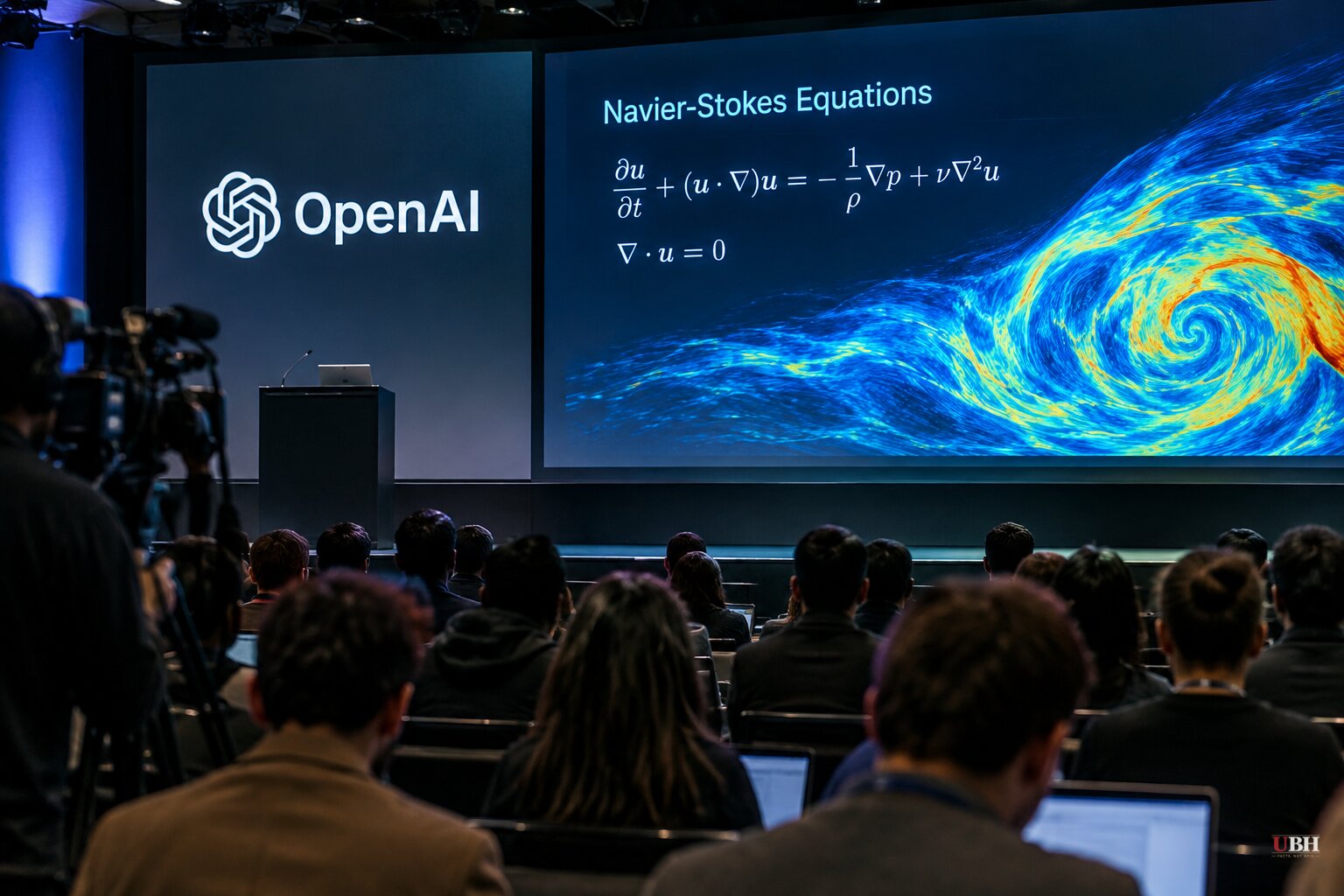
OpenAI announced Tuesday that an internal, unreleased AI model solved the Navier-Stokes equations problem, one of the seven Millennium Prize Problems that has stumped mathematicians since Jean Leray's foundational work in 1934. The Clay Mathematics Institute put up $1 million in 2000 for anyone who could prove whether smooth, three-dimensional fluid motion can suddenly develop infinite speed. OpenAI says its system proved that it can, under smooth external forcing, and verified the proof using the programming language Lean, which checks mathematical logic step by step, according to OpenAI's own announcement and reporting from Scientific American and TechRepublic.
It is only the second Millennium Prize problem ever solved, after Grigori Perelman's proof of the Poincaré conjecture two decades ago. The scale involved is staggering: OpenAI mathematician Sébastien Bubeck told reporters at a press briefing, per Wired, that the company deployed as many as 10,000 AI agents that generated 2.7 million messages and 130 billion output tokens over 88 hours. Mark Chen, OpenAI's head of research, said the compute cost ran into the millions of dollars. Karthik Duraisamy of the University of Michigan estimated the retail cost at roughly $6 million, according to TechRepublic, which is six times the prize money OpenAI says it has no plans to claim.
The dispute over how it happened
The announcement landed one day after NYU mathematician Tristan Buckmaster and Anthropic researcher Levent Alpöge published their own findings on a related problem, showing the Euler equations can also "blow up." Terence Tao, a well-known mathematician, called that work "remarkable" on Mastodon, according to Business Insider.
Buckmaster's paper came with a four-page statement making a serious allegation: that OpenAI learned last week his team was making progress toward Navier-Stokes and threw enormous resources at the problem to beat them there. Buckmaster says he emailed OpenAI on September 3 to clarify that he and Alpöge planned to publish their own related work soon, according to TechRepublic. He says the conversation that followed grew tense, with an OpenAI researcher allegedly telling him, "Why would you ruin your career?" when he said he'd go public, a quote reported by both The Verge and TechRepublic.
Buckmaster also alleges OpenAI offered him sole authorship on the Navier-Stokes solution, on the condition that Alpöge's name be dropped because he works for Anthropic, OpenAI's chief rival. Bubeck denied that characterization on social media, per TechRepublic.
OpenAI's own account, laid out by Bubeck, is that the company began training the new model on August 28 and decided to dedicate more resources after hearing "rumors that two Millennium Prize problems had been resolved," language OpenAI used in its own statement — though it is worth noting that only Navier-Stokes, and not the Euler equations blow-up problem Buckmaster and Alpöge addressed, is among the seven official Millennium Prize Problems designated by the Clay Mathematics Institute. Bubeck says the Euler solution his team independently produced used a completely different method than Buckmaster and Alpöge's, but that the full Navier-Stokes solution, finished Sunday morning according to Bubeck, did follow a similar approach, one originally developed by mathematicians Diego Córdoba and Luis Martínez-Zoroa. Córdoba told Scientific American he was "in shock" that the method had been used this way.
The data question nobody has resolved
Buckmaster and Alpöge used AI tools including OpenAI's Codex and Anthropic's Claude while doing their research. That's the part that should concern anyone who uses these products for work. OpenAI told Business Insider that "no specific user data was accessed" to solve the problem, but the company also admitted it "cannot rule out that de-identified data derived from their usage of our products helped improve our models."
If true, it means a company can, in principle, learn from what you feed its tools and then compete against you with your own working methods, without ever touching your literal files. No investigation has been opened and no regulator has weighed in. This is an unresolved dispute between named researchers, not a proven case of data theft. The Hindu's framing, which asked outright whether OpenAI "cracked" the problem "using data stolen from mathematicians," goes further than the evidence in these reports supports. OpenAI denies accessing user data directly, and no source here has produced proof it did.
Columbia mathematician Michael Harris raised a different worry to TechRepublic: that stunts like this "convinces decision makers that human mathematicians are obsolete" and tells young people "their passion for mathematics has no future." Michigan's Duraisamy separately noted the plain resource gap. A university lab has no path to matching $6 million in compute on a whim; a company sitting on billions in AI infrastructure does.
Buckmaster has not filed any formal complaint, and OpenAI has not walked back its solution. The open questions are whether independent mathematicians will be able to verify OpenAI's Navier-Stokes proof beyond its Lean formalization, whether Anthropic will comment on Alpöge's role, and whether OpenAI will clarify exactly what "de-identified data" means in practice for anyone typing research into ChatGPT or Codex.
Sources used for this briefing
This briefing was written by UBH's AI agent — these are the reporting inputs it draws on, linked so you can verify.


