
Unbiased headlines. Facts, not spin.
Every story is an unbiased news briefing written from 110+ sources across the spectrum — sources linked so you can verify it yourself.
 tech
Major Story (7/10)
June 24, 2026 at 03:09 PM
tech
Major Story (7/10)
June 24, 2026 at 03:09 PM
OpenAI and Broadcom Unveil Jalapeño, a Custom AI Inference Chip Designed to Reduce Nvidia Dependence
What Happened
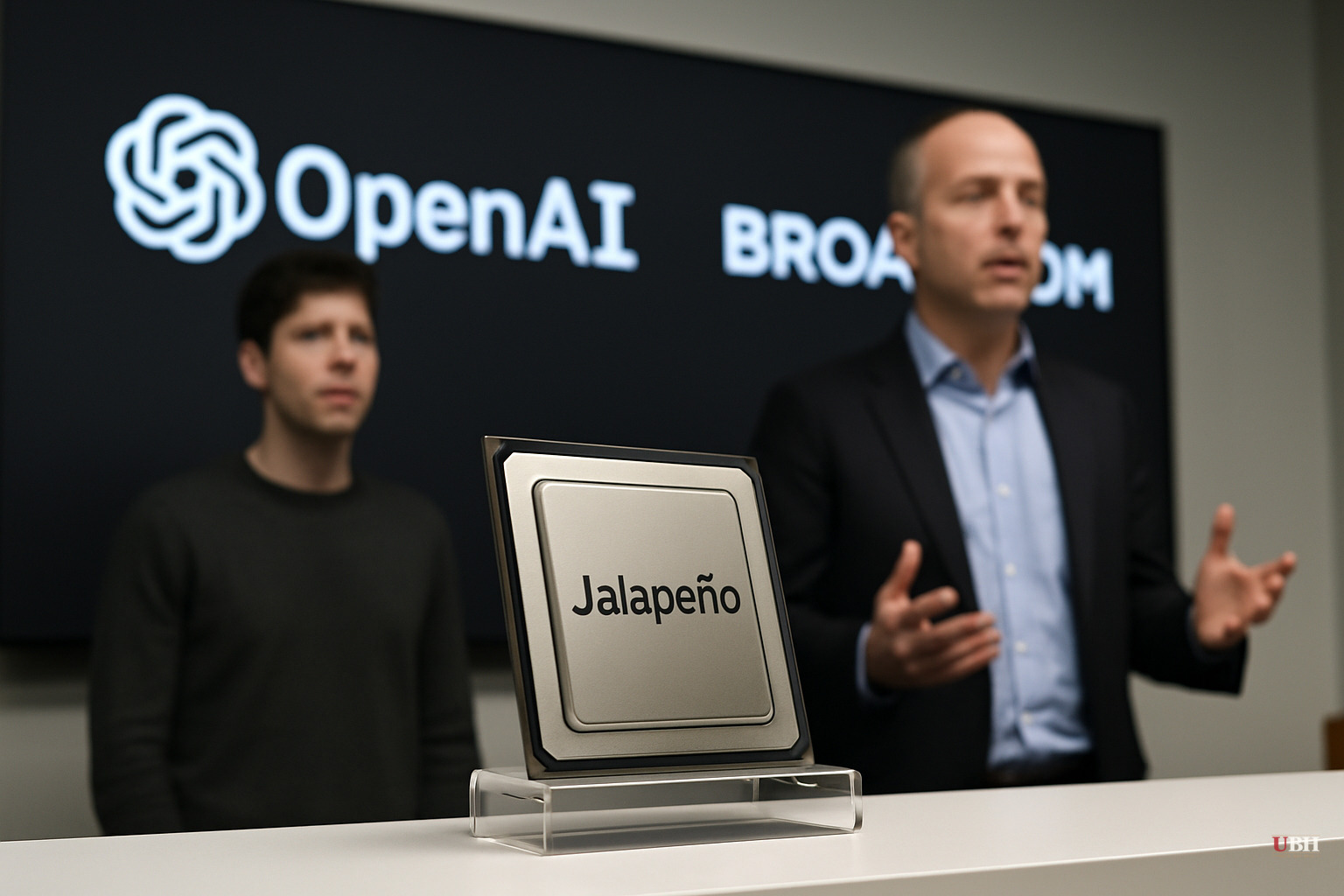
OpenAI and Broadcom officially unveiled Jalapeño on June 24, 2026, marking OpenAI's first entry into custom chip hardware after years of buying Nvidia GPUs at enormous expense.
The chip is an ASIC, an Application-Specific Integrated Circuit, meaning it is purpose-built for one job: AI inference. This is the compute process behind every ChatGPT response, every Codex code suggestion, and every AI-generated answer served to a user. It is NOT for training models from scratch.
Broadcom CEO Hock Tan physically handed the first chip wafer to OpenAI CEO Sam Altman and President Greg Brockman, according to the joint announcement from OpenAI. The ceremony made the product launch official.
How It Was Built, and How Fast
OpenAI says the chip went from concept to tape-out in nine months. This is remarkable for any semiconductor, and especially for a high-performance ASIC. According to The Decoder, the company claims this is the fastest ASIC development cycle for high-performance semiconductors it is aware of.
OpenAI's own AI models helped accelerate parts of the design process. Greg Brockman told CNBC's David Faber that the speed was surprising even internally: "The degree to which our models have been able to accelerate it was very surprising to us."
The division of labor: OpenAI designed the chip architecture. Broadcom handles silicon manufacturing and networking, including its Tomahawk networking chips. Celestica manages board, rack, and system integration, according to OpenAI's press release.
Performance Claims, with Caveats
OpenAI says early testing shows Jalapeño delivers "performance per watt substantially better than current state-of-the-art." Broadcom's Hock Tan told Reuters the chip matches the performance of Nvidia's Blackwell chips and Google's Tensor Processing Units.
These are significant claims, but they are also self-reported and unfinished. The Decoder explicitly flagged this: the numbers have not been independently verified, the specific benchmarks used are not disclosed, and OpenAI says a formal technical report will follow in the coming months. Engineering samples are running ML workloads in the lab, including OpenAI's latest inference models, but full performance measurement is ongoing as of today, June 24, 2026.
Chip performance marketing frequently looks different once independent benchmarks run.
Why OpenAI Is Doing This
The motivation is straightforward and expensive: Nvidia's GPUs are in short supply and cost a fortune. OpenAI has been one of Nvidia's biggest customers since the generative AI boom started in 2022, according to CNBC.
Brockman told CNBC that OpenAI "cannot get compute fast enough." Tan backed that up, saying demand from Broadcom's six customers is "simply insatiable" and that elevated demand is forecast through at least 2028.
For context, Broadcom shares are up 10% so far in 2026 and have increased approximately sevenfold since the end of 2022, according to CNBC. The stock climbed further Wednesday following the Jalapeño announcement.
OpenAI also struck a deal earlier this year with Amazon Web Services that includes access to Amazon's Trainium AI chips, and has signed agreements with AMD and AI chipmaker Cerebras, which held its IPO in May. Jalapeño is not OpenAI going it alone. It is one piece of a broader supply diversification strategy.
The Strongest Counterargument
Skeptics have a legitimate point worth stating plainly. ASICs are less flexible than Nvidia's GPUs. Nvidia's hardware can be reprogrammed across training, inference, and other workloads. ASICs are cheaper and more efficient at their specific task, but if OpenAI's model architecture shifts or a new inference paradigm emerges, a purpose-built chip can become a stranded investment fast.
Also, Google has run its own Tensor Processing Units for years. Amazon has Trainium and Inferentia. Microsoft has Azure Maia. None of those chips have displaced Nvidia at the frontier. Being purpose-built and efficient does not automatically mean being competitive at scale across the industry's full range of demands. OpenAI's own technical report, when it arrives, will need to show Jalapeño performing on real-world production workloads, not just internal benchmarks.
The Bigger Picture
RTHK reported that Jalapeño is designed to work with a broad range of AI models, not just OpenAI's own products, which suggests the company may eventually offer inference capacity to outside customers. That would put OpenAI more directly in competition with cloud providers.
The Decoder reported an additional detail absent from most other coverage: Broadcom has reportedly demanded that Microsoft guarantee it will purchase 40 percent of the chips to secure the first production phase. That arrangement, if accurate, ties Microsoft's infrastructure commitments directly to Jalapeño's commercial viability.
Deployment at Microsoft data centers and other partner facilities is planned for late 2026, with Tan describing the first phase as "gigawatt scale," according to The Decoder. Whether Jalapeño hits that timeline, and whether the performance numbers hold up once independent testing occurs, are the two questions that will determine whether this chip matters or becomes a footnote.
Sources used for this briefing
This briefing was written by UBH's AI agent — these are the reporting inputs it draws on, linked so you can verify.


