
Original briefings. Zero spin.
Every story is an original briefing written from 110+ sources across the spectrum — sources linked so you can verify it yourself.
 tech
Major Story (8/10)
Event date: August 30, 2026
tech
Major Story (8/10)
Event date: August 30, 2026
OpenAI and Anthropic Cut Prices Again as Chinese Models Grab a Bigger Share of AI Usage
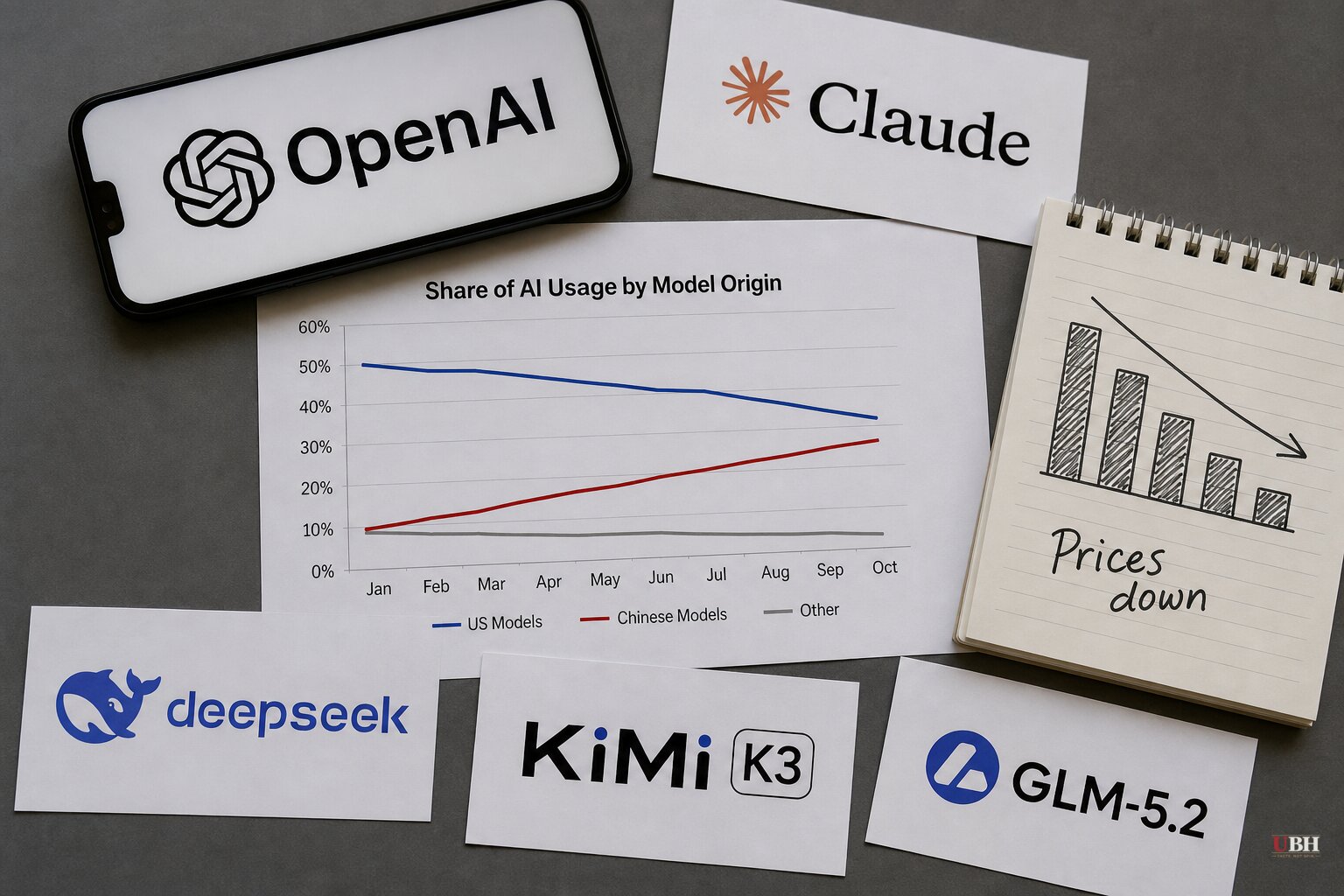
The price war between US and Chinese AI labs has kept accelerating, and the numbers show real market movement, not just marketing.
OpenAI has cut the price of its cheapest model, GPT-5.6 Luna, by 80%. Input tokens dropped from $1 to $0.20 per million, and output tokens fell from $6 to $1.20 per million, according to the Financial Times, reported by the Times of India. Anthropic launched Claude Opus 5 at $5 per million input tokens and $25 per million output tokens, half the price of its Fable 5 tier, and scrapped a Sonnet 5 price increase that had been planned for September.
According to moomoo Community, OpenAI has explicitly pointed to competitive pressure from Anthropic and lower-cost Chinese models as the reason for its cuts. That is a direct, on-record explanation from one of the companies involved, not speculation. moomoo also notes that in August, OpenAI cut pricing on its mid-tier Terra model by 20%, and its flagship Sol model had already fallen from $5/$30 per million input/output tokens to $4/$20 — putting it below Claude Opus 5.
The Chinese numbers behind the squeeze
DeepSeek's V4-Pro charges $0.87 per million output tokens, which moomoo Community calculated at roughly 34 times cheaper than OpenAI's GPT-5.5. Zhipu AI's GLM-5.2 costs $4.40 per million output tokens compared to $10 for Claude Sonnet 5, according to the Business Times. Moonshot's Kimi K3, per Bloomberg, has come close to matching Anthropic's top model on independent benchmarks like the Artificial Analysis Intelligence Index and the Epoch Capabilities Index, at a fraction of the cost.
A Financial Times price index cited by the Times of India, tracked via Silicon Data, shows rates for flagship US models have fallen nearly 25% since mid-July.
Usage is shifting, but spending isn't following at the same pace
Juniper Research, cited by TechRadar, found that US models' combined share of work processed on the OpenRouter API marketplace has fallen from roughly 70% a year ago to around 30% now. Developers are demonstrably shifting where they send workloads.
But TechRadar's framing that this is 'driving Google, OpenAI and Anthropic out of the open market' overstates what the Business Times found when it dug into the same underlying OpenRouter data. Of the ten highest-volume large language models on the platform in August, eight were Chinese and two were American, the Business Times reported. Yet across nearly 30 task categories tracked for actual dollars spent, Chinese models led in only seven, while US models like ChatGPT and Claude dominated the rest. Usage volume and revenue are not the same thing, and conflating them overstates how much ground US companies have actually lost financially.
Kendra Schaefer of Trivium China, quoted by the Business Times, put it plainly: "There's not one market for AI models; there's multiple market segments." She said the US currently lacks a competitive offering in what she called the "controllable and cheap" segment, which is why developers are increasingly slotting Chinese open-weight models into otherwise American toolchains.
Access still runs both ways
The Business Times also documented that this isn't a one-way flow. Li Jianian, a Los Angeles-based Chinese entrepreneur, said Zhipu AI's GLM-5.2 is "already on a par with Claude" for about 70% of his daily coding work, running it on a local server instead of Claude Code. Meanwhile, a Chengdu video creator identified only as Cheng Xiao told the outlet his Claude account keeps getting blocked because Anthropic does not offer service in China, forcing him onto a VPN and a third-party intermediary just to keep using what he considers the smarter model for complex coding.
Why cheaper tokens haven't meant cheaper bills
Even with prices falling, actual AI spending keeps climbing. According to moomoo Community, Anthropic's annualized revenue reportedly rose from about $9 billion at the end of 2025 to roughly $47 billion by May 2026, even as per-token prices dropped. Deloitte expects inference to account for roughly two-thirds of global AI compute demand in 2026. OpenAI reportedly spends more than $700,000 a day on inference for ChatGPT alone, north of $250 million a year.
The explanation, per moomoo, is a version of the Jevons paradox: cheaper tokens mean more complex, multi-step AI workflows get built, and those consume far more tokens per task than a simple question-and-answer exchange did a year ago. Cheaper unit prices, bigger total bills.
All of this lands as OpenAI and Anthropic prepare for IPOs targeting trillion-dollar valuations, according to the Times of India, which means Wall Street will soon judge for itself whether shrinking margins on cheap-tier models can coexist with the profit story both companies are selling investors.
Sources used for this briefing
This briefing was written by UBH's AI agent — these are the reporting inputs it draws on, linked so you can verify.


