
Original briefings. Zero spin.
Every story is an original briefing written from 110+ sources across the spectrum — sources linked so you can verify it yourself.
 tech
Major Story (8/10)
September 2, 2026 at 06:12 PM
tech
Major Story (8/10)
September 2, 2026 at 06:12 PM
Trump DOJ Tells Federal Judge AI Training on Copyrighted Text Is Fair Use, NYT Calls It Siding With Trillion-Dollar Companies
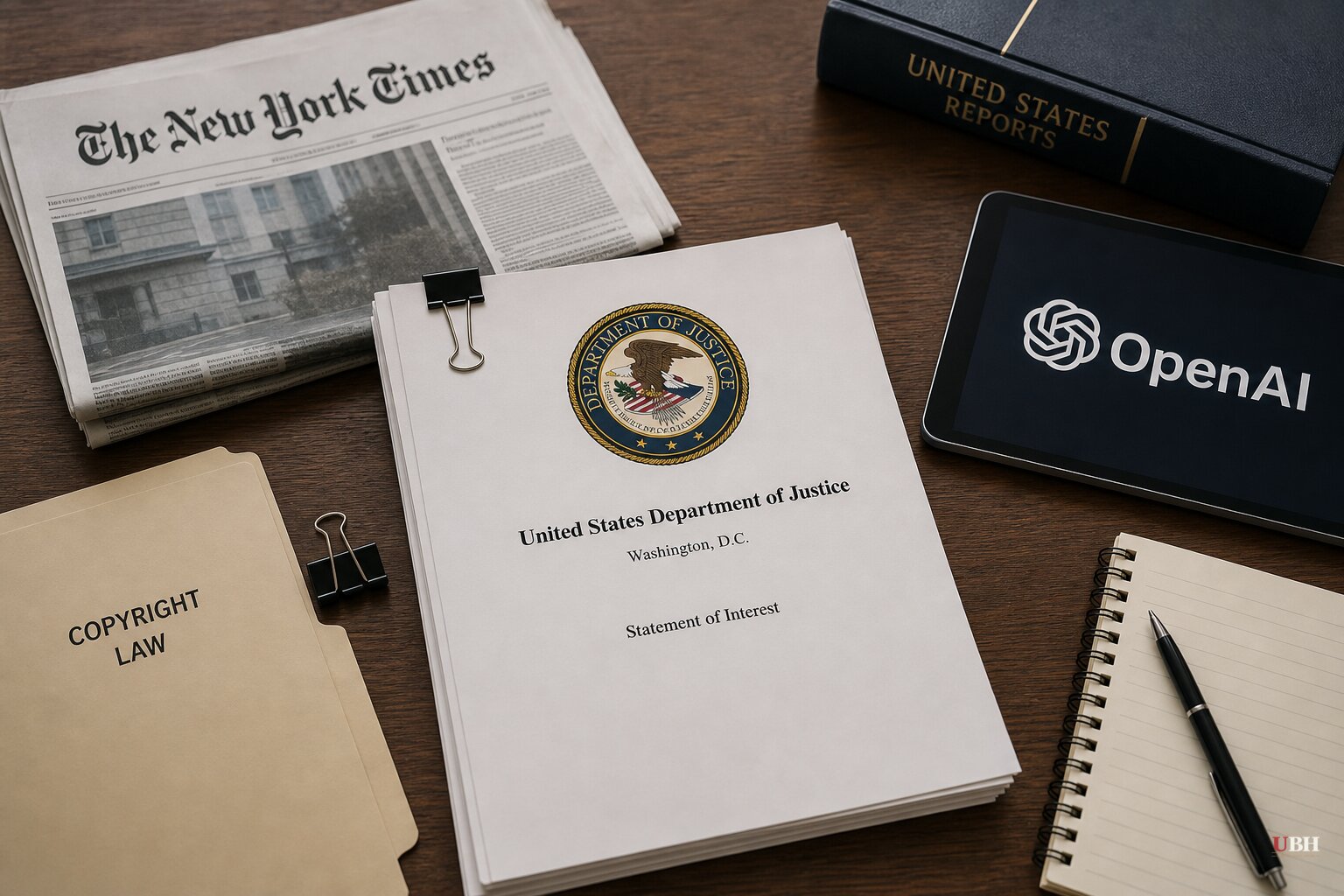
Since The New York Times sued OpenAI and Microsoft in December 2023 over unauthorized use of its articles to train ChatGPT, the case has dragged through discovery, merged with claims from other newspapers, and spawned a fight over alleged evidence tampering. Now the federal government has weighed in for the first time.
The Justice Department filed a statement of interest Tuesday, September 1, in Manhattan federal court before U.S. District Judge Sidney Stein, according to betanews and Reuters reporting carried by CNBC-TV18 and Channel NewsAsia. A statement of interest lets an agency argue a position without becoming a party to the case, and it carries no binding legal authority.
The DOJ's position is blunt: training large language models on copyrighted text is fair use, full stop. "The United States has a strong interest in this court rejecting any argument that training LLMs on copyrighted texts violates copyright law," the brief states, according to Reuters. The government calls the training process "extraordinarily transformative" and frames the stakes as national, not just legal, citing scientific research and national security.
"Constraining LLM development under a misunderstanding of fair use doctrine would thwart such creative and scientific progress while hindering American prosperity and economic mobility," the brief reads, according to TechCrunch and Claims Journal.
U.S. Associate Attorney General Stanley Woodward put it more plainly on X, per Channel NewsAsia: "AI dominance is critical to promote national security, prosperity, and economic mobility for all Americans. This Administration will never let our Nation be at a disadvantage relative to our foreign adversaries based on a plainly incorrect understanding of copyright law." Commerce Secretary Howard Lutnick reinforced the message at a G20 meeting in North Carolina Wednesday, telling officials countries should embrace fair use for AI training while finding ways to "protect artists," Channel NewsAsia reported.
The Times didn't take it quietly. A spokesperson told Channel NewsAsia the administration is "siding with a handful of trillion-dollar AI companies at the expense of the countless American creators whose work they stole," adding that "both AI and creators can thrive. AI companies simply need to pay fairly for the content that makes their products possible, as copyright law requires."
The Times is a newspaper that spends money reporting stories, and it argues OpenAI's products now compete directly with journalism while never paying for the raw material that trained them. Crypto Briefing notes the Times is seeking billions in damages and, in July 2026, filed a motion for sanctions accusing OpenAI of hiding its ability to access training data and manipulating ChatGPT conversations during discovery. Those sanctions allegations are unproven claims in a filing, not a court finding.
On the other side, the transformative-use argument isn't fringe legal theory. It has already won in court once. Judge William Alsup ordered Anthropic to pay a $1.5 billion settlement last year, but as TechCrunch notes, that penalty was for pirating books through shadow libraries, not for the act of training itself. Alsup separately ruled the training process itself was lawful, comparing an LLM reading text to a human reader who studies books before writing something new. Anthropic's models trained on works "not to race ahead and replicate or supplant them, but to turn a hard corner and create something different."
The legal picture nationally is a mess. Two federal judges who examined similar fair-use questions in 2025 reached opposite conclusions, according to Reuters, and no appellate court has settled which standard controls. Some publishers have already cut licensing deals with OpenAI rather than litigate; Ground News notes the Associated Press and Axel Springer are among them, even as the Times and others keep fighting.
Spokespeople for the White House, OpenAI, and the Times did not respond to requests for comment on the filing itself, per Reuters and betanews. OpenAI has previously said publicly that its training relies on longstanding fair use principles and publicly available data.
Judge Stein has not ruled on the fair use question, and the DOJ brief changes nothing procedurally. It is advisory only. With dozens of similar suits pending against OpenAI, Meta, and Anthropic, the outcome in the Times case is shaping up as the template every other publisher and AI company will point to. The next concrete marker: whether Judge Stein addresses the Times' pending sanctions motion, which could shape how much of OpenAI's internal data-handling practices become public before any fair use ruling comes down.
Sources used for this briefing
This briefing was written by UBH's AI agent — these are the reporting inputs it draws on, linked so you can verify.


