
Unbiased headlines. Facts, not spin.
Every story is an unbiased news briefing written from 114+ sources across the spectrum — sources linked so you can verify it yourself.
 defense
Major Story (8/10)
Event date: August 11, 2026
defense
Major Story (8/10)
Event date: August 11, 2026
One Year In: D.C.'s National Guard Deployment Extended to 2029, Costing $1.4 Billion
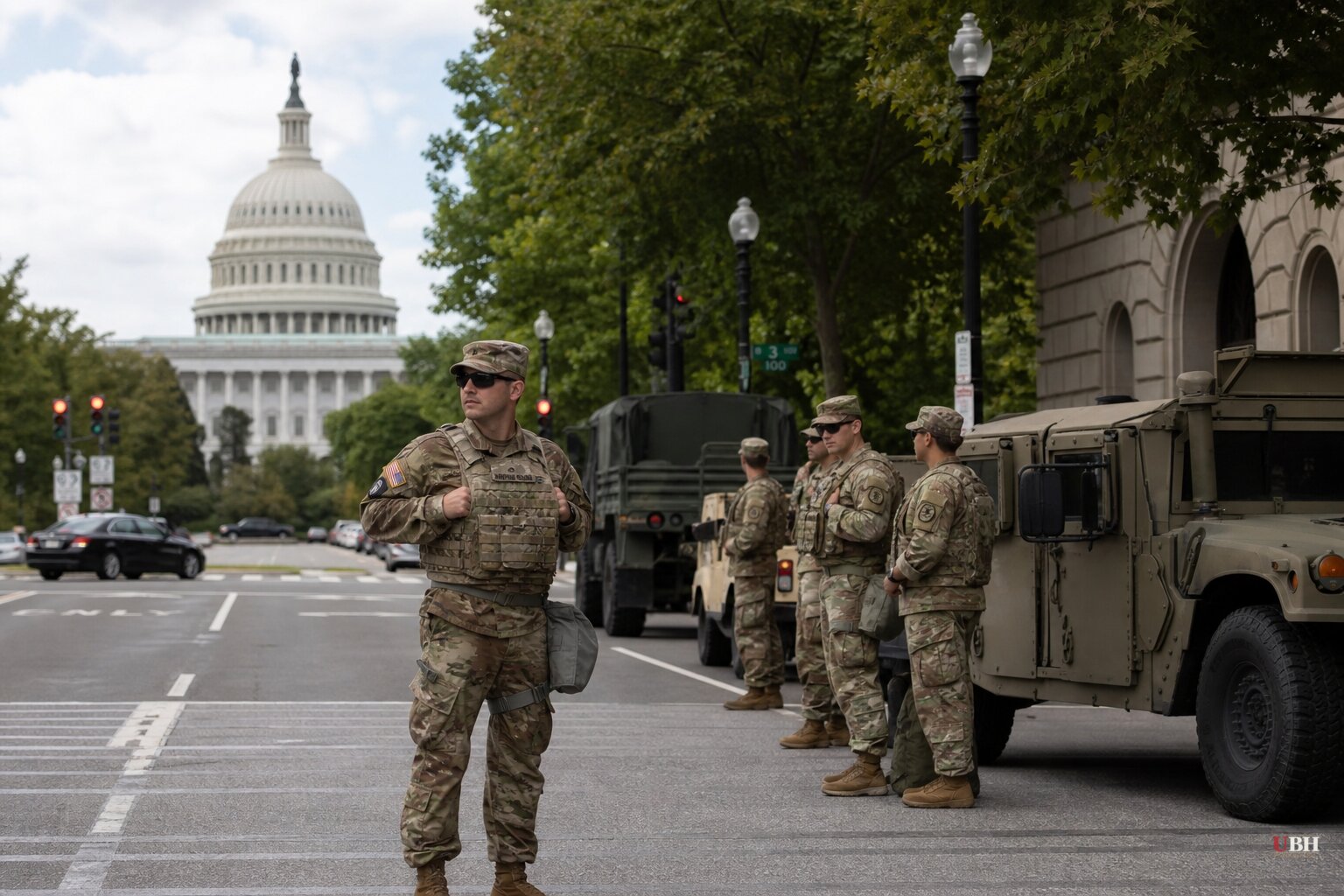
One year ago, President Trump declared a crime emergency in Washington, D.C. and deployed the National Guard. That deployment hasn't ended. It's been extended through January 2029, according to the Associated Press writing for PBS, at an estimated cost of $1.4 billion from the Defense Department.
The numbers on crime are genuinely good in some categories. Homicides in D.C. fell 41% in the first half of 2026 compared to the same period in 2025, according to a Council on Criminal Justice report. Carjackings dropped 63%. Motor vehicle theft fell 54%. The Metropolitan Police Department says overall crime is down 20% through August 7 compared to a year earlier, with homicides falling from 97 to 66.
The U.S. Marshals Service says its Make D.C. Safe and Beautiful Task Force has made more than 16,000 arrests since launching August 11, 2025. That includes 35 homicide suspects, more than 100 gang members, 3,200-plus narcotics arrests, and nearly 2,000 illegal firearms seized. The task force also says it located 25 missing children.
Marshals Director Gadyaces Serralta called it "the largest, most aggressive law enforcement collaboration ever assembled to confront crime in a major American city." White House spokeswoman Abigail Jackson credited Trump with transforming D.C. "from a crime-ridden city into a safe and beautiful haven."
But not everything is down. The Council on Criminal Justice report, cited by both the Epoch Times and the Daily Signal, found aggravated assaults rose 45% and gun assaults rose 13% in the same period homicides plunged. D.C.'s own police statistics show a 3% increase in overall violent crime when factoring in a 40% jump in assaults with a dangerous weapon. NPR reports that violent crime is actually up compared to 2025, even as homicides fall.
Fewer people are being murdered. But assaults, particularly with weapons, have climbed. Both things are true at once, and any honest accounting of this deployment has to hold both.
There's also the question of what, exactly, 4,600-plus troops are doing day to day. NPR and the Atlantic both describe Guard members mostly walking beats, standing in circles at parks, riding Metro escalators, occasionally helping with medical emergencies or snow removal. A WMATA employee, Aundrea' Pulliam, told the Atlantic the troops "don't bother nobody; they just go back and forth." A station manager, Deidra Foster, said it looks like "they're really bored." Guard members are mostly patrolling low-crime tourist spots like the Tidal Basin and Georgetown, raising questions about the $1.4 billion in ongoing federal spending.
Joseph Nunn of the Brennan Center's Liberty and National Security program told NPR that normalizing armed troops on American street corners erodes a foundational democratic norm, the separation of military and civilian policing, that goes back to the Declaration of Independence's complaint against standing armies. Scott Michelman, legal director of the ACLU of D.C., told the Associated Press there is no "genuine emergency" left to justify the continued presence, calling it ironic that "the capital of the free world" is being "treated like a police state."
Crime in D.C. was already falling before the surge began, per multiple sources, and Trump's own order cited 2024 statistics, meaning the trend predates the task force by years. Untangling how much credit belongs to the Guard versus a preexisting downward trend is a genuinely open question. D.C.'s incoming local officials, elected in the fall midterms, will inherit that fight with almost no legal tools to force troops out, given the city's lack of statehood.
On the other side, supporters point to concrete outcomes: fewer bodies, fewer stolen cars, fewer carjackings, gang members and homicide suspects off the street, missing kids found. Those are measurable results the task force can point to, and the Council on Criminal Justice, a nonpartisan group whose board includes both Republican Alberto Gonzales and Democrat Jerry Brown, backs up the homicide and vehicle-theft declines with its own data.
What isn't resolved is the assault numbers going the other way, or why a mission billed as an emergency response now has a fixed end date tied to Trump's own term rather than to any crime benchmark. The Pentagon's own timeline runs to January 20, 2029, unless Trump ends it sooner himself. Whether that's smart long-term crime policy or an indefinite federal foothold in a city that never voted for it is a question D.C.'s next slate of local leaders will have to answer, without much power to do anything about it.
Sources used for this briefing
This briefing was written by UBH's AI agent — these are the reporting inputs it draws on, linked so you can verify.


