
Original briefings. Zero spin.
Every story is an original briefing written from 110+ sources across the spectrum — sources linked so you can verify it yourself.
 politics
Notable (6/10)
September 13, 2026 at 11:32 AM
politics
Notable (6/10)
September 13, 2026 at 11:32 AM
One Year After Canada Recognized Palestine, Carney's Own Conditions Remain Largely Unmet
The Conditions Nobody Can Read
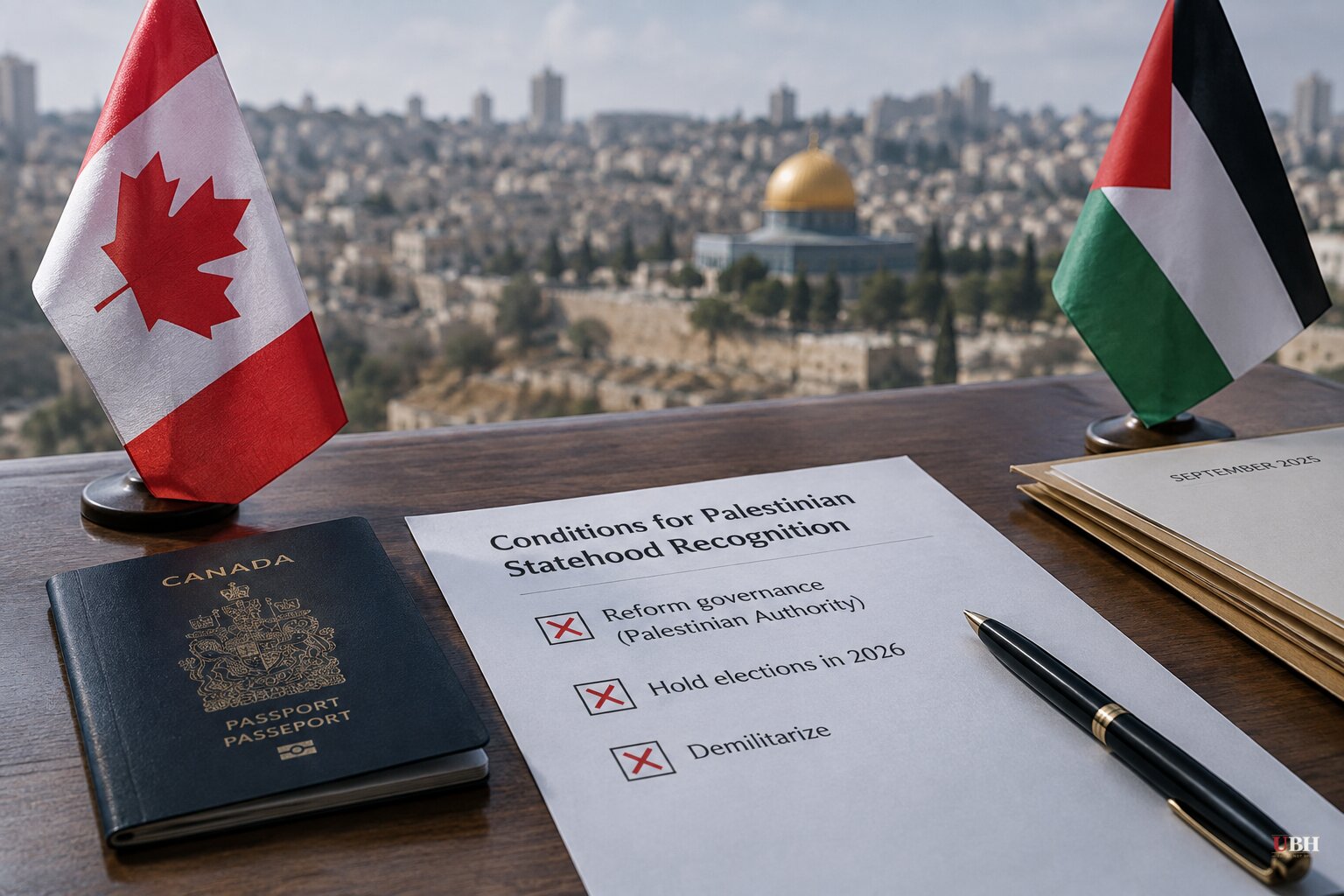
In September 2025, Prime Minister Mark Carney announced Canada was recognizing the State of Palestine. He told reporters the recognition was "predicated on the Palestinian Authority's commitment to much-needed reform," a commitment he said he received in a letter from Palestinian President Mahmoud Abbas and discussed with him by phone, according to CTV News and Global News.
Canada's Privy Council has refused to publish that letter, citing respect for international diplomatic relations, according to both outlets. A year later, the public still cannot read the document Carney says justified recognizing a state.
Carney laid out three benchmarks: governance reform excluding Hamas, general elections in 2026, and demilitarization of the future Palestinian state. Based on reporting from The Canadian Press, here's the status of each.
Governance: PA Says 30 of 33 Boxes Checked
Feda Abdelhady, the Palestinian ambassador to Ottawa, told The Canadian Press in August that reforms are underway to boost democratic institutions. But she said progress is limited while Palestinians face what she called constant violence, adding, "we could do the most incredible job of implementing reforms from textbooks and curriculum and everything else — but the occupation remains."
A Palestinian finance ministry report released in July 2026, shared with The Canadian Press by Abdelhady's delegation, claims the PA has completed 30 of 33 promised legal and social-system reforms over an 18-month period. That claim comes from the Palestinian Authority itself, not an independent auditor. The same report argues the PA cannot fund further reforms or social services because Israel has withheld tax revenue collected on Palestinian consumption and imports, and has capped financial transfers and canceled worker permits since the October 2023 Hamas attacks.
Elections: One Vote, in One City
Carney said Abbas promised general elections in 2026 that would exclude Hamas. Palestinians last voted nationally in 2006. Hamas seized Gaza in a 2007 civil war and Abbas's Fatah party has governed parts of the West Bank since.
Last fall, the PA said it could only hold general elections a year after the Gaza war ends completely, and only if candidates in the West Bank and East Jerusalem can campaign without being detained by Israel. As of this reporting, the PA has held exactly one election, in the Gaza city of Deir al-Balah in April 2026. No general election has been scheduled.
Demilitarization: Unresolved
Senior Canadian officials briefing reporters in September 2025 said demilitarization must include ending PA payments to families of Palestinians imprisoned for killing people, a reference to the PA's long-running stipend program for prisoners and their families. No source reviewed confirms whether those payments have stopped.
Canada Moves on Settlements Instead
Rather than revisiting recognition itself, Ottawa's most concrete recent action has been aimed at Israel. On September 8, 2026, Canada joined Denmark, Finland, France, Iceland, Ireland, Norway, Poland, Portugal, Spain, Sweden and the UK in a joint statement announcing intentions to introduce national or European restrictions on trade in goods from Israeli settlements in the West Bank, according to Global Affairs Canada.
The statement calls the Israeli government's publication of tenders for the E1 settlement project "unacceptable" and says settler violence and settlement expansion are "undermining the possibility of a two-State solution." It names UK Prime Minister Keir Starmer, French President Emmanuel Macron and Carney as having agreed on the need to act. The statement says the UK, France and Canada will bring forward national measures banning trade in settlement goods, following steps already taken by Ireland, Spain, the Netherlands, Norway and Belgium.
The same statement condemns the October 7 Hamas attack as "the worst antisemitic massacre since the Holocaust" and calls for accountability for settler violence and investigations into allegations against Israeli forces. It reaffirms the twelve countries' commitment to a two-state solution consistent with what it calls the New York Declaration, adopted a year earlier.
The Unanswered Question
Critics of Carney's original recognition argued it rewarded a Palestinian Authority that hadn't yet delivered on its promises, and that a secret letter from Abbas is a thin basis for a major foreign policy shift, especially since Ottawa still won't release it. The PA's own defenders counter that Israeli economic restrictions and the continuing war make full reform impossible regardless of Palestinian intentions, a point Abdelhady made directly.
Israel has consistently opposed Western recognition of Palestinian statehood as a unilateral move made outside negotiations. Neither the reform benchmarks nor the trade restrictions have altered conditions on the ground in Gaza or the West Bank. The question now is whether Canada will treat the still-unmet 2026 election promise and the unresolved demilitarization condition as grounds to reassess recognition, or whether those conditions become permanent works in progress while Ottawa's diplomatic energy shifts toward pressuring Israel instead.
Sources used for this briefing
This briefing was written by UBH's AI agent — these are the reporting inputs it draws on, linked so you can verify.


