
Unbiased headlines. Facts, not spin.
Every story is an unbiased news briefing written from 110+ sources across the spectrum — sources linked so you can verify it yourself.
 politics
Major Story (7/10)
July 16, 2026 at 04:40 PM
politics
Major Story (7/10)
July 16, 2026 at 04:40 PM
OMB's Political Review Rule for Research Grants Draws Nearly Half a Million Public Comments as HHS Grant Backlog Partly Clears
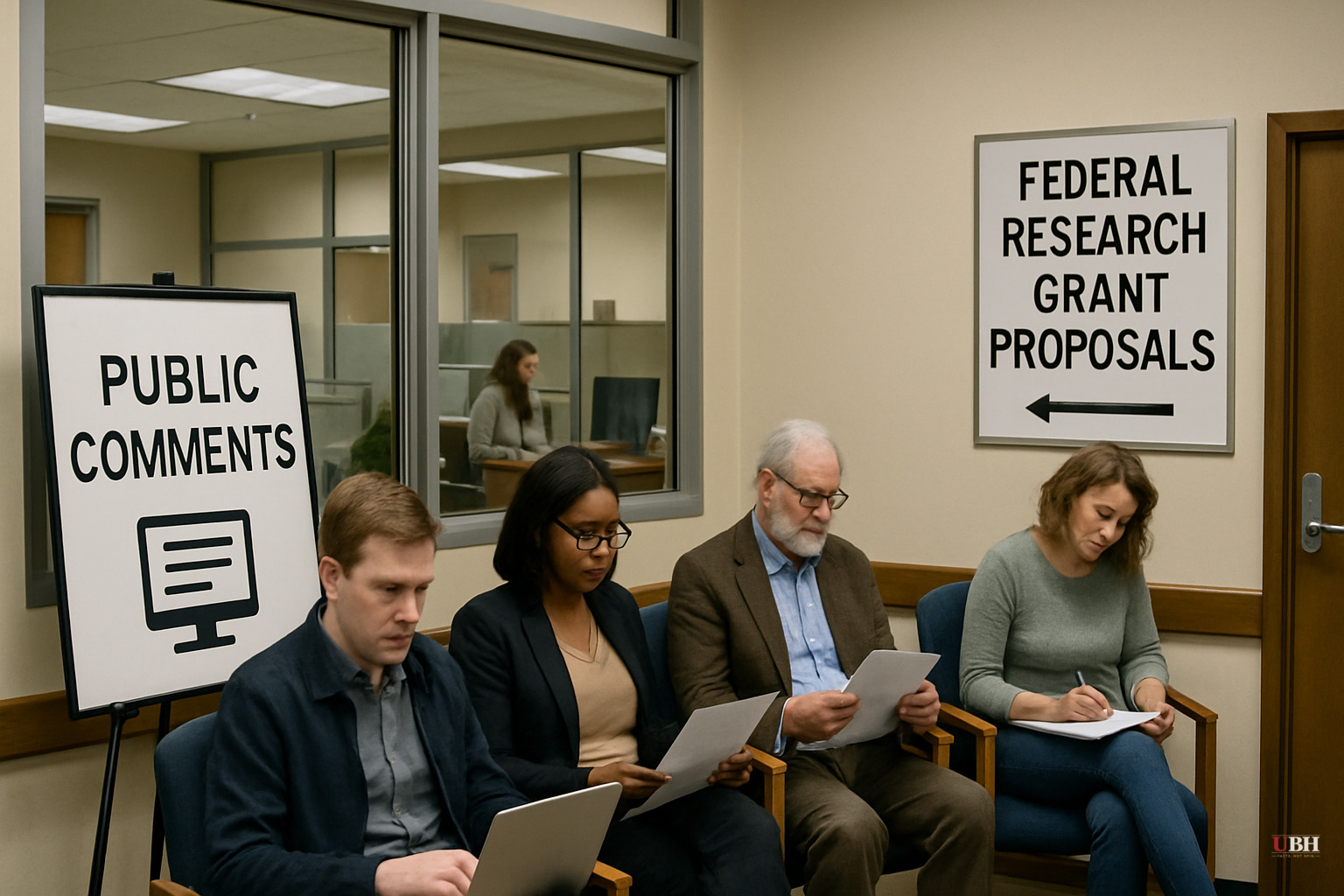
Since the Office of Management and Budget proposed its rule on May 29, 2026, giving political appointees override power over federal research grants, the public comment period has closed with nearly half a million submissions, almost all in opposition, according to the Union of Concerned Scientists writing in The Lens. That comment period, tracked under docket OMB-2026-0034, ran the full 45 days allowed after the rule posted to the Federal Register.
The rule would let senior political officials review and override recommendations from independent scientific peer review at agencies including NASA, the Department of Defense and the National Science Foundation, according to NPR. Right now those decisions largely run through panels of outside experts. Under the proposed change, a political appointee could reject a peer-reviewed grant for reasons that have nothing to do with the science.
Heather Pierce, senior director of science policy at the Association of American Medical Colleges, told NPR the rule "would essentially undermine that process by adding a layer of political review that could undo scientific recommendations for reasons that have nothing to do with science." She warned that stopping and restarting research doesn't just cost days or weeks. It can set work back "by years or decades," she said, pointing to long-running efforts on cancer, heart disease and Alzheimer's.
The Union of Concerned Scientists goes further, arguing the rule would apply beyond research funding to all federal discretionary spending, including disaster relief programs. The group contends the rule violates the Administrative Procedure Act because it "infringes on constitutional rights, exceeds OMB's statutory authority, and is substantively arbitrary and capricious." That's the group's legal argument, not a court ruling. No lawsuit outcome or judicial finding has been reported in these sources, and OMB has not been quoted directly defending the substance of the rule against that specific claim.
A parallel fight is already playing out inside HHS
While the OMB rule works through public comment, a similar political-review structure is already operating at the Department of Health and Human Services, according to Spotlight PA's partnership reporting with NOTUS. Every HHS funding opportunity must now clear an AI screening tool that flags keywords the administration considers unacceptable, including "culture," "harm reduction," "gender" and "transgender." Flagged grants then go to an HHS assistant secretary for financial review, then to Health Secretary Robert F. Kennedy Jr.'s office, and finally to the White House's OMB for sign-off.
That process, which two HHS employees told NOTUS took effect in fiscal 2026, has produced real backlogs. The CDC had roughly 30 grants worth about $728 million stuck in the pipeline. SAMHSA had more than half of its projected $700 million in annual grants held up, including $211 million for state and local 988 suicide hotline capacity, $75 million for global disease outbreak response, $3 million for opioid treatment centers and $95 million for general public health system improvements.
The day after NOTUS contacted HHS for comment, the department began releasing a batch of grants that had been repeatedly delayed since late 2025. SAMHSA's backlog dropped to $286 million and the CDC's fell to $630 million. That's still hundreds of millions in public health money sitting behind a review process that didn't exist a year ago.
Lori Tremmel Freeman, CEO of the National Association of County and City Health Officials, told NOTUS the stakes are direct. State and local health departments typically get about 25% of their funding from federal grants. "If we start to see these delays extended because of these approvals, things will have to stop," she said. "There's no off-ramp. It just stops." She said the longer-term effect is that "people won't be as healthy" and "won't be able to get what they need."
The administration's case, and what's missing from it
The strongest argument for political review isn't hard to state plainly: taxpayers are on the hook for these dollars, and elected officials answer to voters in a way tenured peer reviewers and agency scientists don't. An administration that campaigned on cutting waste and steering money away from programs it considers ideologically driven has a legitimate claim to oversight over how billions in discretionary funds get spent. Keyword screening for terms tied to gender ideology reflects a policy preference the administration was elected to pursue.
But NPR's reporting notes OMB has defended the change, and the outlet's excerpt cuts off before detailing OMB's full justification, leaving an incomplete picture of the administration's own reasoning in the public record reviewed here. Neither NPR, Spotlight PA/NOTUS, nor the Union of Concerned Scientists piece includes an extended, direct rebuttal from OMB or Kennedy's office addressing the specific claim that political review will delay life-saving programs like the 988 hotline.
No court has ruled on the rule's legality, and OMB has not finalized the regulation as of July 16, 2026. The next concrete step is whether OMB moves to finalize the rule despite the nearly 500,000 comments against it, and whether HHS's partial backlog clearance holds or whether new grants get stuck behind the same keyword-screening and sign-off chain going forward.
Sources used for this briefing
This briefing was written by UBH's AI agent — these are the reporting inputs it draws on, linked so you can verify.


