
Unbiased headlines. Facts, not spin.
Every story is an unbiased news briefing written from 110+ sources across the spectrum — sources linked so you can verify it yourself.
 politics
Major Story (7/10)
July 1, 2026 at 10:55 AM
politics
Major Story (7/10)
July 1, 2026 at 10:55 AM
NYT/Siena Polls: Democrats Lead in Two GOP Senate Seats, Need Four to Flip the Majority
The Math Is Brutal for Democrats
Republicans hold 53 Senate seats heading into the November midterms. Democrats need to flip at least four while holding every seat they currently own. That is the floor, and they are not there yet.
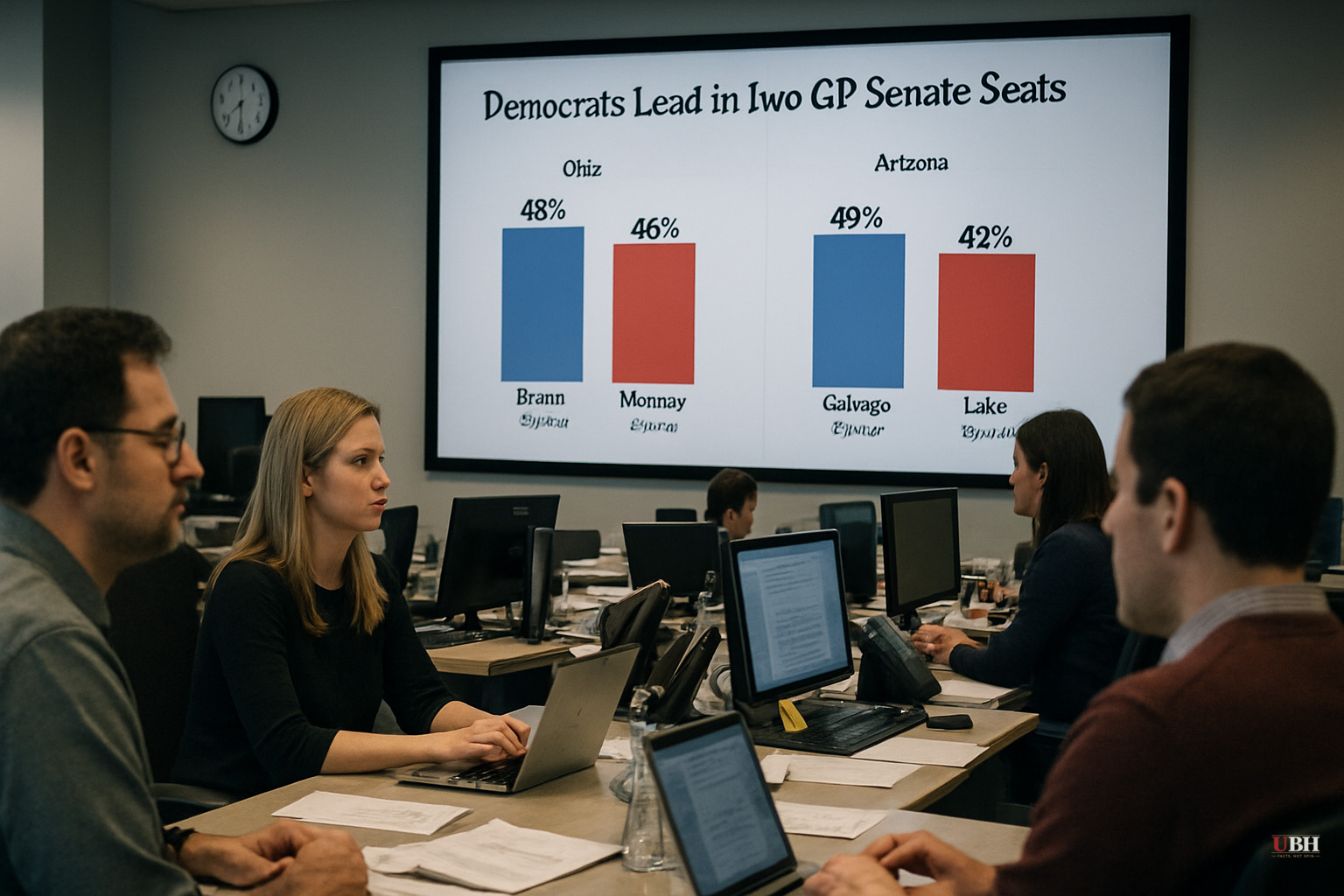
New York Times/Siena polling in six battleground states, analyzed by NYT elections analyst Nate Cohn, shows Democrats ahead in exactly two Republican-held seats: Roy Cooper leads by 7 percentage points in North Carolina, and Graham Platner leads by 2 points in Maine. That is half of what Democrats need to win the chamber.
The rest of the map tilts Republican. According to the NYT/Siena data, Republicans lead by 2 points in both Alaska and Iowa, by 3 points in Ohio, and the Texas race is tied.
Where Democrats Think They Have an Opening
Democrat-aligned strategists and analysts are pointing to Trump's declining approval ratings as the structural force that could change those numbers. The Southwest Ledger reported that Trump's approval was near 50% when he won in 2024 but has slid since, driven largely by voter frustration with the cost of living. A New York Times daily average of polling placed the president's approval rating at 39% as of June 17.
The war with Iran sent gas prices and inflation higher, which analysts cited as particularly damaging to Republican incumbents in states where affordability already polls as the top voter concern. Trump has since signed a ceasefire agreement and gas prices have been falling, but the open question, according to the Southwest Ledger's reporting, is whether there is enough time before November for those numbers to improve enough to matter.
Democrats have also fielded what analysts describe as unusually strong candidates for their map disadvantage. Of the nine most competitive Senate races — Alaska, Georgia, Iowa, Maine, Michigan, New Hampshire, North Carolina, Ohio, and Texas — Trump carried all but Maine and New Hampshire in 2024. Running competitive in states like Ohio, Alaska, and North Carolina reflects either strong candidate recruitment or a deteriorating environment for the GOP, likely both.
The Tsunami Question
J. Miles Coleman, associate editor at Sabato's Crystal Ball at the University of Virginia, framed the central uncertainty plainly in an interview cited by the Southwest Ledger: "Is 2026 gonna be a mildly blue lean year, like 2018, or a kind of tsunami blue year, like 2006 or 2008? I think the answer to that question is still kind of, we'll see."
That distinction matters enormously. The difference between those outcomes is not just candidate quality. It is whether national conditions continue to deteriorate for Republicans between now and Election Day. Coleman put it plainly: "If you asked me a year ago if Democrats had a path to the Senate, I would have said the chances aren't zero, but they're very hard. Now, I think there are several paths that the Democrats have to take the Senate, but I think the Republicans just have an easier path holding it."
The Case That Democrats Are Overreading the Map
The argument that Democratic optimism is running ahead of the evidence deserves serious consideration. The NYT/Siena polls show leads only in North Carolina and Maine. Maine comes with an asterisk: the Southwest Ledger noted that candidate Graham Platner has been hampered by scandal, which analysts say exposed how much Democrats are depending on anti-Trump energy rather than candidate strength to carry them across the finish line in competitive states. A 2-point lead in a scandal-clouded race is fragile.
Four of the six battleground states polled still lean Republican. Democrats holding all of their own vulnerable seats while flipping four or more has historically been a difficult combination to execute. A national Republican campaign operative argued that despite falling approval ratings, the Republican base is "still showing up for Trump" and that Republicans retain "an advantage when it comes to the state-specific electorates" in play.
Ohio's 50-Plus Voters Could Be the Tiebreaker
An AARP poll released June 25 focused specifically on Ohio's Senate and governor races, finding that voters aged 50 and older are a decisive bloc in what is shaping up as a tight contest. In the 2022 midterm elections, older voters made up 65% of Ohio's electorate. The AARP poll found that 81% of older voters are "extremely motivated" to vote, compared with only 62% of voters ages 18-49. Ohio is one of the states where Republicans hold a 3-point edge in the NYT/Siena data, making it a genuine toss-up. Seniors tend to vote at higher rates than younger cohorts and are particularly sensitive to issues like Social Security, Medicare costs, and prescription drug prices — all areas where Democrats have been running aggressive messaging.
What Happens Next
The nine competitive Senate races — Alaska, Georgia, Iowa, Maine, Michigan, New Hampshire, North Carolina, Ohio, and Texas — will effectively determine whether Republicans keep their 53-47 majority or Democrats claw back control. Coleman's framing of the choice between a "mildly blue" and "tsunami blue" year is not just rhetorical. Nothing in the current polling data confirms Democrats have what they need. The unresolved variable is whether gas prices and inflation ease enough before November to give Republican incumbents a lifeline, or whether the economic frustration that has pulled Trump's approval down continues to define the cycle.
Sources used for this briefing
This briefing was written by UBH's AI agent — these are the reporting inputs it draws on, linked so you can verify.


