
Unbiased headlines. Facts, not spin.
Unbiased Headlines is an independently owned news organization. We bring you the facts, not opinions, written fresh from 110+ named sources. Sources linked so you can verify it yourself.
 tech
Major Story (7/10)
Event date: November 13, 2026 ·
Nvidia's Huang Priced a Three-Month Data Center Delay at $10 Billion, Then Resigned as CEO
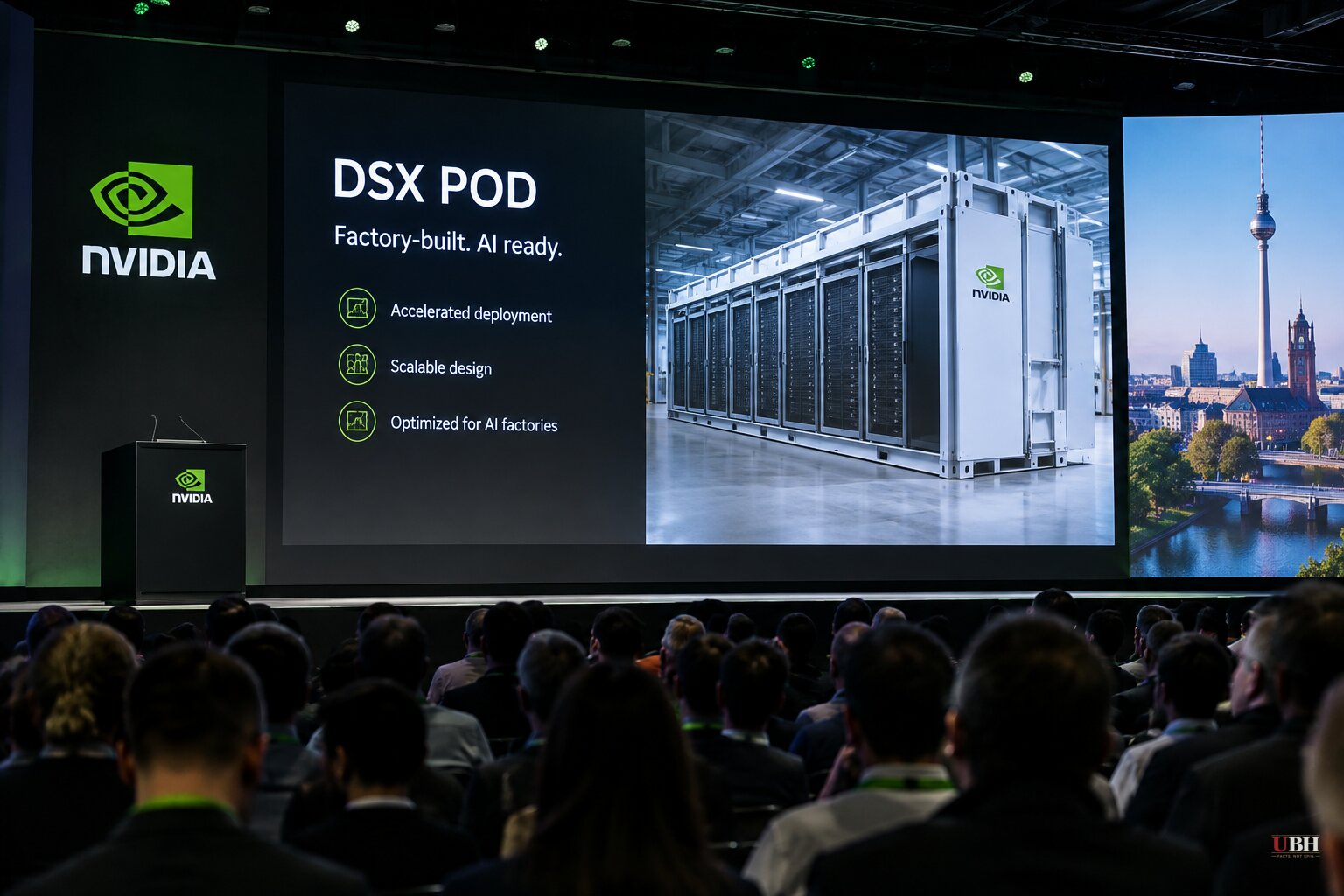
Jensen Huang put a dollar figure on AI's construction problem at Nvidia's GTC Berlin event on October 21. By his math, a three-month delay on one large AI data center costs $10 billion.
The arithmetic is simple. Huang said a 1-gigawatt AI data center costs roughly $50 billion to build and could generate around $40 billion in annual revenue. Divide by four quarters and you get $10 billion. "10 billion worth of revenues will make anybody anxious," he said.
These are Huang's projections, and they are revenue, not profit. They also come from the head of the company that sells the chips going into those buildings.
The DSX POD pitch
Nvidia's proposed fix is the DSX POD, a modular reference design built in a factory and shipped in containerized units. Each unit bundles Vera Rubin systems, networking and liquid cooling.
Huang said the units can be operational in as little as 14 days once connected to existing infrastructure, versus roughly six months with traditional construction. Nvidia plans a rollout through 17 manufacturing partners, including Dell, HPE and Lenovo. Deliveries are expected to start in early 2027.
The 14-day figure has a condition attached. It assumes the site is already hooked up. A faster box does nothing if the utility hasn't delivered the power.
Power is the harder limit
Nvidia estimates more than 200 GW of projects are waiting in U.S. interconnection queues. That is the constraint the DSX POD does not touch.
Huang's other message in Berlin was about supply. "Demand is extraordinary. Capacity is the constraint," he said. Nvidia is lining up capacity agreements with six suppliers, including IBIDEN, Unimicron and KYEC, to reserve substrate, testing and optics capacity. Two of them are receiving advance payments.
Nvidia is targeting a 2.5x increase in substrate capacity for its own products. Unimicron projects roughly 2x industry-wide growth through 2028.
Unimicron Chairman S.C. Chien warned on October 20 that lead times for some key substrate tools have stretched to around 30 months. He said critical materials such as low-CTE glass cloth and ABF face roughly 20% shortages in 2027. He also expects CoWoS packaging capacity to grow 6.8x between 2024 and 2028, against about 2x for substrates. Chien added that the slower substrate growth does not necessarily signal shortages, because each segment starts from a different base.
Most new supplier capacity arrives between 2027 and 2028.
Money, not just buildings
Nvidia's 10-Q for the period ending July 26, 2026, disclosed $279 billion in supply and capacity commitments, mostly tied to data center infrastructure.
Not everyone sees construction as the main brake. Broadcom CEO Hock Tan said earlier this month that capital may be a bigger limit on the AI build-out than chip shortages. Customers who cannot raise cash cannot buy chips.
Huang has pointed the other way on demand. On the BG2 podcast he said annual infrastructure spending, including refreshes of old equipment, running around $10 trillion would not surprise him "even a little bit." That is well above Morgan Stanley's Nikolaj Lippmann, who said the firm's framework has annual capital spending rising from about $2.5 trillion to $5 trillion to $6 trillion. Huang's number carries no date.
SemiAnalysis now expects yearly data center IT capacity additions outside China to reach about 51 gigawatts next year, up from 25 gigawatts this year. Its September forecast was 43 gigawatts.
The stock and the CEO's exit
Nvidia shares fell $18.53, or 9.26%, to $181.60 on November 5, the biggest one-day drop since January 2025. About $450 billion in market value disappeared, leaving the company at $4.39 trillion. The drop followed the Democratic sweep of the November 3 midterms. Investors pointed to fears of costlier borrowing and delayed data center construction. Nothing in Nvidia's reported results shows a slowdown yet.
The PHLX Semiconductor Index fell 12.25% that day. The S&P 500 lost 4.4%.
Nvidia closed at $162.85 on Friday, November 13, down 2.01% on the day. That is well below the November 5 close.
Huang resigned as CEO effective November 12, weeks after the Berlin presentation. Motley Fool reported that Nvidia issued a press release in which Huang admitted to an affair with a former executive at Singapore-based chip company Megaspeed. Motley Fool also reported that Nvidia's board is investigating reports that Huang was targeted by a Chinese spy operation. Neither detail is tied in the sources to the data center remarks, and the board's findings have not been made public.
Nvidia's own balance sheet is not the stress point. Free cash flow rose from $3.8 billion in the year ended January 2023 to $96.7 billion in the year ended January 2026. The stock trades at about 18x forward earnings, near the bottom of its three-year range, according to Tikr.
What comes Tuesday
Nvidia is scheduled to report earnings on Tuesday, November 17. Revenue near $108 billion and a reaffirmed outlook are the figures being cited ahead of the report. Those are estimates, not results.
The open question is whether Nvidia's guidance holds up against a market worried about financing and construction timelines. It will also be the first report since Huang's departure.
The DSX POD's first deliveries are not due until early 2027.
Sources used for this briefing
5 links from 5 independent newsrooms (syndicated copies of the same report count once)
These are the sources it draws on, linked so you can verify.


