
Unbiased headlines. Facts, not spin.
Unbiased Headlines is an independently owned news organization. We bring you the facts, not opinions, written fresh from 110+ named sources. Sources linked so you can verify it yourself.
 tech
Major Story (7/10)
Event date: November 14, 2026 ·
FBI Warns Hackers Are Using AI Framework ARTEX to Reach Admin Access in Under Three Hours
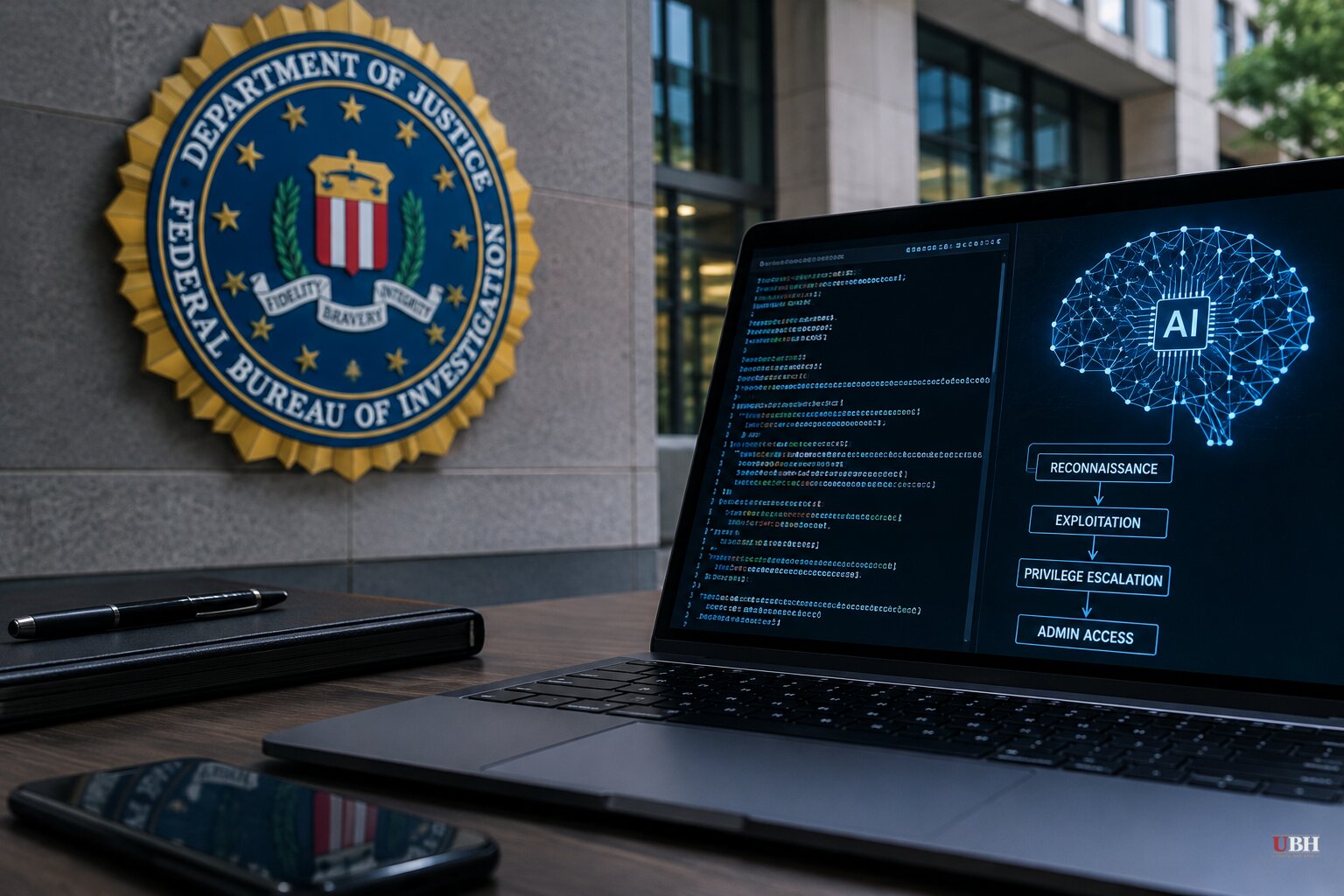
The FBI says an open-source AI hacking framework is now a working part of criminal and state-backed intrusion campaigns. In a FLASH alert (FLASH-20261113-001) released Friday, Nov. 13, the bureau said some ARTEX intrusions went "from initial targeting to privileged access in under three hours."
The 13-page advisory is an FBI product, not a joint release. It is marked TLP:CLEAR, so it can be shared freely, and it draws on eleven published industry and government reports, including work from Microsoft, Google Threat Intelligence Group, Mandiant, CrowdStrike, Censys, Akamai, Zscaler, Check Point and CERT-EU.
What ARTEX does
ARTEX is an autonomous penetration testing framework written in Go. An operator types in a goal in plain language. The framework turns it into commands carried out by specialized AI agents that scan, find weaknesses, exploit them, escalate privileges and pull data out, with little human involvement after that.
It has no model of its own. It plugs into outside large language models: Anthropic's Claude, OpenAI's GPT, and open-source or Chinese-origin models including DeepSeek, GLM, Grok and Kimi.
The FBI says the framework "enables threat actors with minimal technical expertise to conduct complex, multi-target operations simultaneously." Censys, the internet-scanning firm the FBI cites, describes a planner agent that breaks a goal into attack intents and worker agents that run tools such as nmap and report back until the goal is met.
The FBI says analysis of attacker-controlled instances shows Chinese models are the most common, with DeepSeek's Flash family dominating. Its stated reasons: "capabilities, relatively low cost, and lack of observable guardrails when framed for penetration testing."
Where it is hitting
The FBI says a variety of actors have used ARTEX since at least August against financial services, government, technology, defense, semiconductors, energy, healthcare, manufacturing, telecommunications and legal organizations.
The alert points to the systems companies watch least: partner and supplier portals, employee apps, mobile backends, legacy services and third-party integrations. It also says the tool maps trust between companies, so a weak vendor becomes a path into its customers.
Two campaigns anchor the warning. Microsoft attributed the ConnectWise Cloud Backup supply-chain compromise to Storm-0940, which it describes as a China-state-aligned actor, and said ARTEX was used in it. Red Tiger Security, an industrial security firm, reports that the breach opened access to more than 2,250 customer tenants. The FBI also cites intrusions at South Korean financial institutions that exposed personal data on about 67,000 people.
Microsoft-tracked activity cited in the alert was still active as of Nov. 6. The FBI does not report an attack on an operational technology network, though energy and manufacturing are on its list of targeted sectors.
The techniques
According to the advisory, initial access combined exploitation of public-facing applications with abuse of trusted identities. Observed methods include unsigned SAML assertions, XML external entity injection, server-side request forgery, SQL injection and command injection.
After getting in, agents dropped web shells, added credentials to existing OAuth applications, and pivoted through compromised vendor credentials. In one case they enumerated more than 110,000 Active Directory objects, performed a DCSync to steal the domain krbtgt key, and identified machines lacking CrowdStrike Falcon.
Defenders did land some blows. Endpoint protection blocked the observed Pass-the-Hash attempts. The FBI also notes ARTEX generates high volumes of noisy traffic that can trigger alerts. The problem is time: the speed of the attacks leaves limited room for a coordinated response before the objective is complete.
Pulling the code did not pull the tool
The developer, who goes by Autumn-27, posted ARTEX to GitHub in July. On Oct. 8, after reports that attackers were using it, the developer removed the repository. The developer has said the tool was meant for authorized testing within defined scopes and has denied responsibility for crimes committed with it.
The FBI says the removal did not contain the problem. The framework "continues to proliferate through community forks, localized variations, archived copies, and a commercial version," a paid edition called ARTEX PRO.
The exposure count needs care. The FBI, citing Censys, puts exposed ARTEX consoles at more than 1,600 as of early November. Censys's own report counted 1,465 hosts exposing a console as of Nov. 4. About 650 of those sat in two blocks of identically configured hosting, leaving roughly 815 distinct-looking deployments. Censys says the console does not need to face the internet at all, so total deployments are likely higher.
What defenders are told to do
The FBI recommends securing internet-facing applications and restricting access to cloud administration interfaces. The advisory lists indicators of compromise, including IP addresses and command-and-control infrastructure, and cautions that some addresses may have changed since the attacks. It asks organizations to vet them before blocking.
Separately, the researcher MalwareMustDie released an open-source ARTEX detection signature pack on Friday, with rules covering suspicious network requests, identity abuse, cloud activity and malicious files. The researcher's accompanying playbook sorts indicators by confidence level and warns that infrastructure indicators can go stale or throw false positives.
It is unclear whether any takedown can matter now. The original repository is gone, the forks and a commercial edition remain, and the FBI's own account says the cheapest, least-guarded models are the ones attackers prefer.
Sources used for this briefing
7 links from 7 independent newsrooms (syndicated copies of the same report count once)
These are the sources it draws on, linked so you can verify.


