
Unbiased headlines. Facts, not spin.
Unbiased Headlines is an independently owned news organization. We bring you the facts, not opinions, written fresh from 110+ named sources. Sources linked so you can verify it yourself.
 tech
Low Interest (3/10)
Event date: October 30, 2026 ·
NVIDIA Says AI Agents Now Steer the Allen Telescope Array. No Alien Signal Has Been Reported
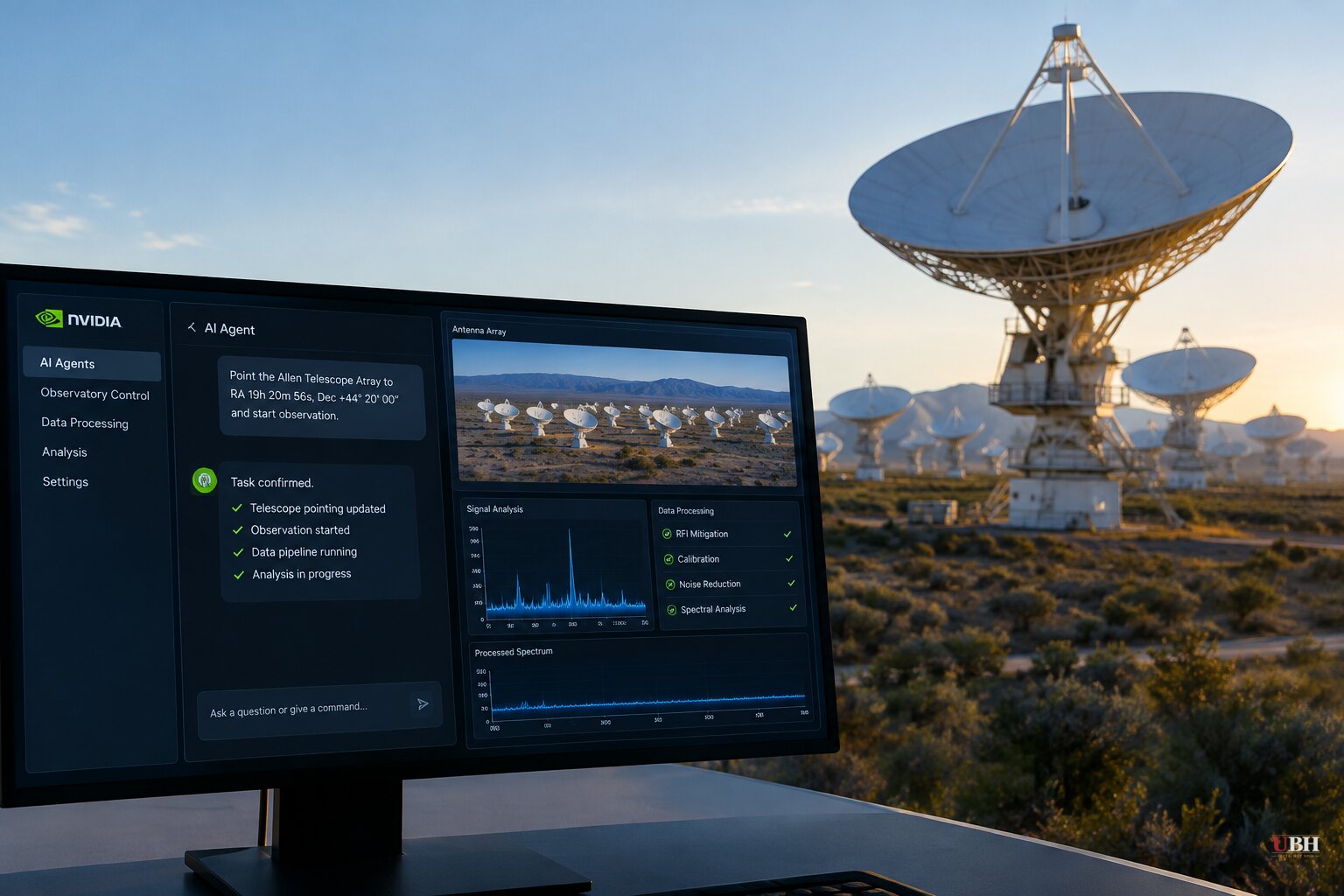
On Oct. 30, NVIDIA announced that Breakthrough Listen and the SETI Institute have put AI agents into daily operations at the Allen Telescope Array in Northern California. Researchers can type a request in ordinary language and the agents handle the work behind it.
No extraterrestrial signal has been announced. The one demonstration NVIDIA cites is a pulsar in the Crab Nebula, a spinning stellar remnant that astronomers already know is natural.
What the agents do
According to NVIDIA, a single natural-language request can make an agent steer the telescope's antennas, calibrate and focus the instrument, catch and fix data errors, and plot the result. NVIDIA also says agents can apply AI models to the incoming data stream.
The coordinating software is called Nexus, a web-based observatory orchestrator. NVIDIA describes it as the harness that gives agents one shared view of instrument state, computing resources and processing pipelines.
Through Nexus, NVIDIA says, researchers can monitor packet loss, read live spectrograms and rewrite signal-processing blocks, all by prompt.
NVIDIA claims the combined workflow compresses tasks that would take humans weeks or years into hours. That is the company's figure. NVIDIA has not published a benchmark behind it.
The hardware and data pipeline
The system runs on NVIDIA's Holoscan platform. A Holoscan library called DAQIRI pulls telescope data straight into GPU memory, so observations are processed as they arrive instead of piling up on hard drives.
CyberEther, a signal-processing framework developed at the SETI Institute, does the math using NVIDIA's CUDA-X libraries, including cuFFT and cuBLAS.
NVIDIA says the setup handles 2.4 terabits per second on RTX PRO 6000 Blackwell GPUs. Inference runs on premises, next to the instrument, so the data does not have to be shipped elsewhere first.
The SETI-side Stelline project describes related server hardware on its website. Its "Coyote" class machines carry four RTX 6000 Blackwell GPUs each, with up to 800 gigabits per second of fiber input and up to 256 terabytes of NVMe storage. The site also shows live Allen Telescope Array data flowing into CyberEther over 100 Gigabit Ethernet.
The pulsar result
NVIDIA says the pipeline has already achieved the first real-time AI detection of a pulsar, in the Crab Nebula. The "first" is NVIDIA's own designation.
The detection shows the system can find a known, strongly pulsing source while the data streams in. It does not show the system can recognize an artificial signal from another civilization, which is a different and much harder problem.
NVIDIA's announcement does not claim a detection of extraterrestrial intelligence.
Siemion's framing
Andrew Siemion, the Bernard M. Oliver chair for SETI at the SETI Institute and principal investigator of Breakthrough Listen, offered a philosophical read on where this leads.
"As our new agentic observatories reach out into the universe, what they find may have much more in common with themselves than with the humans who created them," Siemion said. "But this isn't something to fear. Rather, it's a breakthrough in translation."
NVIDIA's own post leans into the idea. It suggests that older civilizations might have developed AI of their own, so the search could end up as human-built agents listening for alien-built ones. That is speculation. Nobody has presented evidence that any such civilization exists.
What comes next
The team is evaluating open models, including NVIDIA Nemotron, for cases where keeping data local and getting fast answers matter most. That is an evaluation. NVIDIA has not said Nemotron powered the pulsar detection.
NVIDIA also points to a more distant use: observatories that could one day run offline on the far side of the moon. No such deployment has been announced.
The working deployment is at the Allen Telescope Array. The test still ahead is whether agents that can calibrate, clean and analyze at 2.4 terabits per second can flag something no one has seen before, and whether researchers will publish how they check what the agents decide to throw away.
Sources used for this briefing
7 links from 6 independent newsrooms (syndicated copies of the same report count once)
These are the sources it draws on, linked so you can verify.


