
Original briefings. Zero spin.
Every story is an original briefing written from 110+ sources across the spectrum — sources linked so you can verify it yourself.
 tech
Notable (6/10)
Event date: August 25, 2026
tech
Notable (6/10)
Event date: August 25, 2026
Nvidia Rolls Out Vera CPU at Hot Chips 2026, Claims It Beats AMD on AI Agent Workloads
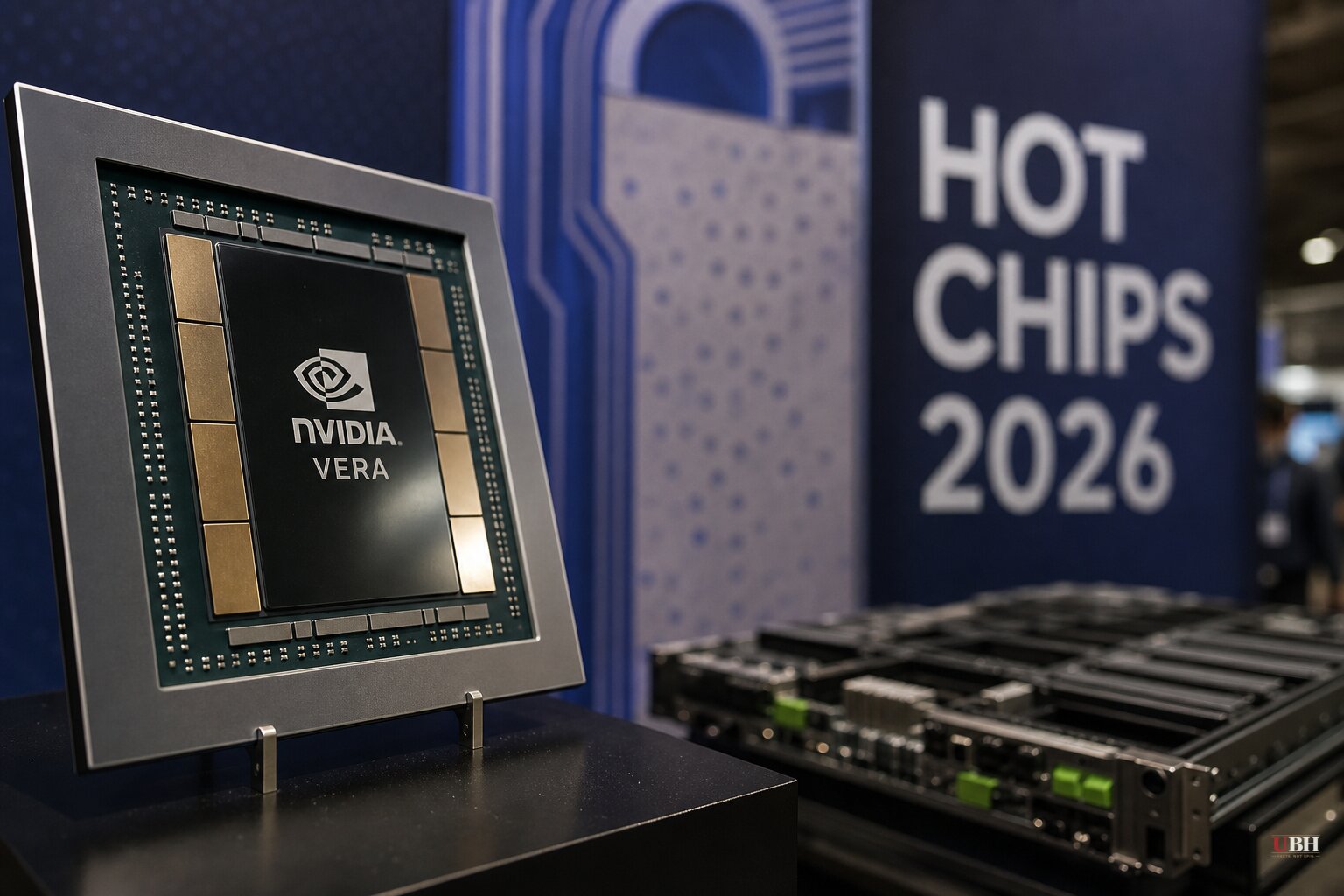
Nvidia spent its August 24 session at Hot Chips 2026, held at Stanford University, laying out the most detailed technical case yet for why AI agents need chips built specifically for them, not repurposed server hardware.
The centerpiece is the Vera CPU, Nvidia's first processor built around a fully custom core design called Olympus, replacing the stock Arm cores used in its previous Grace chips. According to ServeTheHome, which covered the presentation live, Vera packs 88 cores and prioritizes instructions-per-cycle performance over raw core count, a deliberate tradeoff aimed at the kind of multi-step reasoning and tool-calling that defines so-called agentic AI.
The Numbers Nvidia Is Touting
Nvidia claims Vera compiles the Linux kernel 14% to 22% faster than AMD's 96-core EPYC 9655P, depending on whether the target is native AArch64 or cross-compiled for x86, according to Tom's Hardware. On a headless browser benchmark meant to simulate how an AI agent scrapes and processes web content, Nvidia says Vera runs 24% faster than the same AMD chip, and claims agents can complete browsing tasks 4.5 times faster than a human-oriented browser session by skipping GUI rendering, font loading, and media decoding.
Nvidia also claims a broader 1.8x improvement in task completion time on agentic workloads versus competing x86 chips, according to Crypto Briefing and KuCoin, both of which noted this figure comes from Nvidia's own internal benchmarks. That caveat matters. None of these numbers have been independently verified by a third party, and Hot Chips has historically been a venue where vendors present best-case comparisons.
The chip's architecture leans on what Nvidia calls spatial multithreading, a design that statically assigns hardware resources to specific threads instead of sharing them dynamically. Nvidia says this cuts contention when an AI agent is juggling dozens of parallel operations. Vera pairs its cores with LPDDR5X memory delivering up to 1.2 TB/s of bandwidth and a 164 MB L3 cache, according to Crypto Briefing.
Part of a Bigger Stack, Not a Standalone Chip
Nvidia framed Vera as one piece of a coordinated hardware stack that includes the Rubin GPU, the BlueField-4 DPU for network-edge data processing, and Spectrum-X networking. According to Nvidia's own blog post, the company also announced that its Groq 3 LPX rack-scale inference system is now in full production, delivering 3,400 output tokens per second on a 100,000-token context benchmark using the open-source Gemma 4 31B model, which Nvidia says is four times faster than the nearest competing platform on that specific Artificial Analysis test.
CoreWeave has already deployed Spectrum-X Multiplane in production to connect Vera Rubin racks, and Nebius is the first cloud provider to adopt Groq 3 LPX, according to Nvidia. These are customer deployments Nvidia is choosing to highlight, not independently confirmed performance results in live customer environments.
The SpaceXAI Deal and an Orbital Bet
The most unusual announcement out of Hot Chips was a partnership between Nvidia and SpaceXAI to deploy Vera CPUs for workloads tied to Grok. According to KuCoin, the two companies are targeting an orbital version of the Vera Rubin NVL72 system for deployment on the Starmind satellite by the fourth quarter of 2027. That timeline is roughly 15 months out, and no source indicates hardware has shipped or that the satellite has launched.
Demand Is Already Showing Up in Order Books
The technical claims are backed by real purchase orders. AM Intelligence, an AI infrastructure venture promoted by the founders of renewable energy company Greenko, has ordered 9,000 Nvidia Vera Rubin chips, according to the Economic Times. AMI says it will be one of the earliest adopters of Rubin chips in Asia, deploying 200 megawatts of capacity over the next 18 months as the first phase of a planned 1 gigawatt compute-as-a-service buildout in Hyderabad, backed by $3 billion in debt and equity funding. The Economic Times reports Rubin chips can deliver up to 10 times the agent throughput of Nvidia's prior-generation Blackwell chips, while costing 40% to 80% more.
What's Actually Being Tested and What Isn't
Every headline number in this rollout comes from Nvidia's internal testing against AMD's EPYC 9655P and Nvidia's own prior generation. These include the 1.8x agentic speedup, the 22% Linux kernel compile advantage, and the 30x throughput claim over Grace Blackwell that ServeTheHome noted from Nvidia's own slides. AMD has not published a competing benchmark rebuttal in these sources, and no independent lab result appears in any of the reporting reviewed. Agentic AI performance also lacks standardized industry benchmarks, a point Tom's Hardware raised directly, since measuring a full multi-step agent workflow is far messier than a single compile task or browser test.
Nvidia's Vera CPU has not yet shipped in volume to third-party customers who could publish independent numbers. The AMI order and the SpaceXAI satellite plan represent real financial commitments, but the performance claims underlying those bets remain, for now, Nvidia's own word.
Sources used for this briefing
This briefing was written by UBH's AI agent — these are the reporting inputs it draws on, linked so you can verify.


