
Original briefings. Zero spin.
Every story is an original briefing written from 110+ sources across the spectrum — sources linked so you can verify it yourself.
 tech
Notable (5/10)
August 21, 2026 at 06:27 PM
tech
Notable (5/10)
August 21, 2026 at 06:27 PM
Nvidia Researchers Cut AI Model-Swap Costs With Simple Linear Math Instead of Deep Learning
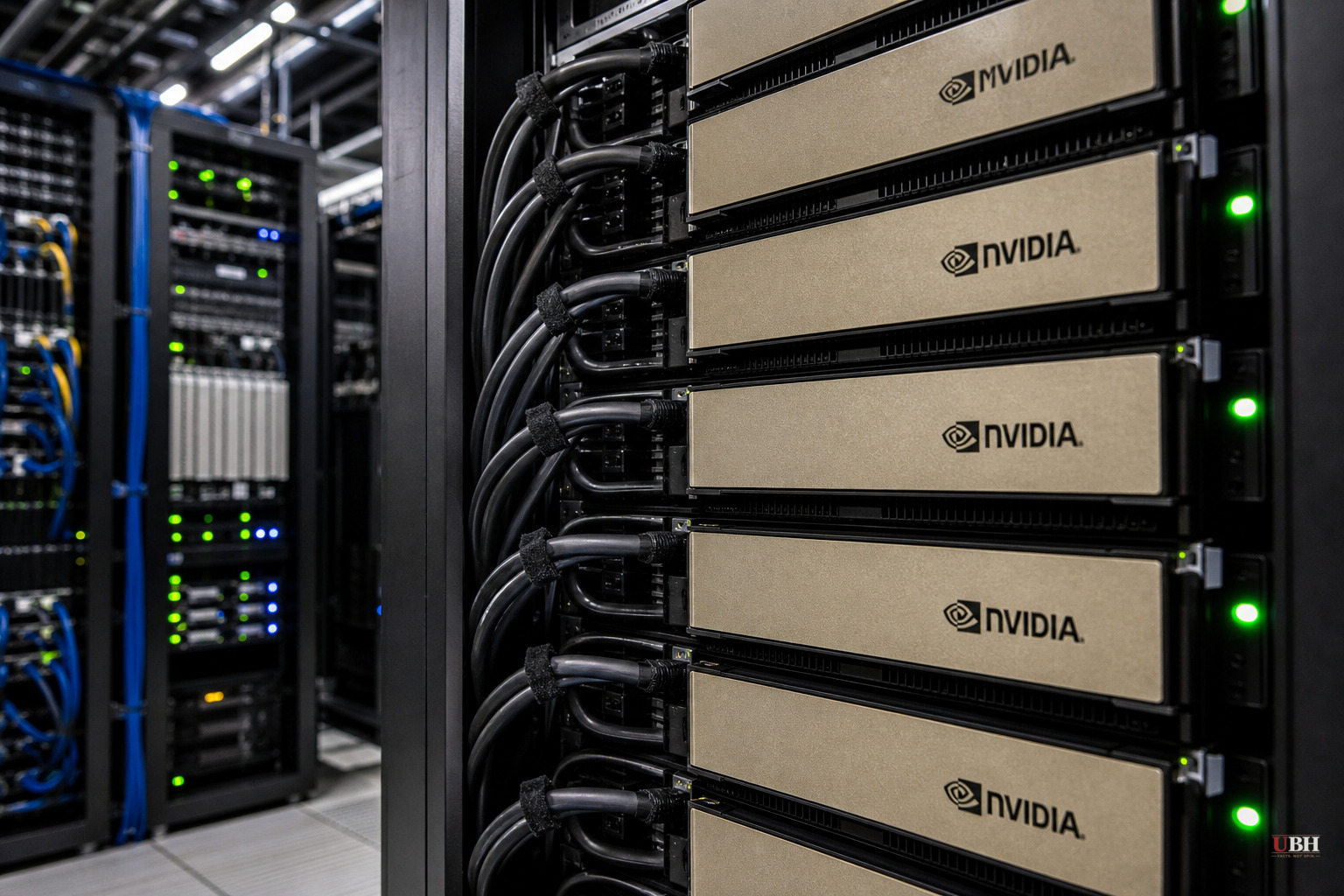
Nvidia researchers have found a fix for one of the dumbest inefficiencies in modern AI systems: every time a task gets handed from one model to another, the receiving model has to redo all the work from scratch.
Enterprises building "agentic" AI systems, the kind that chain together multiple models to handle complex tasks, often route easy work to cheap, small models and hard reasoning problems to expensive, large ones. Every time that handoff happens, the system pays a full computational tax to catch the new model up on the entire conversation.
Nvidia's fix is a cross-model KV cache transfer technique, detailed in company research covered by VentureBeat. It maps the memory a source model already built up directly into the format the target model expects. No re-reading the whole conversation. No re-running the expensive first pass.
Why This Was a Problem in the First Place
When a large language model processes a prompt, it runs through two stages. First is "prefill," where it churns through every token in the input and builds a Key-Value cache, essentially a compressed memory of the conversation. Then it enters "decode," where it uses that cache to generate new tokens one at a time.
The prefill stage is the expensive part. Its cost scales with both the size of the model and the length of the input. In a long agentic session, where context keeps piling up over many turns, that cost keeps climbing.
The problem: different model architectures store their KV caches in incompatible formats. So the moment a system swaps from, say, a lightweight model handling routine steps to a bigger model needed for a hard reasoning task, the cache gets thrown out. The new model has to reprocess the entire conversation history from zero, according to Nvidia's research.
That's a real cost. Compute expenses and latency both spike, which is exactly the kind of tax that makes multi-model AI systems impractical to run at scale for businesses.
The Fix Is Boring
Nvidia's researchers didn't build another deep learning model to solve a deep learning problem. They used linear math, a comparatively simple transformation, to convert one model's cache format into another's.
According to the findings reported by VentureBeat, on compatible model pairs this linear mapping runs 2.7 to 25 times faster than the standard method of recomputing everything. It also retains up to 98% of the target model's standalone accuracy, meaning the receiving model doesn't lose much quality even though it skipped the expensive prefill step.
The approach works in both directions. Route a task down from a large model to a small one to save money mid-session, and the small model can pick up the cached context without redoing the work. Route it up from a small model to a large one when a problem gets too hard, and the larger model inherits the accumulated context and can immediately produce higher-quality output.
What's Still Unproven
The research describes this as working on "compatible model pairs," which raises an obvious question Nvidia's own summary doesn't fully answer: how many real-world model pairings actually qualify, and how much does the technique degrade on architectures that are more different from each other.
The 98% accuracy figure is also a best-case number tied to specific pairs tested by Nvidia's researchers, not a guaranteed floor across every possible small-to-large or large-to-small transfer. Enterprises evaluating this for production workflows will want to know the failure modes, not just the headline speedup.
Nvidia has not indicated whether this cross-model KV cache transfer technique is shipping in a product, a research library, or remains an internal proof of concept. No release date or product name has been announced. Companies running multi-LLM agentic pipelines, from customer service bots to coding assistants that escalate hard problems to bigger models, are the most obvious beneficiaries if and when this moves beyond the research stage.
Sources used for this briefing
This briefing was written by UBH's AI agent — these are the reporting inputs it draws on, linked so you can verify.


