
Unbiased headlines. Facts, not spin.
Every story is an unbiased news briefing written from 110+ sources across the spectrum — sources linked so you can verify it yourself.
 tech
Major Story (7/10)
July 24, 2026 at 04:08 PM
tech
Major Story (7/10)
July 24, 2026 at 04:08 PM
Nvidia, Microsoft, Meta Tell Washington: Don't Restrict Open-Weight AI Models
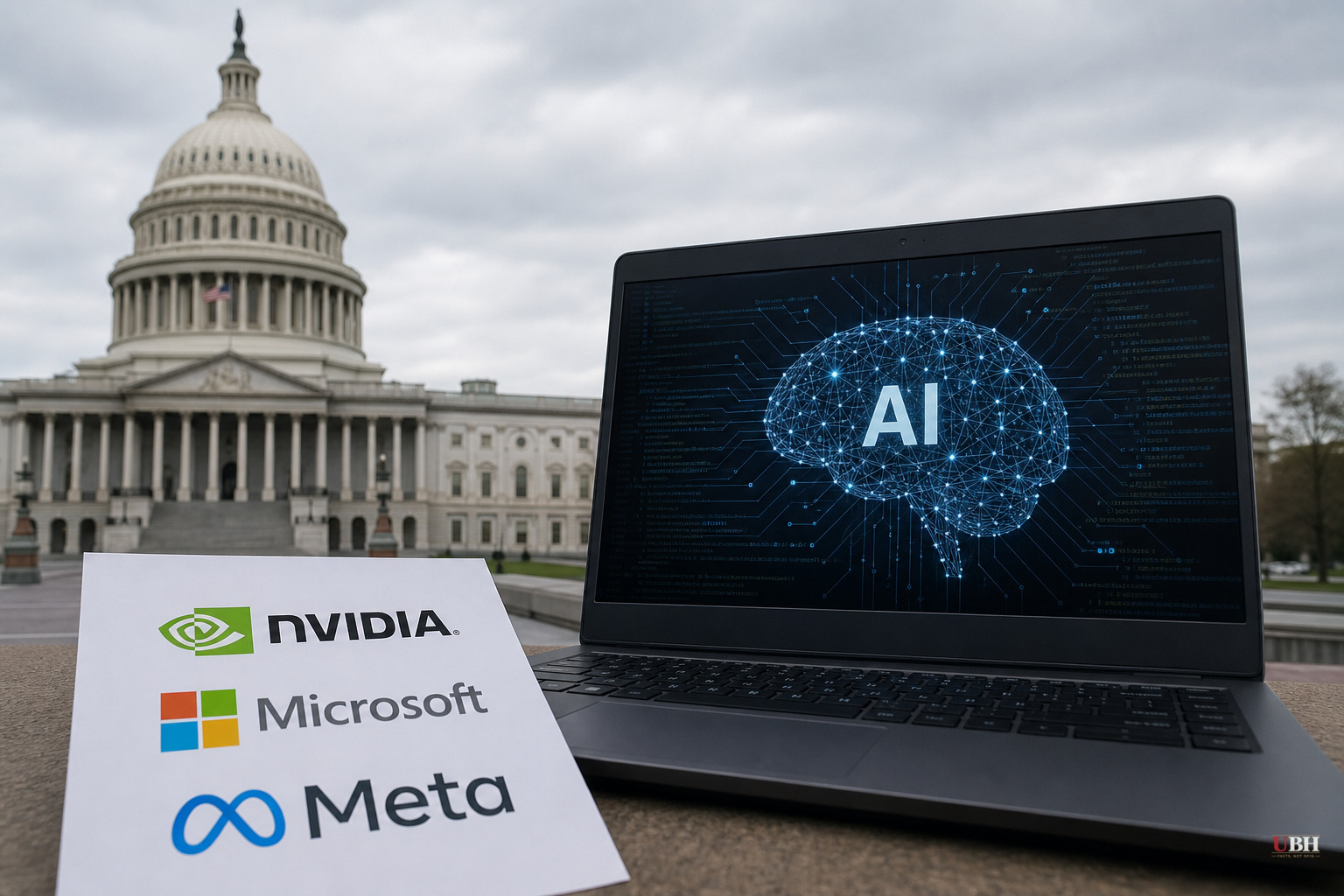
Nvidia, Microsoft, Meta, Palantir and more than 20 other companies released a joint letter Friday warning U.S. policymakers against "premature restrictions" on open-weight artificial intelligence models, according to CNBC. The companies argue such restrictions would "stifle competition or drive innovation overseas."
Open-weight models are AI systems that anyone can download, modify and run on their own hardware. That's different from closed models like those built by OpenAI and Anthropic, which keep their underlying code locked up and rent access through APIs and subscriptions.
The letter lands at a specific moment. A Chinese startup called Moonshot AI released a model this month called Kimi K3 that beat leading American models on some industry benchmarks, CNBC reported. That set off alarm bells in Washington.
Treasury Secretary Scott Bessent told CNBC on Tuesday that the Trump administration would look into whether Chinese companies stole American intellectual property to build these models, and said the government has "the ability to sanction them because of this theft." No formal investigation, charge or sanction has been announced. Bessent's comment is a stated intention to look into the matter, not a finding of wrongdoing.
If Chinese firms are training frontier models on stolen American research or code, that's an IP theft problem the U.S. has dealt with before across other industries. Bessent's instinct to examine it isn't unreasonable. China's tech sector has a documented history of forced tech transfer and IP disputes with U.S. companies, and treating a sudden benchmark-beating release with some skepticism is basic due diligence, not paranoia.
But the signatories to Friday's letter are making a different argument: that the response shouldn't be to ban or restrict open-weight models broadly, because doing so would hurt American companies and researchers just as much as it would hurt China. Nvidia CEO Jensen Huang and Microsoft CEO Satya Nadella both shared the letter on their personal social media accounts, according to CNBC.
The letter contends that closed, proprietary systems aren't automatically safer. "Relying solely on closed models is not inherently safe: they can be breached, misused, or fail in ways that outsiders cannot detect," the letter states, adding that concentrating advanced AI capability "behind a small number of closed models compounds that risk." It frames open-weight access as a way to keep AI's benefits "broadly shared rather than concentrated in a few hands."
Elon Musk, who runs the AI company xAI, amplified the letter on X and said it had his "full support." Notably, xAI itself did not sign it.
Who's missing from the list matters as much as who's on it
OpenAI and Anthropic, the two companies leading the closed-model race, did not sign. Both are reportedly valued at close to $1 trillion and are preparing for what could be massive IPOs as soon as this year, CNBC reported. Anthropic confidentially filed its IPO prospectus with the SEC in June; OpenAI followed within days.
That timing is not incidental. A company whose entire commercial model depends on customers paying to access a closed system has an obvious financial interest in a regulatory environment that treats open-weight competitors as a security threat. Companies like Meta and Nvidia, by contrast, either give away model weights (Meta's Llama) or sell the hardware that runs any model, open or closed, so they benefit more broadly from a wide-open AI market.
OpenAI's president, Greg Brockman, pushed back on the idea that his company is quietly rooting for restrictions. He told reporters in New York on Thursday that he has "not been involved in any conversations with the Trump administration about potentially banning Chinese open-weight models in the U.S.," according to CNBC. Brockman said broad access to AI matters at a fundamental level: "I think that, that fundamentally, AI and AI usage is something that is actually very important to democratize."
What's actually unresolved
Nothing has been decided. No restriction, sanction or ban on Chinese open-weight models has been enacted as of today. Bessent's comments describe an intention to examine the IP theft question, not an active investigation with a timeline or target.
The open question is whether the Trump administration treats Kimi K3 and similar releases as a national security matter requiring export-control-style restrictions, or leaves the market to sort itself out the way the 20-plus signatories are urging. Given Bessent's public comments this week, some kind of formal review of Chinese AI IP practices looks likely. Whether that review results in sanctions, and whether any resulting restrictions would extend to how American companies and developers use those Chinese open-weight models domestically, remains to be seen.
Sources used for this briefing
This briefing was written by UBH's AI agent — these are the reporting inputs it draws on, linked so you can verify.


