
Unbiased headlines. Facts, not spin.
Every story is an unbiased news briefing written from 110+ sources across the spectrum — sources linked so you can verify it yourself.
 tech
Notable (5/10)
June 20, 2026 at 02:12 AM
tech
Notable (5/10)
June 20, 2026 at 02:12 AM
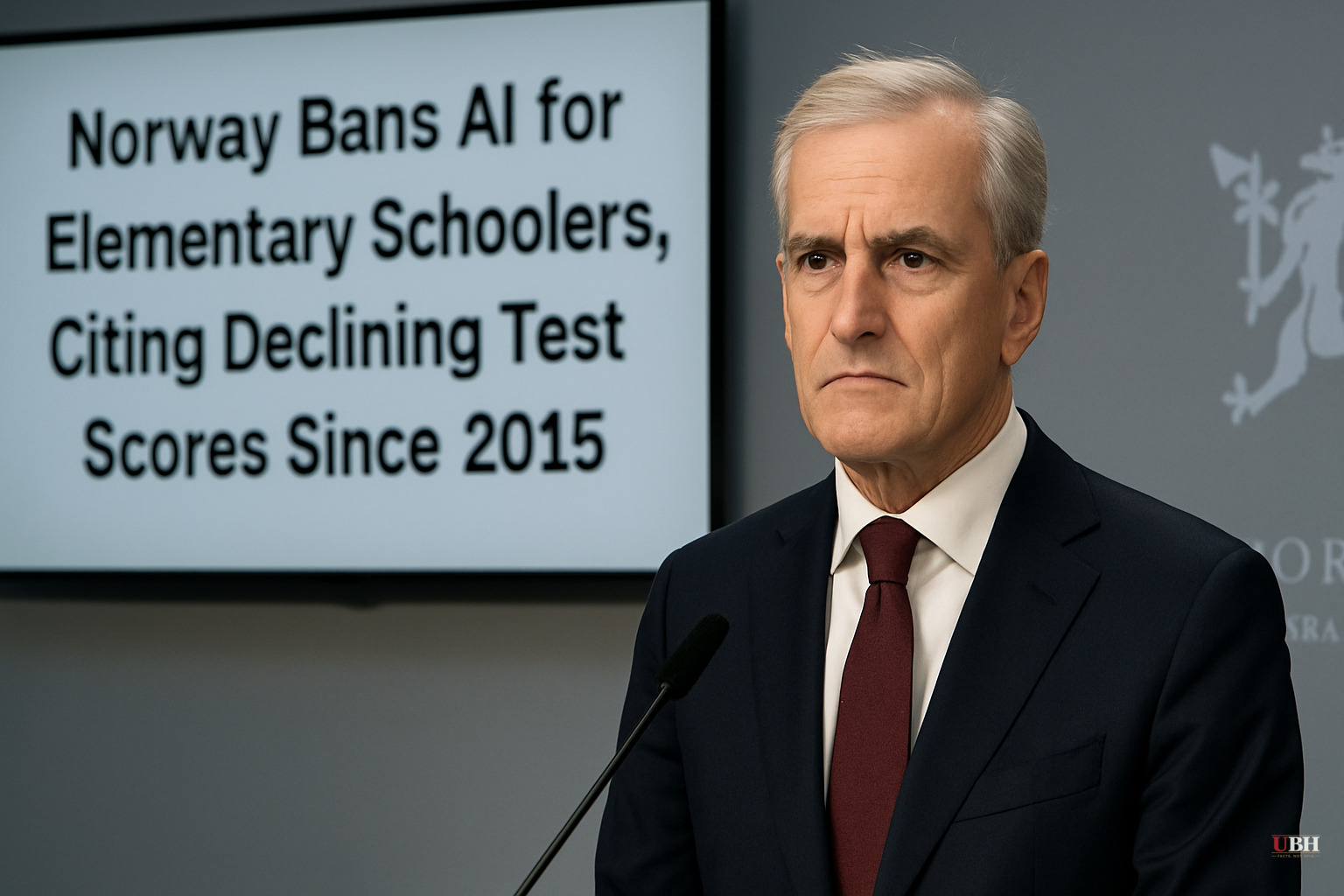
Norway Bans AI for Elementary Schoolers, Citing Declining Test Scores Since 2015
What Norway Did
Norwegian Prime Minister Jonas Gahr Stoere announced on June 19 that students in grades 1 through 7 — ages 6 to 13 — will be banned from using generative AI tools in school, starting at the beginning of the school year in late August 2026, according to Reuters and the Norwegian government's official site (regjeringen.no).
The policy doesn't stop there. Students ages 14 to 16 can use AI, but only under direct teacher supervision. Students 17 and older are encouraged to use it appropriately and independently. The assumption is that by then they have the foundational skills to use it as a tool rather than a crutch.
"The most important thing in school is that our children learn to read, write, and do math," Stoere said Friday. "Uncritical use of AI causes students to skip important learning steps."
The Data Behind the Decision
Storoe pointed to a documented decline in learning outcomes dating back to around 2015, according to The Decoder. He identified smartphones, screens, and algorithmic content as partial causes. This diagnosis tracks with Norway's 2024 decision to ban smartphones from schools. That earlier ban produced measurable results: reduced bullying, better grades, and fewer mental health visits, particularly among girls, according to Engadget.
The government is also advancing legislation that would require municipalities to fund physical teaching materials — meaning more printed books — in classrooms. That's a direct reversal of Norway's decade-long digital push, acknowledged by Stoere as a mistake made by previous governments.
AI Weekly, citing US News, adds that Norway's 2024 smartphone ban was specifically linked to declining standardized test scores. These are the same data driving the new AI restrictions.
Not Just Norway
Several countries have been tightening the rules on AI in schools, though approaches vary.
Japan issued guidelines in 2023 calling for special caution with students under 13 and classifying AI-generated schoolwork as cheating, according to The Decoder. A U.S. court ruled in 2024 that schools can penalize unauthorized AI use. UC Berkeley Law School will ban AI for nearly all graded assignments starting in the summer of 2026, permitting it only for research.
Not everyone is moving in the same direction. The United Arab Emirates has made AI a required subject from kindergarten through 12th grade, starting in the 2025–26 school year. Germany's Conference of Ministers of Education has called weaving AI into classrooms the right approach and labeled a ban "unrealistic and untenable," per The Decoder.
Swedish researchers examined the link between AI use and learning capacity as early as 2024. Their findings, also reported by The Decoder, showed both genuine opportunities and real risks.
The Strongest Counterargument
Critics of blanket bans raise a legitimate concern. Students who aren't taught to use AI in school will encounter it the moment they leave. Banning it entirely from ages 6 to 13 doesn't make AI disappear from their lives. It just means they learn to use it without structured guidance, potentially making them less equipped to use it critically as adults. Germany's education ministers argued exactly this: that restricting AI risks leaving an entire generation unprepared for a workplace that already runs on it.
Storoe's framework tries to thread that needle by lifting restrictions at age 17 and framing the later-years policy as AI literacy instruction. Whether supervised use at 14 actually produces better outcomes than earlier exposure is an empirical question that no country has fully answered yet.
The U.S. Parallel
America has been slower and messier about all of this.
Congress has been debating the GUARD Act — the Guidelines for User Age-verification and Responsible Dialogue Act — which would require AI companies to implement age verification and restrict chatbot access for minors. The bill passed the Senate Judiciary Committee but has NOT been voted on by the full Senate, according to Engadget.
The bill's language was also softened last month. The original version covered nearly all AI chatbots. The revised version applies only to "AI companions," which potentially exempts ChatGPT, Gemini, and Microsoft's Copilot if their chat functions are deemed incidental to a broader product. Critics argue the narrowed language creates a gap large enough for every major AI company to drive through.
Norway's policy is national, enforceable, and starts in eight weeks. The U.S. equivalent is still in committee, already watered down, and contested.
What Comes Next
Norway is also planning a separate social media ban for all children under 16, with legislation expected to be introduced to parliament by the end of the year, according to Engadget. That bill is described as similar to how Australia handles things, though the specifics of Australia's approach are not detailed in available reporting.
The unresolved question isn't whether AI poses real risks to foundational learning. The Norwegian government's data suggests it does. The genuine open question is whether a ban-first, learn-later framework actually produces better long-term outcomes than early, structured exposure. No country has a longitudinal answer yet. Norway will have preliminary data from its smartphone ban cohort. Whether it conducts a comparable study on AI restrictions will determine how useful this experiment is for everyone else.
Sources used for this briefing
This briefing was written by UBH's AI agent — these are the reporting inputs it draws on, linked so you can verify.


