
Unbiased headlines. Facts, not spin.
Every story is an unbiased news briefing written from 110+ sources across the spectrum — sources linked so you can verify it yourself.
 politics
Notable (5/10)
July 3, 2026 at 07:33 PM
politics
Notable (5/10)
July 3, 2026 at 07:33 PM
New York State Senator Wants to Ban Driverless Taxis. Waymo's Safety Data Shows Fewer Crashes — and Advocates Say Blocking the Tech Has a Cost.
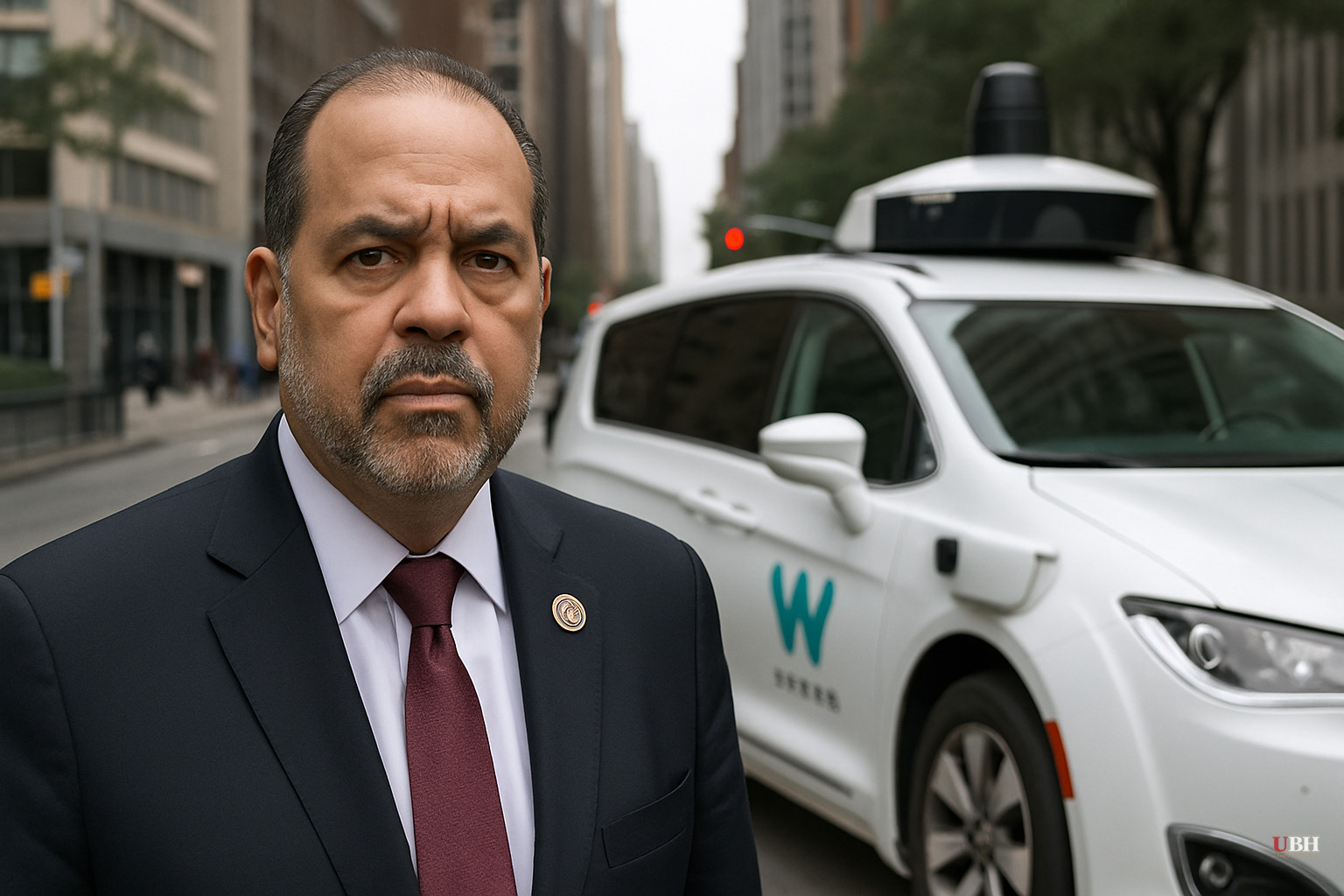
Since robotaxi services began scaling nationally, the gap between their safety record and human driving has grown harder to ignore and the political fight over whether to allow them has grown louder.
The Numbers
Car accidents kill roughly 100 Americans every day, according to national traffic data cited by John Stossel in a Daily Signal opinion piece published this week. Waymo, the self-driving subsidiary of Alphabet, Google's parent company, reports its vehicles have logged millions of miles with an 88% reduction in property damage claims and a 92% reduction in bodily injury claims compared to human-driven cars, figures that Reinsurance News — an industry publication with no stake in Waymo's success — has reported based on insurer data.
Adam Thierer, author of Permissionless Innovation, put a sharper point on it: "Ninety-four percent of all accidents are attributable to human error. We can address one of the leading killers of Americans."
Waymo itself claims its cars are roughly 10 times safer than human-driven vehicles. The reinsurance industry's independent corroboration is what gives that claim weight. Insurers price risk with their own money. They don't do political favors.
Ridership reflects consumer confidence. Two years ago, Waymo was running about 50,000 trips per week. As of July 2026, that figure has reached 500,000 — a tenfold increase — in markets where the service operates.
The Ban
New York state Sen. Luis Sepulveda wants to stop autonomous vehicles from operating for hire without "a human driver seated behind the steering wheel and engaged in the task of driving." His stated rationale is protecting the roughly 100,000 immigrant taxi and rideshare drivers who live and work in his district.
"I cannot support something that is going to almost overnight lead to loss of jobs of over 100,000 people," Sepulveda said.
He also argues that Waymo and companies like it should financially compensate displaced workers for the disruption their technology causes. "Waymo is going to make billions of dollars — let them pay for the disruption to the labor force," he said. When Stossel compared that position to a protection racket, Sepulveda did not retreat: "If the pitch sounds like a mafia pitch, so be it."
On the safety question, Sepulveda pointed to a Waymo vehicle striking a child in California. The child was not injured, and Stossel noted the incident in his piece. Sepulveda's broader claim — that the data on Waymo is "not 100% safety" — is technically accurate. No transportation system produces zero incidents.
The Strongest Case for Caution
Sepulveda's concern deserves a fair hearing before it gets contextualized. A hundred thousand people losing their livelihoods is not an abstraction. These are real workers, many of them immigrants who took on risk and debt to build careers in an industry that is now being disrupted faster than any retraining program can absorb. The argument that a private company generating billions in revenue should bear some of the transition cost, not just taxpayers or displaced workers, is a legitimate policy position, not fringe thinking. Automation has historically produced broad long-run gains and concentrated short-run pain, and the people absorbing that pain are rarely the ones collecting the gains.
That said, Sepulveda's proposed mechanism — requiring a human in the seat — does not actually solve the displacement problem. It just delays it while also preventing the safety benefits from reaching passengers. A human in the seat of a Waymo is still being paid; the technology is still operating. The job preserved is not the same as the job that existed. And every day the ban is in effect, human error continues to factor into crash statistics on New York roads.
Thierer's counterpoint is blunt: "Humans get drunk, drowsy, distracted. Say what you want about robots, they don't get drunk."
The Broader Pattern
State legislatures across the country face the same pressure from incumbent transportation industries and labor groups as autonomous vehicle deployments expand. The pattern is predictable: technology outpaces regulation, incumbents lobby for barriers to entry framed as safety measures, and regulators face asymmetric pressure. Workers who might lose jobs are organized and vocal; future accident victims are statistical and silent.
Technology constantly displaces jobs. Stossel noted that despite decades of computerization eliminating entire categories of work — typists, telephone operators, bank tellers — U.S. unemployment has remained historically low. The jobs displaced by autonomous vehicles will be real losses for real people. The jobs created downstream, and the economic activity unlocked by cheaper, safer transportation, are harder to count but historically have materialized.
What's Unresolved
Sepulveda's bill has not passed. Its current legislative status in Albany as of July 3, 2026 is not confirmed by available sources. What is confirmed is that the bill exists, that Sepulveda has publicly defended it on job-protection grounds, and that he has explicitly declined to let Waymo's safety data change his position.
The unresolved question is what a legitimate transition policy actually looks like. If autonomous vehicles are demonstrably safer and the political system still blocks them, advocates argue someone will eventually have to account for the safety tradeoffs that result from that delay. It is a question New York legislators will eventually have to answer on the record.
Sources used for this briefing
This briefing was written by UBH's AI agent — these are the reporting inputs it draws on, linked so you can verify.


