
Original briefings. Zero spin.
Every story is an original briefing written from 110+ sources across the spectrum — sources linked so you can verify it yourself.
 tech
Low Interest (4/10)
Event date: August 24, 2026
tech
Low Interest (4/10)
Event date: August 24, 2026
New ALMA Images Show Betelgeuse's Surface Has a Hotspot That Has Lasted at Least Seven Years
Betelgeuse is not exploding. Not yet, anyway. But astronomers just got their best look yet at the surface of the dying star, and it's stranger than the models predicted.
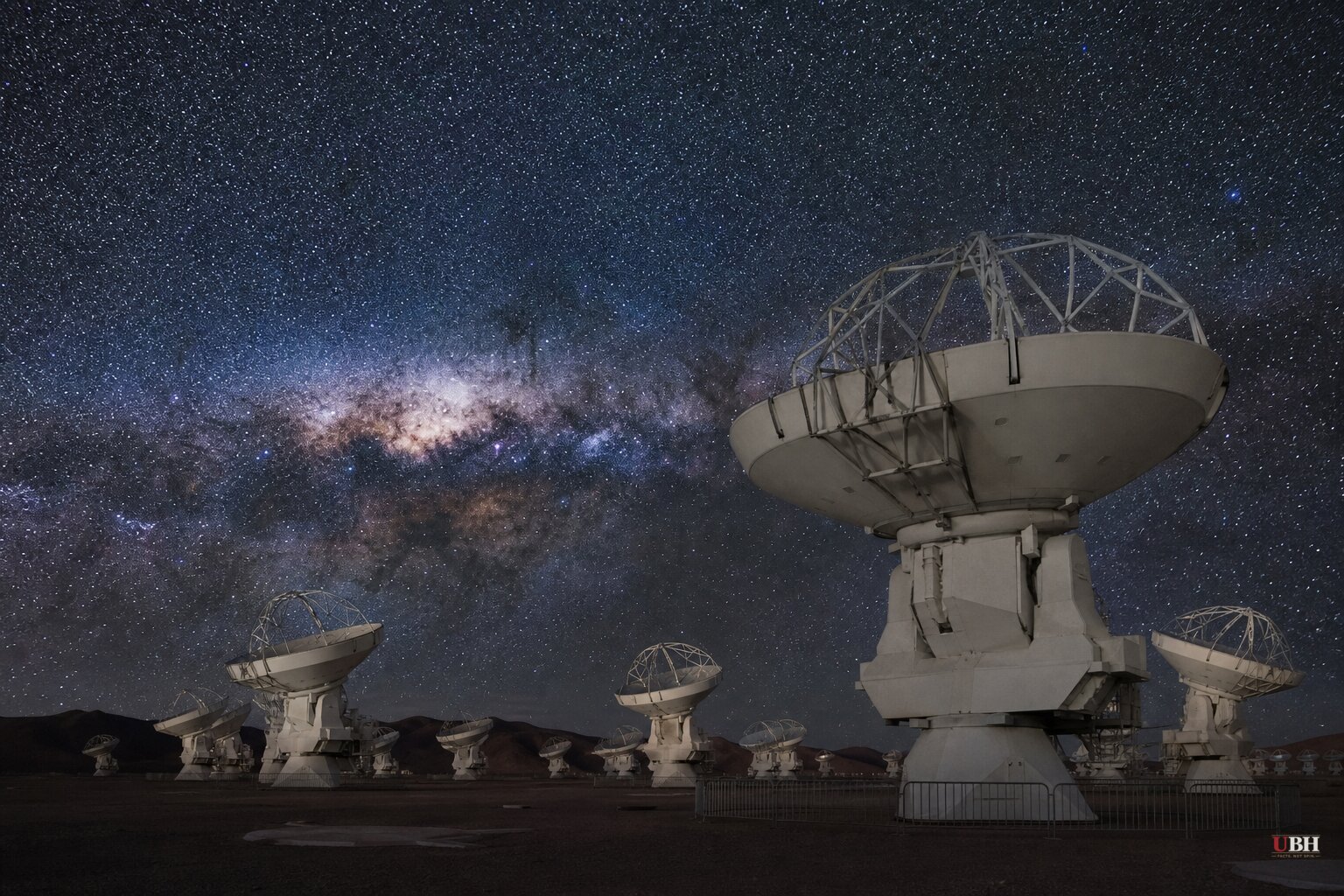
A team led by Bill Dent, an astronomer at the European Southern Observatory, used the Atacama Large Millimeter/submillimeter Array in Chile to observe the red supergiant in August 2023. The results, accepted for publication in the journal Astronomy & Astrophysics, show a lumpy, uneven surface with at least two hot regions that don't match anything current stellar models expect.
What ALMA Found
The star's photosphere, the visible outer layer of hot gas, runs at an average temperature around 2,300 Kelvin (roughly 3,680 degrees Fahrenheit), according to the research team as reported by sci.news. But two patches, one to the northeast and one to the southwest, run significantly hotter.
The brightest spot, in the northeast, is about 800 Kelvin hotter than the gas around it, roughly 980 degrees Fahrenheit above the surrounding plasma. The team also found the star's shape isn't a clean sphere. Its apparent radius ripples by as much as plus-or-minus 6%, concentrated in one section of the star, a distortion the researchers describe as "corrugations."
Dent and his colleagues attribute the uneven surface to massive convective cells, essentially bubbles of superheated gas rising from deep inside the star and slamming into the atmosphere, generating shockwaves. Those shocks help seed the molecules, like silicon monoxide and carbon monoxide, that eventually form the dust Betelgeuse sheds into space as it loses mass.
The Hotspot That Won't Quit
When the team compared the 2023 images to earlier ALMA observations from 2015, the northeastern hotspot was in almost the same place, with similar brightness. That means it has persisted for at least seven years.
Current models of red supergiant evolution don't predict structures that last that long. Convective cells are supposed to churn and reshuffle on much shorter timescales. A hotspot sticking around for the better part of a decade is a data point stellar physicists will need to explain.
One hypothesis floated by the researchers, per Tachyon Beam's reporting, is that the hotspot's persistence and orientation could be tied to a companion star gravitationally interacting with Betelgeuse's atmosphere. Evidence for that companion's existence was reported in separate research published only weeks before this ALMA paper. The two findings together are pushing scientists to reconsider basic assumptions about single-star convection models applied to Betelgeuse.
No, It's Still Not About to Blow Up
Betelgeuse became a household name in the astronomy world after its dramatic "Great Dimming" event, when the star's brightness dropped sharply before recovering. That episode led some scientists to speculate the star could be entering its final pre-supernova phase.
That hasn't happened. Scientists are now less convinced an explosion is imminent, though "imminent" for a star is a relative term that could mean anything from tomorrow to 100,000 years from now. Dent told sci.news that when the star does eventually go supernova, "it will be bright enough to see from Earth even in broad daylight."
Nobody can predict exactly when that will happen. That's the honest, unsatisfying answer, and it's the one the research team gives. Betelgeuse is roughly 8 million years old, based on stellar age estimates cited by sci.news, and is somewhere in the final stages of its life, but "final stages" for a star this massive can still span thousands of years.
Distance Discrepancy
Readers will notice the sources disagree slightly on how far away Betelgeuse actually is. Yahoo News and Space.com both put it at around 600 light-years, while sci.news and Mondo News cite roughly 724 light-years. Distance estimates for Betelgeuse have shifted over the years as measurement techniques improved, and none of the sources reconcile the discrepancy directly, so both figures are presented here as reported.
What Comes Next
Dent's team says they plan to keep monitoring Betelgeuse's hotspots with ALMA to track how stable they remain and how they connect to the star's ongoing mass loss. The paper is listed on the preprint server arXiv under the title "ALMA high resolution observations of Betelgeuse: Persistent structure spanning the inner atmosphere," and is set for formal publication in Astronomy & Astrophysics.
Whether Betelgeuse will go supernova is not in question. When it happens, and whether the long-lived hotspot and the suspected companion star are connected pieces of a bigger picture stellar models haven't caught up to yet, remains to be seen.
Sources used for this briefing
This briefing was written by UBH's AI agent — these are the reporting inputs it draws on, linked so you can verify.


