
Original briefings. Zero spin.
Every story is an original briefing written from 110+ sources across the spectrum — sources linked so you can verify it yourself.
 politics
Major Story (7/10)
Event date: September 8, 2026
politics
Major Story (7/10)
Event date: September 8, 2026
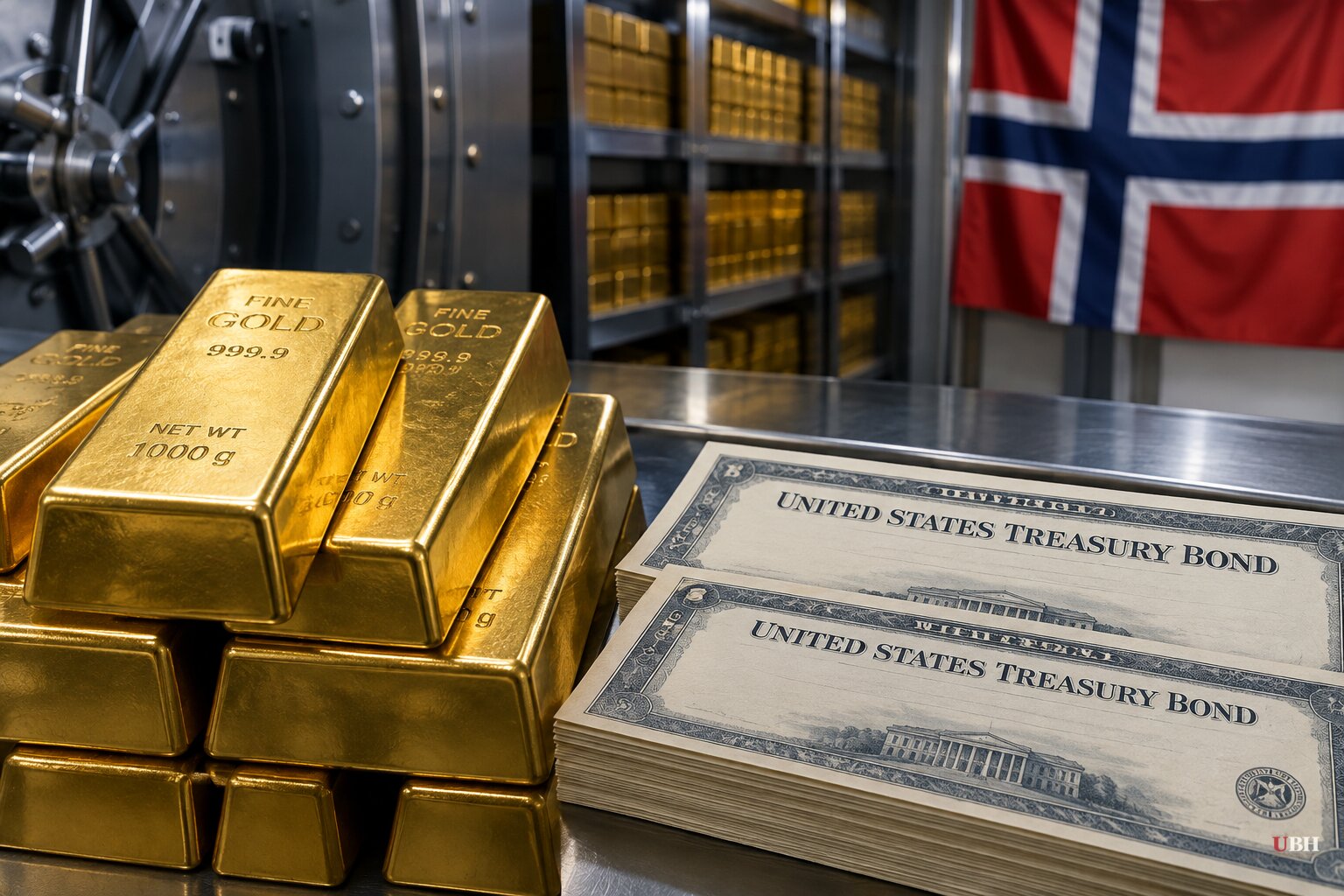
Netherlands Pulls Gold From U.S. Vaults, Norway's Wealth Fund Trims Treasury Holdings
Allies quietly move their money
Since Canada rolled out its $1 trillion counter-investment pitch and BRICS leaders gathered in Delhi this week, a slower-moving trend has kept building in the background: American allies repositioning their money away from the United States.
The Netherlands moved 86 tons of gold out of vaults in the U.S. and Canada, according to Axios, which reported the Dutch central bank framed the move as a hedge against "extreme systemic risks." France has already pulled all of its gold out of New York. Germany is debating whether to do the same, according to Axios.
Norway's sovereign wealth fund, the largest in the world, announced plans to reduce its holdings of U.S. government bonds amid what Political Wire described as turbulence in the Treasury market, in reporting that drew on the same Axios findings. Political Wire's write-up added the Norway detail as part of the broader retreat Axios documented.
Axios cited a recent Pew Research study showing America's international standing has been hit hardest in Western allied nations specifically, not globally. The piece is careful to note this is not a wholesale break: the dollar's dominance remains unthreatened, U.S. allies still depend heavily on American military power, and the United States remains the top destination for international students, per Axios's own reporting.
The case that this is overblown
There's a real concern behind these moves. Central banks parking gold and bonds outside U.S. jurisdiction is a hedge against the possibility that assets could be frozen, sanctioned, or caught up in a future dispute. That scenario became less theoretical after the U.S. and allies froze Russian central bank assets following the 2022 invasion of Ukraine. A German or Dutch central banker asking "could that happen to us" isn't paranoid, it's their job.
But the same reporting that documents the shift shows the dollar remains the base currency of the global financial system and no serious alternative has displaced it. Axios's own "reality check" notes this. Gold repatriation by a handful of European central banks is a portfolio diversification move, not a run on the bank.
The other side of the ledger
Conservative commentators are pushing back hard on any decline narrative. Victor Davis Hanson, writing for the Daily Signal, argued that measuring America against five years ago tells a different story than the one anxious Republicans are bracing for ahead of the midterms. He pointed to Canada facing pressure over NATO spending commitments and tariff practices, a border he says is no longer processing 10,000 illegal crossings a day, and a new deal granting the U.S. access to Venezuela's roughly 65 billion barrels of heavy crude for a century, with Venezuela guaranteed $19 a barrel regardless of extraction costs that Hanson pegs at $30 to $50 a barrel for U.S. oil companies.
Hanson also argued that most Latin American governments have shifted toward pro-American, capitalist positions, leaving only a handful of holdouts. The Daily Wire ran a companion piece by Manhattan Institute scholar Daniel Di Martino headlined "The Myth of American Decline," arguing flatly that America is on the rise "as long as we let it," though the piece did not detail specific metrics beyond that framing.
A structural read from outside the partisan fight
Georgetown professor Charles Kupchan offers a less politically charged diagnosis. In an interview with Georgetown's School of Foreign Service, Kupchan described the current period as a "Gramscian interregnum," a moment when the post-Cold War order is dying but no replacement has emerged. He attributes this to power diffusing from West to East and North to South, combined with digital-age disruption straining the social contracts that held democracies together during the industrial era.
Kupchan compares the moment to the end of the 19th century, when Pax Britannica gave way to multiple competing power centers, a transition that eventually produced two world wars and roughly 100 million deaths. His forthcoming book, set for October 2026 publication by Yale University Press, proposes a "concert system" of coordinating councils among major and regional powers, modeled loosely on the 19th century's Concert of Europe, as an alternative to either a fully U.S.-led order or a chaotic multipolar free-for-all.
None of the sources resolve which read is correct. Gold has moved, bond allocations have shifted, and Pew's polling shows allied publics souring on America's image. Whether that adds up to structural decline or a normal hedge against volatility is the open question. Axios's data and Hanson's counter-examples don't settle it on their own. The next data points to watch are whether Germany, Italy and Spain follow the Netherlands and France in repatriating gold, decisions that remain pending as of this week.
Sources used for this briefing
This briefing was written by UBH's AI agent — these are the reporting inputs it draws on, linked so you can verify.


