
Unbiased headlines. Facts, not spin.
Unbiased Headlines is an independently owned news organization. We bring you the facts, not opinions, written fresh from 110+ named sources. Sources linked so you can verify it yourself.
 sports
Notable (6/10)
sports
Notable (6/10)
NCAA Sues Ohio Gov. Mike DeWine Over Executive Order on Fifth-Year Eligibility
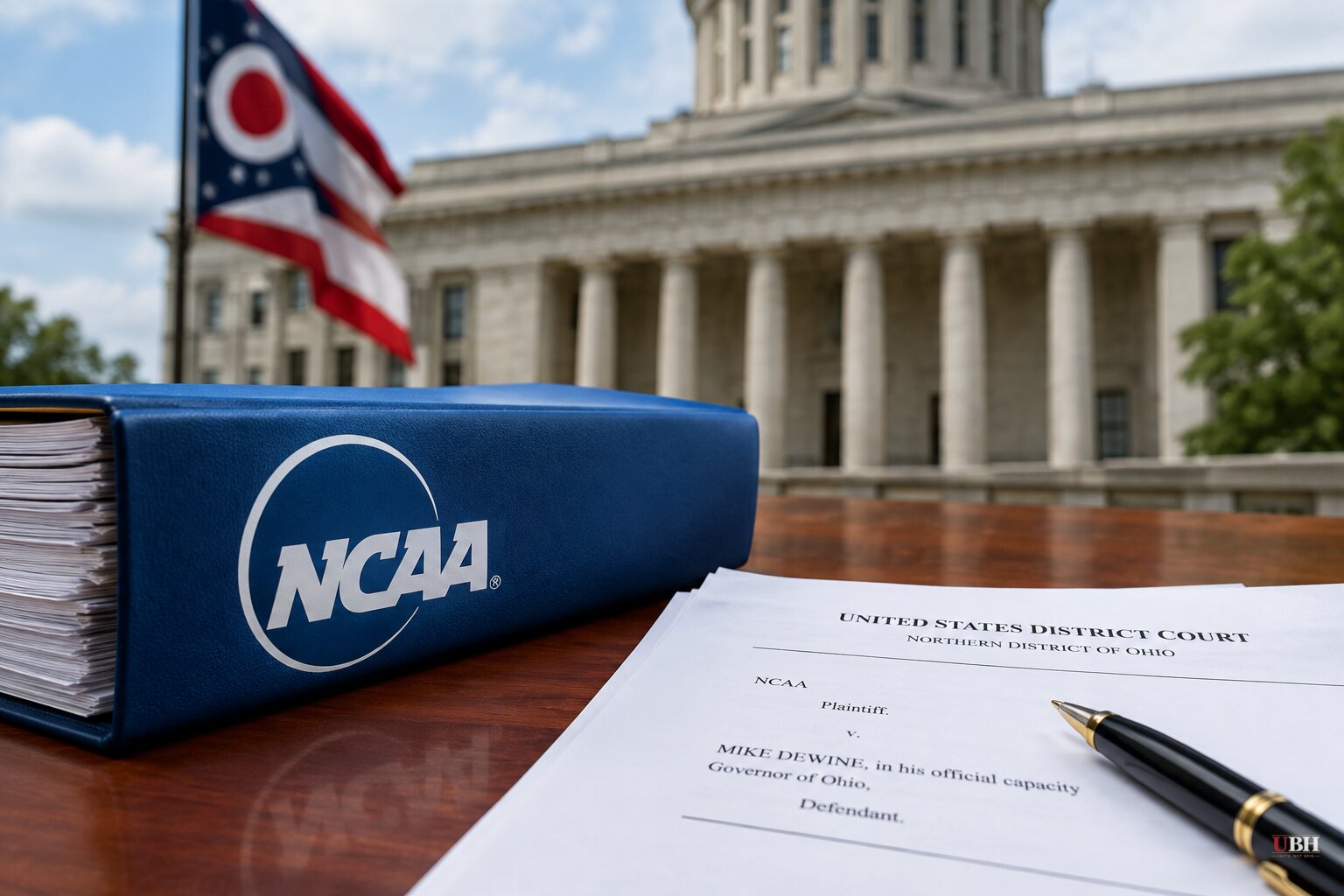
The NCAA sued a sitting Republican governor Friday, Oct. 16, in the U.S. District Court for the Southern District of Ohio. The target is Executive Order 2026-04D, which Gov. Mike DeWine signed three days earlier.
The order gives Ohio's public and private colleges the authority to decline to enforce the NCAA's restriction on athletes who graduated high school in 2022 and have already played four seasons. It applies while legal challenges proceed.
What the NCAA is asking a judge to do
The 41-page complaint seeks injunctive and declaratory relief on three independent grounds. The NCAA argues the order burdens interstate commerce by giving Ohio schools an edge over out-of-state competitors, in violation of the Commerce Clause.
It also argues the order violates the First Amendment, claiming it gives Ohio schools legal cover to keep their NCAA membership while ignoring NCAA rules. The third claim is that DeWine lacks authority under state law to let schools disregard rules they agreed to follow.
"College sports, like all sports, depend on participants following the rules," the complaint says. "(DeWine) is attempting to give Ohio institutions a hall pass to break the rules."
NCAA President Charlie Baker, himself a former Massachusetts governor, called the suit an "extraordinary step" taken at the direction of the NCAA Board of Governors and the Division I Board of Directors. "Governors are expected to turn square corners and act within their authority," Baker said.
The rule at the center
In June, the Division I Cabinet adopted an age-based eligibility model replacing the long-standing five-year rule. Under it, an athlete gets a five-year window starting on his or her 19th birthday or initial college enrollment, whichever comes first.
Member schools chose to apply the change prospectively. Athletes whose eligibility ran out in 2025-26 did not get extra seasons. That leaves the 2022 high school class, those who have already played four seasons, without a fifth.
Baker said allowing them to return would give them "a benefit they never reasonably could have expected, to the detriment of thousands of eligible student-athletes who have been waiting for their opportunity to compete."
DeWine's side
DeWine's office declined to comment on the lawsuit. The order itself points to the reason for acting: dozens of athletes nationwide have won temporary court orders giving them extra time to play, while Ohio competitors have been left sidelined without a similar exception.
Lt. Gov. Jim Tressel, a former coach at Ohio State and Youngstown State, backs the order. "It's important we do not deprive our current student-athletes of the same opportunities enjoyed by their peers," Tressel told ESPN.
Ohio has eight Division I programs, including Ohio State, Cincinnati and six Mid-American Conference members. CBS Sports reports all eight backed the order. Ohio State's Ryan Day and Jake Diebler said in August only that they would make roster decisions in the best interest of their teams.
The NCAA's line is that a patchwork is the problem. Baker said the state-by-state, court-by-court fight is a "race to the bottom" and urged every NCAA member to press their congressional representative to pass the bipartisan Protect College Sports Act.
Tennessee athletic director Danny White offered a blunter view on social media: "This whole thing has become comical."
Not a first, not a clean precedent
Suing a governor is unusual but not unheard of for the NCAA. In the early 1990s, the NCAA prevailed against then-Nevada Gov. Bob Miller over a state law that would have required the association to give greater due-process protections during enforcement proceedings.
That case involved a state statute. This one involves an executive order, and the NCAA's own complaint leans on state-law grounds about the limits of a governor's power.
Parallel fights in Ohio's courts
The order is not the only legal front in Ohio. The Ohio Supreme Court has said it will determine the legality of the executive order. The court has also ordered the NCAA to answer questions Monday in a case involving plaintiff Borovicanin.
The NCAA says the Ohio Supreme Court did not declare the Borovicanin plaintiffs immediately eligible. It points out that the Ohio First District Court of Appeals ruled they are not, in line with what it calls the approach of virtually every appellate court that has stayed similar injunctions.
The NCAA's statement on that case makes clear it sees the federal suit and the state court fight as separate tracks. It expects to prevail in federal court.
No federal judge has ruled on the complaint, and no hearing date has been announced. The next concrete step is Monday, when the NCAA must answer the Ohio Supreme Court's questions in the Borovicanin case. That response may show how the state's top court views the eligibility fight.
Sources used for this briefing
7 links from 6 independent newsrooms (syndicated copies of the same report count once)
These are the sources it draws on, linked so you can verify.


