
Unbiased headlines. Facts, not spin.
Unbiased Headlines is an independently owned news organization. We bring you the facts, not opinions, written fresh from 110+ named sources. Sources linked so you can verify it yourself.
 sports
Notable (5/10)
sports
Notable (5/10)
Nneka Ogwumike Says Prediction Market 'Vitriol' Makes Pro Sports Unsafe for Players as NBA and WNBA Launch Betting-Risk Campaign
Nneka Ogwumike, the former Los Angeles Sparks forward, 2016 WNBA MVP and 11-time All-Star, told the Fortune Most Powerful Women Summit in Santa Barbara on Tuesday, Oct. 13, that players are taking abuse driven by prediction markets.
"It's not a safe place for athletes," Ogwumike said. "Players are definitely having a hard time dealing with the vitriol that comes with prediction markets as it relates to our performance."
She added that there have been "a lot of safety issues and concerns that haven't necessarily been publicly displayed." The players association and the league offer resources to mitigate them, she said, but that "doesn't mean that it stops players from experiencing things that could potentially and have potentially affected their performance."
A fast-growing market
Kalshi and Polymarket are classified as financial exchanges rather than gambling operations. That classification lets them avoid many of the rules that govern traditional sportsbooks.
Last week the two platforms set records, according to Dune Analytics data, with a combined weekly volume of $22.2 billion, driven by NFL and NCAA trading.
What players describe
The incidents players have described involve people who bet on games. Not all of the accounts specify whether the wagers were placed on a prediction market or at a traditional sportsbook.
In July, Las Vegas Aces guard Chelsea Gray posted racist abuse she received on Instagram after a loss to the Indiana Fever. The sender's bio read "sports betting," according to Front Office Sports. The user was later fired by his employer.
Minnesota Lynx guard Courtney Williams made public a voicemail from someone upset about a bet on her after a July game against Phoenix. She answered it with a humorous voice note.
Natasha Cloud told Front Office Sports in July she had been told "they hope that our plane crashes on the way home." She said receiving hateful messages from angry bettors after games has become "normal." She also called on the NBA and WNBA commissioners to act.
The problem is not limited to the pros. The 2025 NCAA GOALS study found more than half of Division I men's basketball players reported social media abuse over their on-court performance. In the same study, 46% pointed to someone who had bet on a game they played as a source of negative or threatening messages.
The leagues' response
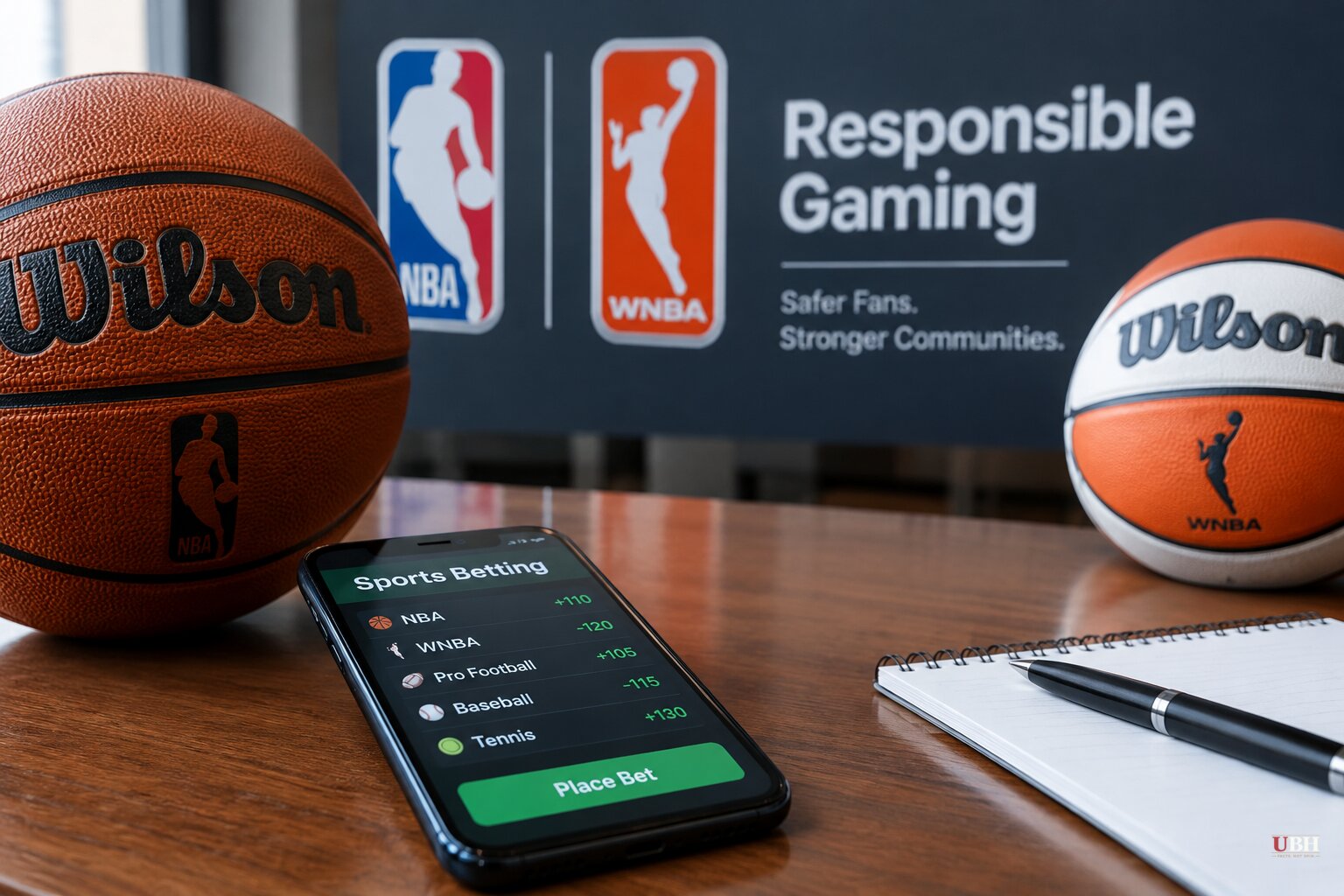
The same day Ogwumike spoke, the NBA and WNBA announced a responsible-gaming campaign with the National Council on Problem Gambling. It is due to begin during the 2026-27 NBA season, with spots on social and linear platforms run through league-owned channels and partners.
The message to fans is that knowing basketball does not protect their money, and that betting or trading on outcomes should be entertainment, not income. Fans are directed to ResponsiblePlay.org and the free, 24-hour National Problem Gambling Helpline at 1-800-MY-RESET.
Scott Kaufman-Ross, the NBA's head of media distribution and partnerships, said that as the ways people engage with sports evolve, fans need to understand the risks of putting money on outcomes.
The campaign targets young adults. An NCPG-commissioned Harris Poll of 2,072 U.S. adults, released in March, found 33% of those aged 21 to 44 had placed a sports bet before turning 21, versus 11% of those 55 and older. The poll found 30% see prediction markets as most similar to gambling, 24% to financial forecasting and 18% to investing.
The campaign as described is aimed at what fans risk with their own money. It says nothing about what happens to players after a bet goes bad.
Ogwumike's own caveats
Ogwumike did not call the markets purely a menace. "I don't think I ever want to say that something is outrightly bad unless it absolutely is," she said. She also said she understands "the business of things and being able to contribute to a growing league," and described the abuse as "growing pains."
The sources offer no data showing prediction-market users abuse athletes at a higher rate than sportsbook customers do. Ogwumike's claim rests on what players report to her.
Threats and racist abuse are the sender's responsibility, whatever platform he lost money on. The Gray case shows that identifiable harassers can face consequences, including losing a job.
Ogwumike said more must be done. The NBA and WNBA have not announced any measure aimed specifically at harassment of players by bettors. It is not yet clear whether the leagues' campaign, due to launch during the 2026-27 season, will be followed by one.
Sources used for this briefing
7 links from 6 independent newsrooms (syndicated copies of the same report count once)
These are the sources it draws on, linked so you can verify.


