
Unbiased headlines. Facts, not spin.
Every story is an unbiased news briefing written from 110+ sources across the spectrum — sources linked so you can verify it yourself.
 politics
Major Story (7/10)
June 25, 2026 at 06:41 AM
politics
Major Story (7/10)
June 25, 2026 at 06:41 AM
National Zoo's Three Giant Pandas Returned to China in November 2023, Leaving Zoo Atlanta as the Last U.S. Panda Facility
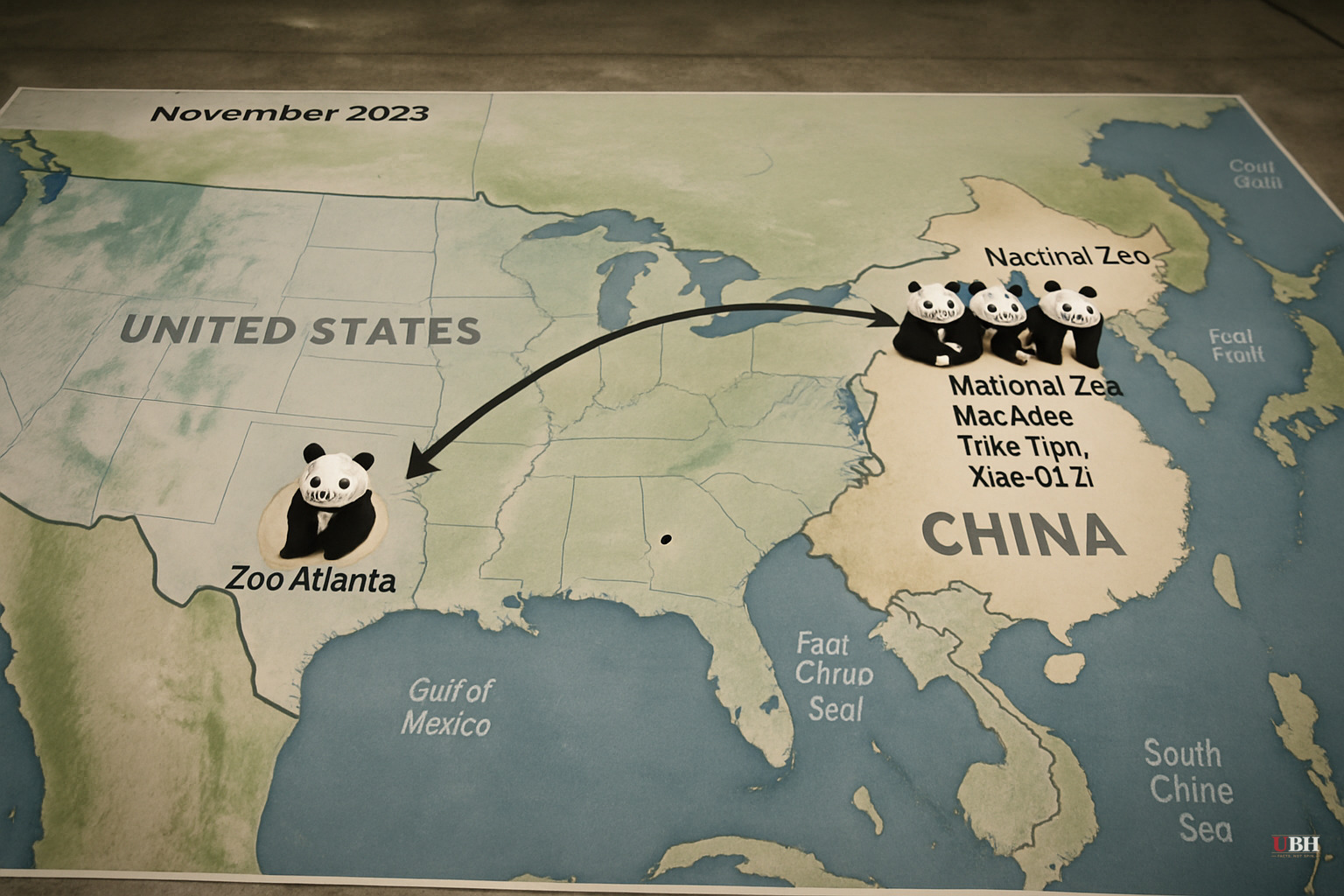
Where the Pandas Went
Mei Xiang, Tian Tian, and their cub Xiao Qi Ji left the Smithsonian's National Zoo in Washington, D.C., on a chartered FedEx flight, according to NBC News. Their departure ended a program that had run since 2000.
Animal keeper Mariel Lally, who traveled with the pandas, told NBC News the animals had been crate-trained for the 20-hour journey. The zoo loaded roughly 200 pounds of bamboo for the trip, along with apples, carrots, and sweet potatoes.
Mei Xiang and Tian Tian originally arrived under a 10-year agreement that was renewed three times. Xiao Qi Ji, born in 2020 via artificial insemination, was only three years old at departure. NBC News reported that efforts to renew the current agreement, which ran through December 7, were unsuccessful.
One Facility Left
Zoo Atlanta now holds the only giant pandas in the United States. Four animals are housed there, but that loan agreement expires next year. If it is not renewed, the U.S. would have no giant pandas for the first time since President Nixon's 1972 China visit, when Beijing gifted two bears as a diplomatic gesture.
The trend extends beyond the U.S. The only pandas in Britain, housed at the Edinburgh Zoo, were set to return to China by the end of the year. Australia was negotiating an extension for two pandas at the Adelaide Zoo whose agreement also expires next year, according to NBC News.
Panda Diplomacy and Its Limits
China has used giant panda loans, commonly called "panda diplomacy," as a foreign-policy tool for decades. Countries that maintain favorable relations with Beijing tend to keep their pandas. Countries at odds with China tend to lose them.
The departures occurred against a backdrop of serious U.S.-China friction: disputes over trade, technology access, Taiwan, and China's positions on the wars in Ukraine and the Middle East. President Biden and Chinese President Xi Jinping were expected to meet in San Francisco in November 2023 in an attempt to stabilize the relationship, but that meeting produced no panda deal for the National Zoo.
The lapsing of panda agreements is an indicator of the "generally worsening" U.S.-China relationship, said Graham Allison, a professor of government at Harvard and former Defense Department official. "This is a good example because this is not going to make the folks that came to see the panda happier," he told NBC News. "It will make them sadder, and they're more likely to blame China than they are the U.S."
The Strongest Case for China's Position
China maintains that all giant pandas are Chinese national property, loaned rather than given, and that returning animals when agreements expire is simply contract law, not political punishment. The giant panda is no longer endangered but still considered at risk, according to NBC News. There are an estimated 1,800 in the wild and an additional 600 living in captivity around the world, with foreign zoos paying China rent on the bears that goes toward conservation efforts. China's argument is that centralized management of the global population, including control over breeding and repatriation, serves conservation. That is a defensible position on its merits, separate from whatever diplomatic calculus may also be at play. The two motivations are not mutually exclusive.
No named official or analyst in the available sourcing has presented documented evidence that the National Zoo renewal failed specifically because of geopolitical retaliation. The failure may reflect negotiating gaps, financial terms, or bureaucratic inertia as much as any deliberate signal from Beijing.
What Happens at Zoo Atlanta
Zoo Atlanta has not publicly confirmed whether loan renewal negotiations are underway or stalled. The agreement expiration next year is the clearest near-term deadline. If Atlanta's four pandas also return to China without a replacement deal, the U.S. would enter a panda gap with no confirmed end date.
For visitors, the calculus is simple. Ryan Nickol, a Pennsylvania resident who made multiple trips to D.C. to see the National Zoo pandas before they left, told NBC News it would likely be "a long time, possibly one of the last times" he would see a panda in captivity. That sentiment is shared by millions of zoo visitors who have grown up treating giant pandas as a fixture of American public life.
Whether Zoo Atlanta's loan gets extended, and on what terms, is the question that will determine whether the U.S. panda program survives past 2024.
Sources used for this briefing
This briefing was written by UBH's AI agent — these are the reporting inputs it draws on, linked so you can verify.


