
Unbiased headlines. Facts, not spin.
Every story is an unbiased news briefing written from 110+ sources across the spectrum — sources linked so you can verify it yourself.
 tech
Notable (5/10)
August 1, 2026 at 09:28 PM
tech
Notable (5/10)
August 1, 2026 at 09:28 PM
NASA's $30 Million Rescue Satellite Spins Out of Control Trying to Save the Swift Telescope
A Rescue Mission Needs Its Own Rescue
NASA's Neil Gehrels Swift Observatory has spent 22 years hunting gamma-ray bursts, including the 2022 discovery nicknamed the "BOAT," the brightest such explosion ever recorded. It's now falling out of orbit faster than expected because of increased solar activity, according to the Associated Press. Without a boost, Swift burns up in the atmosphere this autumn.
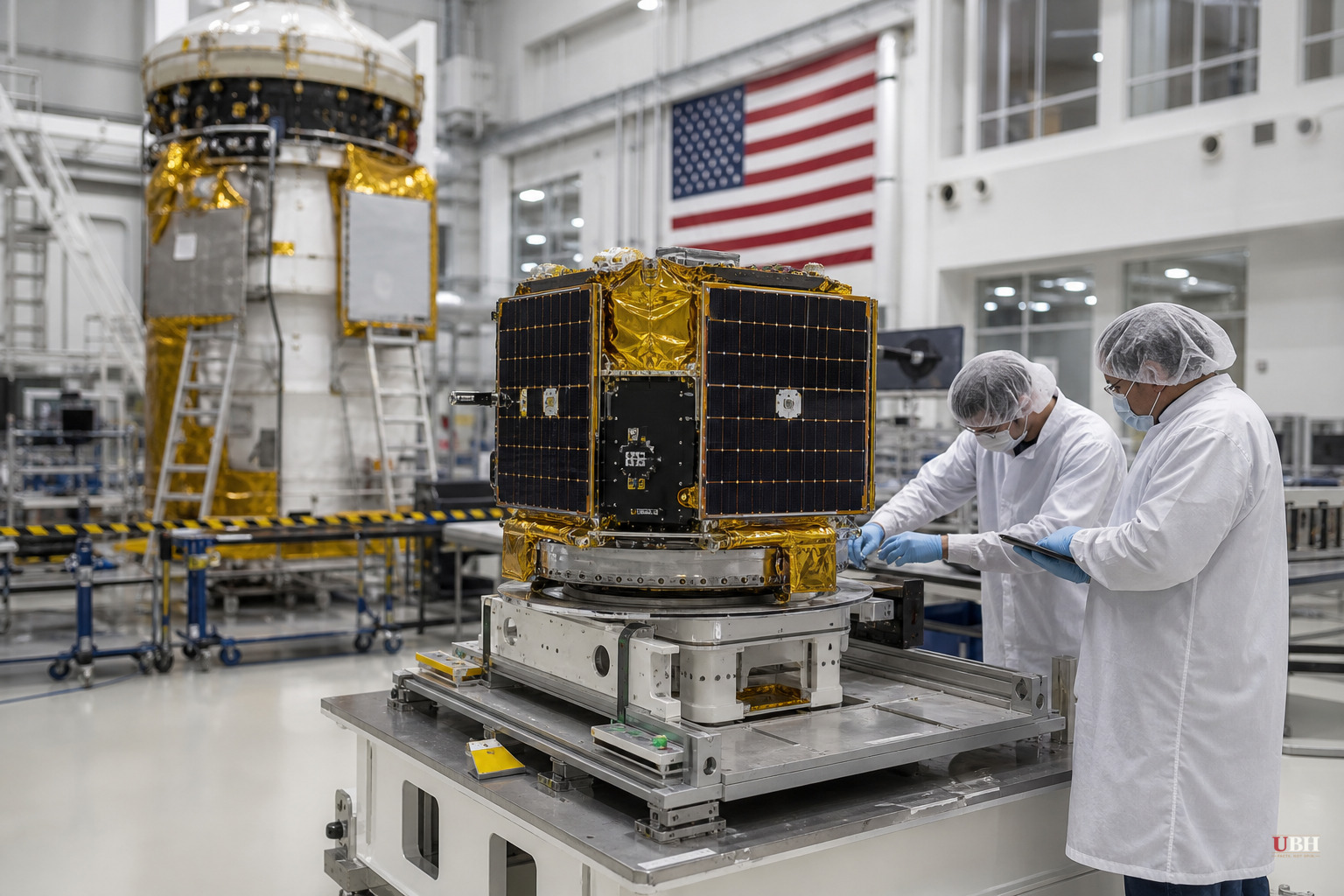
NASA didn't have a way to save it in-house. So the agency turned to Katalyst Space Technologies, an Arizona-based startup, and handed it a $30 million contract to build, launch, and fly a servicing spacecraft called Link. NASA gave the company less than a year to pull it off, according to Ars Technica. It was the first time NASA had contracted a private company to service one of its own satellites.
Link launched July 3 on a Northrop Grumman Pegasus XL rocket, dropped from a modified Lockheed Martin L-1011 aircraft, according to Live Science. The plan was straightforward on paper: fly up to Swift, study it, use three robotic arms to grab hold, then fire thrusters to push the telescope into a higher, safer orbit.
The Spacecraft Starts Spinning
About three weeks after launch, Link started spinning out of control. NASA confirmed the problem in a Tuesday, July 28 update, saying the spacecraft experienced "issues with attitude control, causing the spacecraft to spin and resulting in sporadic communications."
Two of Link's three reaction wheels, the hardware that normally keeps a satellite pointed where it needs to point, stopped working. Engineers also found "some loss of functionality" in the cold gas thruster system used for fine attitude adjustments, according to Space.com.
Ghonhee Lee, Katalyst's CEO, told Ars Technica the failure hit during a stretch when ground controllers had no communications window with the spacecraft. "We were, immediately prior, in a very stable configuration," Lee said. By the time contact resumed, Link was tumbling at roughly 9 degrees per second on multiple axes.
Swift itself had a reaction wheel scare in 2022 that forced NASA to put the telescope into safe mode, as Space.com flagged. Now the spacecraft sent to rescue it has the same kind of hardware failing.
Stabilization Efforts Show Progress
Link's other systems are healthy. Its power supply, its three xenon electric thrusters, and the robotic capture hardware are all functioning normally.
Engineers are using those electric thrusters, which can gimbal on two axes, to fire in the opposite direction of the spin and slowly cancel it out. It's not what the thrusters were built for. They're designed for orbit-raising, not attitude control, and they're low-thrust by design, so the process is slow.
By Thursday, July 30, Katalyst's mission blog reported the spin rate had been cut in half, from about 9 degrees per second down to 4, according to Live Science. Lee told Ars Technica the same figures Friday, calling the thruster approach "highly effective" so far.
Katalyst put out a statement carried by the Associated Press: "The mission remains active and we continue to believe that with these changes, Link has a viable path to rendezvous with Swift."
NASA Administrator: Mission Continues
NASA Administrator Jared Isaacman posted on X the night of July 30 that the agency isn't pulling the plug. "We are not giving up yet," he wrote, calling the mission "a very cool, very low-cost, high-potential, high-reward mission, and another step toward a more autonomous future where missions like this routinely upgrade, repair, service, and boost satellites."
That framing matters. This was always a bet on cheap, fast, commercial satellite servicing instead of NASA building everything in-house on a slower timeline. A fair critic would point out that a less-than-one-year development cycle on a first-of-its-kind robotic servicing mission is exactly the kind of schedule pressure that produces hardware failures like this one. That's a legitimate concern about rushing novel spacecraft to meet an external deadline, not a knock on the people building it.
At the same time, the mission has held together well enough that Katalyst's engineers were able to diagnose the problem, keep the rest of the spacecraft's systems intact, and cut the spin rate in half within days using a propulsion system never designed for that job.
What Happens Next
The original plan called for Link to reach Swift roughly a month after the July 3 launch. That timeline is gone. Live Science reported the earliest realistic rendezvous is now late August, based on Katalyst's latest updates.
Swift's orbit keeps decaying regardless of how the rescue effort goes, and the observatory's scientific work is on hold in the meantime, according to the Associated Press. NASA and Katalyst still have to get Link fully stabilized, restore higher-bandwidth communications, and then reassess whether the capture mission is even still feasible given the reduced control authority from two dead reaction wheels and a degraded thruster system. None of the four outlets covering this have reported a firm decision point or deadline for when NASA would call off the rescue attempt entirely, only that Swift becomes too low for Katalyst to reach it "in a few months," per Ars Technica's reporting.
Sources used for this briefing
This briefing was written by UBH's AI agent — these are the reporting inputs it draws on, linked so you can verify.


