
Unbiased headlines. Facts, not spin.
Unbiased Headlines is an independently owned news organization. We bring you the facts, not opinions, written fresh from 110+ named sources. Sources linked so you can verify it yourself.
 tech
Notable (5/10)
Event date: October 31, 2026 ·
NASA Asks Private Companies to Propose Hubble Reboost or Disposal Missions, With No Funding Committed
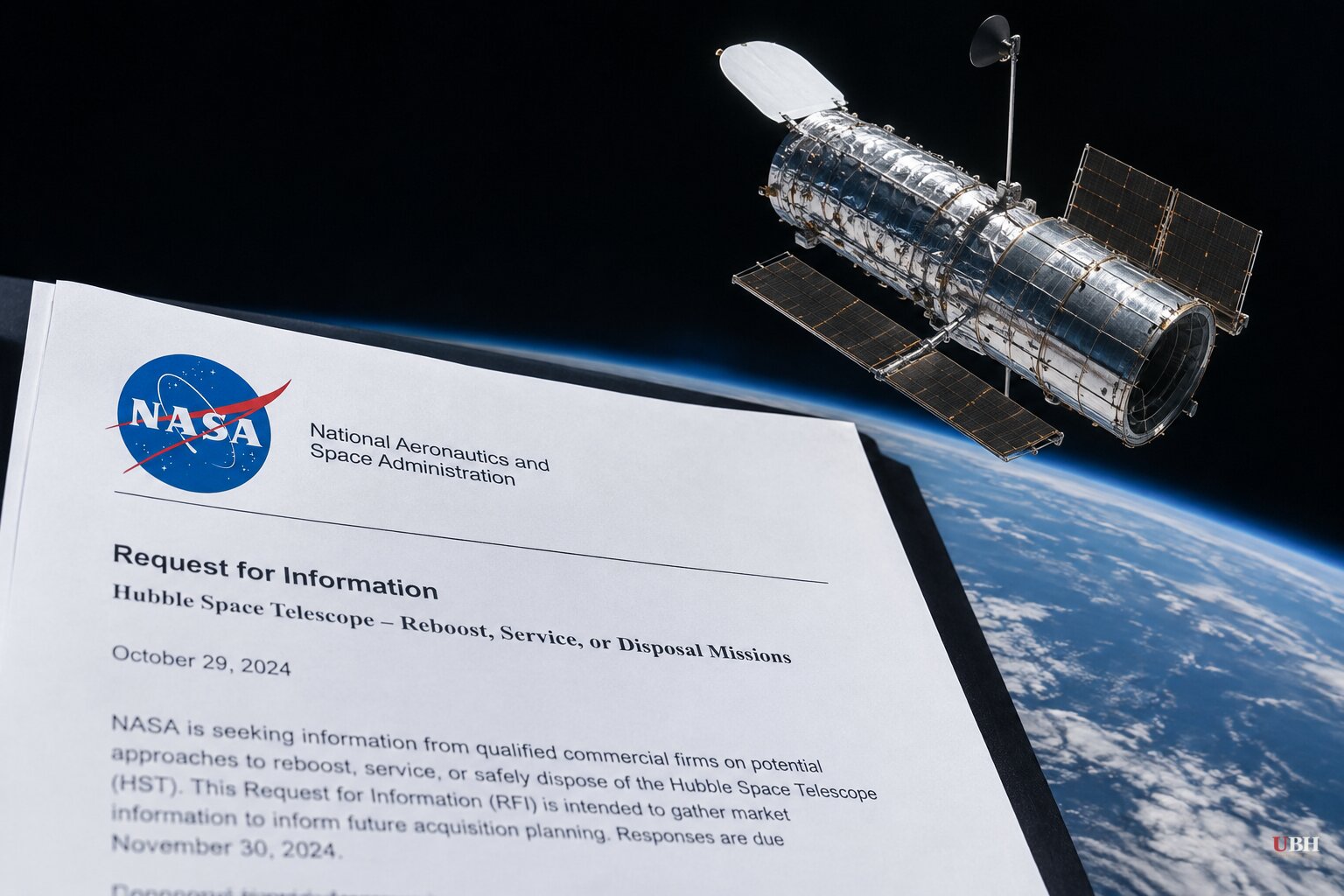
NASA put the Hubble Space Telescope out to industry on Thursday, Oct. 29, with a Request for Information asking private companies what they could do to keep it in orbit or take it down safely. Responses are due by 3 p.m. EST on Monday, Nov. 30.
The notice is exploratory. It is not a contract award, and the agency has not committed funds to buy a rescue flight.
What NASA is asking for
The RFI covers three scenarios: a mission to boost Hubble to a higher altitude and extend its science life, a servicing mission to upgrade its capabilities, or a controlled reentry or orbital disposal at the end of its mission.
A boost would have to lift the telescope to at least 600 kilometers (373 miles). A boost to that altitude would likely keep it aloft another 25 years or so. Any boost or servicing mission must leave the observatory undamaged.
The contractor would supply the launch vehicle, the servicing spacecraft and flight operations, plus crew if applicable. Goddard Space Flight Center in Greenbelt, Maryland, would share technical data and coordinate rendezvous and capture.
The clock
Hubble has no propulsion. Atmospheric drag has been dragging it down since Space Shuttle Columbia last raised its orbit in 2002. The final shuttle visit, STS-125 in May 2009, did not perform a reboost, and the fleet retired two years later.
The telescope has slid from roughly 583 km (362 miles) to about 470 km (292 miles).
NASA's analysis puts reentry in the 2033 to 2034 window, so the agency says a mission would need to happen by 2032. Lifetime analyses run in July 2026 give a 10 percent chance of reentry by September 2032 and 50 percent by December 2033. Solar activity can shift those numbers either way.
Other analysts are less patient. Tech Times reported that Harvard-Smithsonian astronomer Jonathan McDowell has found reentry as early as 2028 is possible without a reboost. It also reported that the Space Telescope Science Institute's median forecast is mid-2033, with under a 10 percent chance of reentry before 2030. Tech Times further reported that the casualty risk from an uncontrolled reentry of the roughly 13-metric-ton telescope is about 30 times NASA's public safety standard. NASA's own announcement does not cite that figure.
Isaacman's second try
NASA Administrator Jared Isaacman said in the announcement: "Hubble still has important science ahead of it, and we should be looking at every reasonable opportunity to keep it delivering for as long as possible." He added: "If there are innovative and cost-effective ways to extend the life of an asset already on orbit, we owe it to the American taxpayer and the scientific community to explore them."
Nicky Fox, associate administrator of NASA's Science Mission Directorate, said commercial industry has "rapidly evolved in recent years to offer new capabilities for in-space satellite capture and servicing." She said NASA wants to explore boosting Hubble "while we develop the flagship mission to follow."
This is not the first run at the idea. In 2022, Isaacman, then a private astronaut, proposed a largely self-funded Crew Dragon mission to raise Hubble's orbit. NASA ran a similar RFI that drew eight responses, including a robotic proposal from Astroscale and Momentus. In 2024 the agency walked away, with its then astrophysics chief calling the plans "really just notional concepts."
Isaacman has acknowledged the history on X. "There was a far lower-cost solution on the table a few years ago that NASA SMD and STScI endorsed, but that was then," he wrote, adding that the effort is still warranted because Hubble deserves it.
That post is the sharpest counterpoint on the record. The cheaper private-funded option was available and was turned down. What a government-funded version would cost remains to be seen.
What has changed
Two things are different. Isaacman now runs the agency, and the servicing industry has matured. According to Hardware Busters, Northrop Grumman launched an advanced robotic servicing satellite with DARPA this year, and Astroscale and Starfish Space hold servicing and refueling demonstration contracts.
The same report describes a closer test case. NASA gave Katalyst Space Technologies $30 million and nine months to build a spacecraft to grab the Swift observatory and lift it. Katalyst launched on time and got within about 10 km of Swift before power and thruster problems ended the approach.
A crewed rescue now looks unlikely. SpaceX plans to retire Crew Dragon by 2030, and Isaacman has said on X that he expects robotics companies to respond.
Why NASA is bothering
Hubble remains heavily used. NASA reports that proposals for observing time exceed available capacity by 7 to 1. The James Webb Space Telescope and the Nancy Grace Roman Space Telescope are not presented as full replacements for everything Hubble does, and no direct successor is expected before the 2040s.
NASA also has to plan a disposal regardless. Whether a company wins a boost contract or not, an uncontrolled fall of a telescope that size is the outcome the agency is trying to avoid.
What comes next
Companies have until Nov. 30 to say what they can do and roughly what it would cost. NASA has not said when it would decide whether to proceed, or whether Congress would be asked for money. With a 2032 deadline and the Katalyst-Swift attempt falling short of capture, the price quotes that arrive after Nov. 30 will show whether a rescue is affordable in time.
Sources used for this briefing
7 links from 7 independent newsrooms (syndicated copies of the same report count once)
These are the sources it draws on, linked so you can verify.


