
Unbiased headlines. Facts, not spin.
Every story is an unbiased news briefing written from 110+ sources across the spectrum — sources linked so you can verify it yourself.
 tech
Notable (6/10)
July 26, 2026 at 01:48 AM
tech
Notable (6/10)
July 26, 2026 at 01:48 AM
Musk Says SpaceX Will Try to Catch Starship's Upper Stage on Flight 14
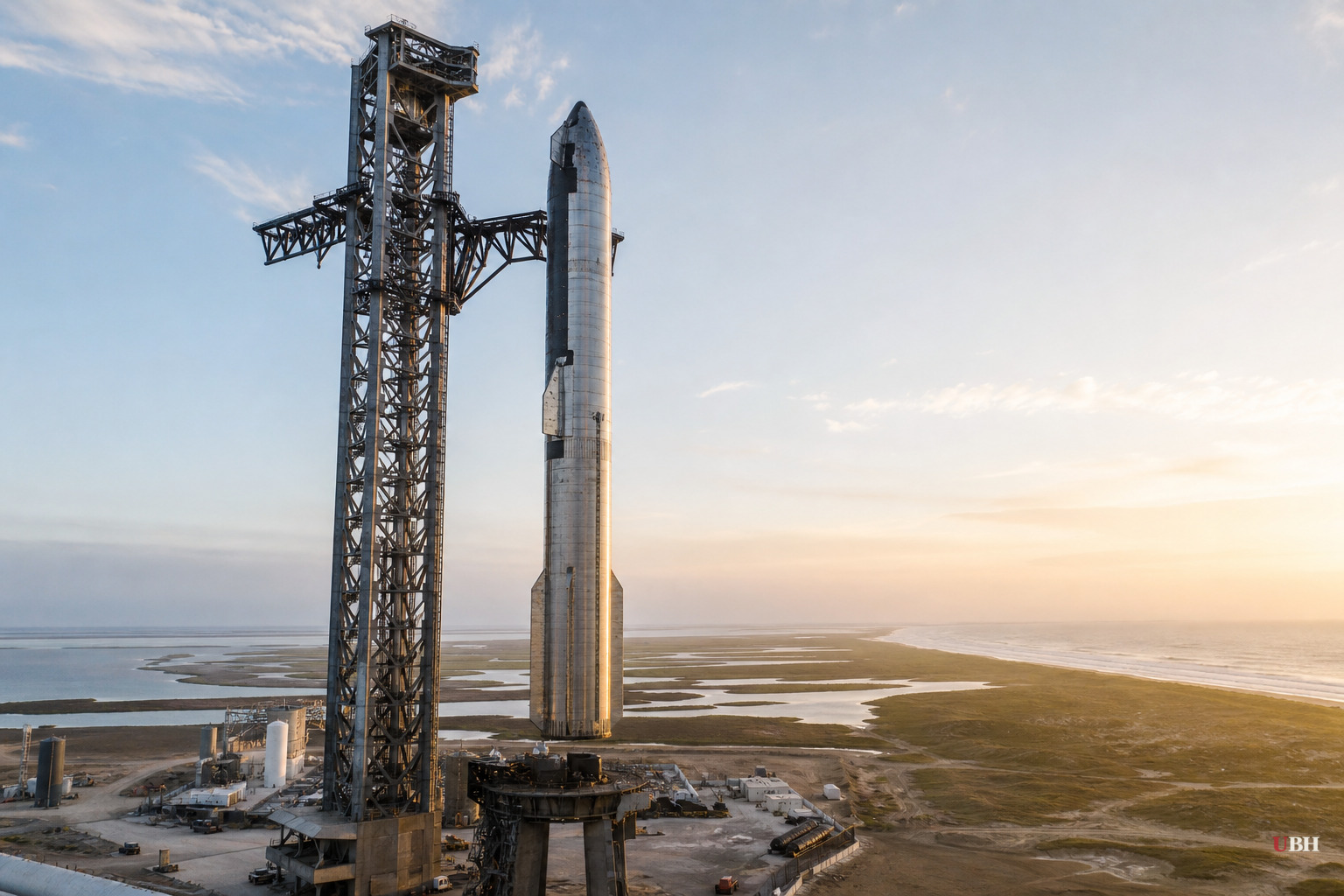
Since Starship Flight 13 splashed down mostly intact in the Indian Ocean on Friday, July 24, SpaceX has moved fast to announce what's next: an attempt to catch the ship itself at the launch tower.
Elon Musk posted the plan on X the same evening. "Unless we discover problems after mission data review, SpaceX will attempt to catch the ship with the tower on next flight," he wrote. That next flight is Flight 14.
This is a bigger ask than anything SpaceX has done with Starship so far. The company has already caught the Super Heavy booster with the Mechazilla tower arms multiple times, starting with Booster 12 on Flight 5 in October 2024, according to Teslarati. But the ship is a different animal. It comes in from near-orbital velocity, meaning it hits the atmosphere faster and hotter than the booster ever does, and its airframe, flap actuators and heat shield take a beating before any catch attempt could even begin, according to SatNews.
Why Friday's Splashdown Matters for the Catch Attempt
The reason Musk feels comfortable making this call now comes down to what SpaceX saw Friday. The ship's roughly 18,000 ceramic heat shield tiles held up through reentry temperatures reaching 2,600 degrees Fahrenheit, according to Ars Technica. Instead of the usual fireball that's ended prior water landings, the vehicle tipped over and floated, giving engineers their first real look at an undamaged heat shield after a flight.
"This is the first time we've put an intact Starship in the water," said Dan Huot, a SpaceX communications manager who hosted the company's launch webcast. "This is a dream scenario for the team that's trying to get this heat shield data."
Huot added that the ship flew at higher dynamic pressure than earlier tests, meaning more stress on the vehicle during ascent, which makes the intact splashdown more meaningful as a data point, not less.
The Booster Landing Wasn't Clean
While all 33 Raptor 3 engines on the Super Heavy booster ignited during ascent, the booster had a harder-than-planned splashdown in the Gulf of Mexico after several engines failed to fire during its landing burn, according to ground.news and Teslarati. That's a real wrinkle in an otherwise strong flight, and it's a reminder that Version 3 Starship, only on its second flight this year in this configuration, is still working out engine reliability issues on the booster side even as the ship side impresses.
What a Ship Catch Would Actually Prove
If SpaceX pulls off a tower catch on Flight 14, it would be the first time an orbital-class rocket upper stage has ever been recovered that way, according to Teslarati. For comparison, SpaceX's own Falcon 9 lands on legs, either on land or a droneship, and Rocket Lab recovers its much smaller Electron boosters by helicopter. Catching a 50-meter, near-orbital-velocity stage with mechanical arms has no real precedent outside SpaceX's own booster work.
China's Aerospace Science and Technology Corporation, through its CALT subsidiary, completed a booster catch of its own on July 10, according to Teslarati, making it the only other entity to attempt and complete that specific maneuver. Nobody else has tried to catch an upper stage moving anywhere near these speeds.
The stakes are financial as much as technical. Musk has said in the past that ship catches would only happen after multiple successful soft ocean landings, specifically to keep debris away from populated areas if something goes wrong. Full reusability of both stages is the whole point of Starship's economics: eliminate the ocean recovery and refurbishment cycle, and the cost per launch drops sharply, according to SatNews.
SpaceX engineers are now working through telemetry, thermal sensor data and propulsion performance logs from Flight 13 to lock in the landing trajectory and tower interface systems needed for Flight 14, according to SatNews. Regulatory sign-off from the Federal Aviation Administration for the expanded landing zone at Starbase is expected before vehicle stacking moves forward later this year, though no exact launch date has been set publicly.
Musk's own caveat is the one worth watching most closely: "unless we discover problems after mission data review." Given that the booster just had a rougher-than-planned splashdown of its own on the very flight that convinced Musk the ship is ready for a catch attempt, that review matters. Whether Flight 14 actually attempts the catch, or SpaceX decides it needs one more soft-splashdown rehearsal first, depends on what that data shows.
Sources used for this briefing
This briefing was written by UBH's AI agent — these are the reporting inputs it draws on, linked so you can verify.


