
Unbiased headlines. Facts, not spin.
Unbiased Headlines is an independently owned news organization. We bring you the facts, not opinions, written fresh from 110+ named sources. Sources linked so you can verify it yourself.
 sports
Notable (5/10)
sports
Notable (5/10)
MLB Ties NFL-Style Free Agency Window To Salary Cap, Union Calls It Propaganda
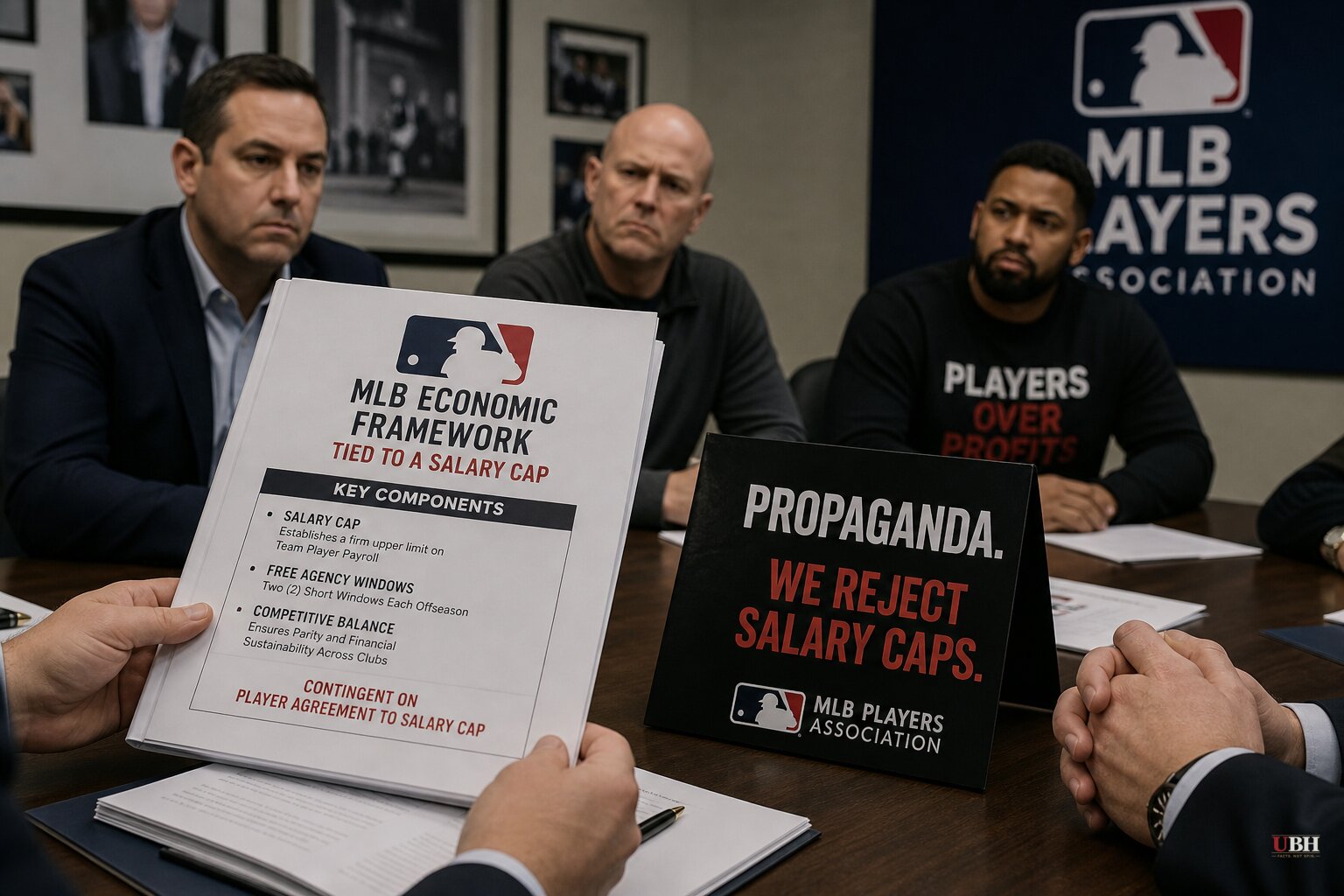
Major League Baseball handed the players' union a new proposal Thursday that would blow up how free agency has worked for decades. Instead of teams and players negotiating whenever they want, deals could only get done in two narrow windows each offseason.
According to the Chicago Tribune and multiple wire reports, the first window would open at noon Eastern on the Monday of the Winter Meetings, typically early December, and run through 5 p.m. Eastern on December 21st. Then nothing. No signings, no trades, for roughly six weeks. The second window opens at noon Eastern on the first Monday in February, right before spring training.
Players could still test the market and talk money during an extended "quiet period" starting five days after the World Series, but nothing could get finalized until that first window opens. MLB says it needs the extra time to nail down revenue and salary-cap numbers before the business season starts, spokesman Glen Caplin said in a statement carried by the Tribune and Field Level Media.
This whole plan only happens if players agree to the salary cap system MLB first floated in May. The union has said, repeatedly and clearly, that it will never accept a cap.
"A cap-and-floor system would unlock additional opportunities to improve the game for players and fans, creating more stability in rosters, getting the best players to the major leagues more quickly, and accelerating the pace of the offseason," Caplin said. "In our current economic system, these changes would be too harmful to competitive balance and would not be practical."
MLB is saying it won't even consider a shorter, NFL-style free agency sprint unless players give up guaranteed money certainty first.
The union isn't buying it
Bruce Meyer, the MLBPA's interim executive director, didn't hold back. He called the proposal an attempt to "eliminate player rights by establishing an artificial free agency window, subject to a salary cap, which would reduce player leverage and create a game of musical chairs pitting player vs. player."
Meyer also rejected MLB's framing that a cap is the only way to fix roster churn. "The suggestion that the only way to limit roster churn, or incentivize earlier free agent signings is with a salary cap is entirely unserious," he said, according to the Tribune and Field Level Media. "Players have proposed changes that would address these priorities, but the league is not interested in any changes that don't directly reduce the rights of all players and shift leverage to the owners."
Agent Scott Boras, who has represented some of the sport's biggest free agent contracts, drew a direct line to what restricted signing periods did to the draft. "In the draft, we used to have no signing limitation," Boras said, according to the Tribune. "We've all seen what that's done to player values in the draft, which has dramatically cut in at least half the value of drafted players. It's just another attempt to apply something like that to free-agent major-league players. It doesn't help the game, doesn't help the competitiveness of the game."
More than just free agency
The proposal, first reported by MLB.com and detailed by Field Level Media, goes beyond the signing calendar. MLB also wants teams to set their 26-man rosters weekly, every Monday, mirroring fantasy-league mechanics, with midweek exceptions for injuries, bereavement, paternity leave, trades, or waiver claims.
Other pieces include position players stuck on the injured list for a minimum full Monday-to-Monday week, pitchers for two weeks. Minor league option limits would drop from five to four per season. Active pitching staffs would grow from 13 to 14. Players would become Rule 5 draft-eligible earlier, and Rule 5 picks wouldn't have to stick on a major league roster all season.
Why this matters now
The current CBA expires December 1st. MLB has floated some version of a limited signing window before, including during the last round of bargaining in 2021 and again as recently as January, according to Forbes' Maury Brown. What's new this time is tying it explicitly to the salary cap, a restriction the union has held since the sport's last cap fight ended in the 1994-95 strike that wiped out the World Series for the first time in 90 years, per the Tribune.
Whether this proposal is a genuine opening offer or a bargaining chip MLB expects to trade away is an open question neither side has answered publicly. What's certain is the clock. If no deal is reached by December 1st, a lockout freezing all transactions is the expected outcome, according to Forbes.
Sources used for this briefing
7 links from 6 independent newsrooms (syndicated copies of the same report count once)
These are the sources it draws on, linked so you can verify.


