
Unbiased headlines. Facts, not spin.
Unbiased Headlines is an independently owned news organization. We bring you the facts, not opinions, written fresh from 110+ named sources. Sources linked so you can verify it yourself.
 defense
Sponsored
Major Story (8/10)
Military Hardware Is Going Commercial. The Software Layer Is Where Systems Now Differ
On Oct. 8, 2026, Kratos Defense & Security Solutions announced a satellite communications demonstration in which the main change was not new hardware. The company's OpenSpace platform turned radio-frequency signal processing into software running on commercial off-the-shelf (COTS) servers, replacing the proprietary hardware modems that satellite teleport sites have traditionally used. A week later, on Oct. 15, 2026, Shift5 announced a five-year, $99 million Army contract for a platform that collects operational data from military weapon systems "regardless of asset type or protocol."
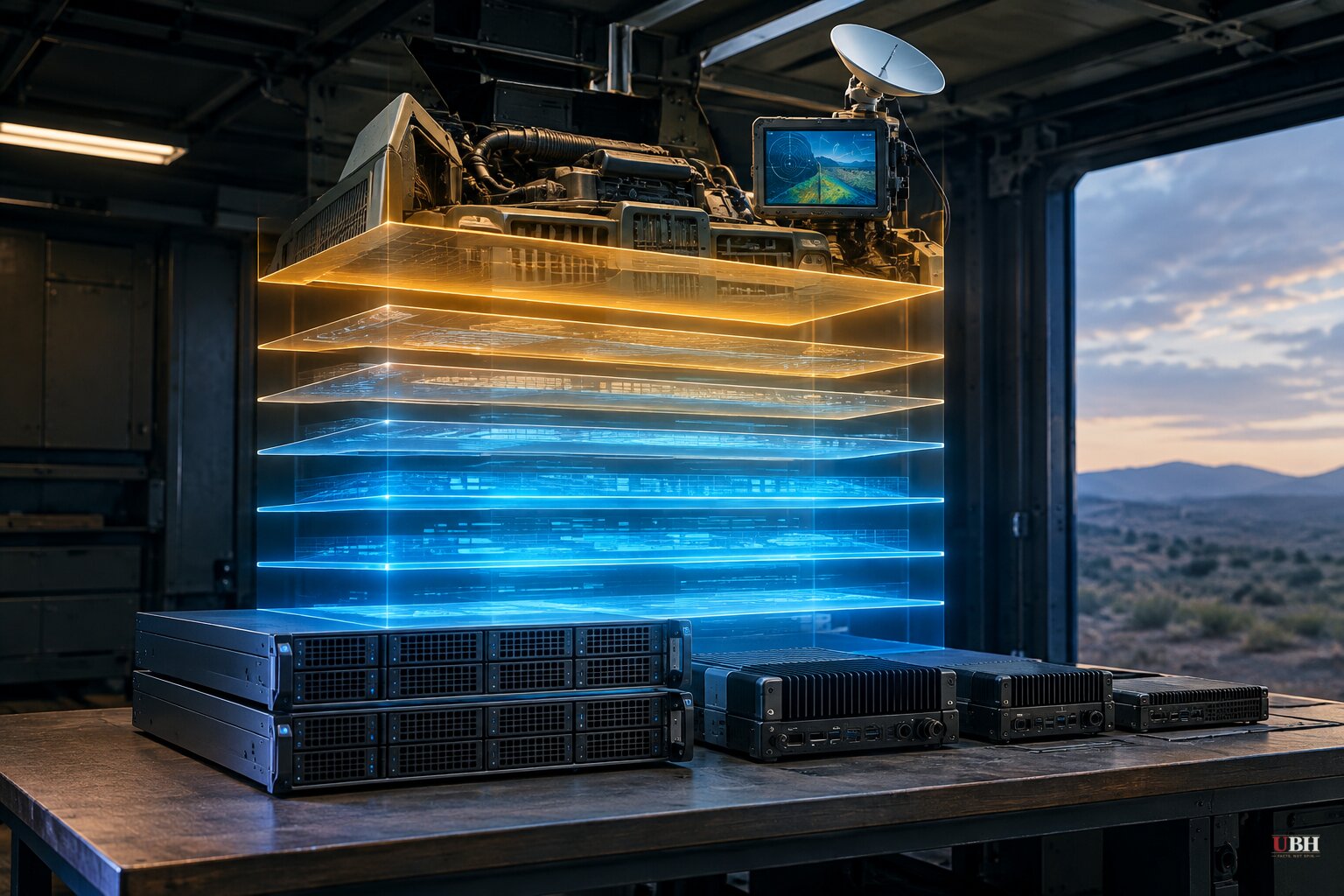
The two announcements cover different missions. Both show the same shift: as the defense sector buys more of its computing hardware commercially, more of what separates one fielded system from another sits in software, from the operating environment installed on a bare server to the applications that read data from vehicles and machinery.
Army Policy Now Puts Commercial Products First
The Army made that direction formal on July 22, 2026, in Army Directive 2026-19, signed by Dan Driscoll, then the Army secretary. The directive makes the Software Acquisition Pathway mandatory for all software development, "including for mixed efforts that include software development," which brings programs that combine hardware and software under the same rules. It tells program managers to "consider commercial solutions first, then configured commercial solutions," and says custom development "should be extremely rare."
The directive also orders Army cybersecurity organizations to implement continuous authority to operate (cATO) processes and to accept reciprocity, meaning an authorization granted by one Army organization is accepted by others. The Army's acquisition office has two years from the directive's date to fold these provisions into a new Army regulation.
The Box Is Standard. The Stack Is Not.
A commercial server, rugged computer or edge device arrives without mission software, security hardening or permission to connect to a military network. Each of those has to be added, and then kept current for the life of the system.
The Kratos demonstration shows where that work moves. In the software-defined ground design Kratos tested, new standards releases, security patches and waveform changes can be delivered as remote software updates instead of hardware replacements, according to a SatNews account of the announcement.
Shift5's contract reaches the other end of the stack: operational technology, the embedded computers and data buses inside vehicles, aircraft and weapons. The company says its platform translates that data and delivers it two ways, as alerts to soldiers and as continuous data streams to situational awareness and logistics applications. Chief executive Toby Magsig said the platform "unlocks the data trapped inside these systems." The firm-fixed-price, indefinite-delivery/indefinite-quantity contract was awarded by Army Contracting Command at Aberdeen Proving Ground, with funding set order by order and an estimated completion date of Sept. 30, 2031. Shift5 said the award expands its role in the Army's Next Generation Command and Control effort from prototyping partner to component.
The Bottleneck Moves to Authorization
Buying commercially does not remove the step that often takes longest: approval to run software on Army networks. At the Association of the U.S. Army's annual meeting, which opened in Washington on Oct. 12, Army officials announced a new environment, Project Gatekeeper, which launched Oct. 23 and lets companies submit software for automated security assessment before they hold an Army contract or have a program manager as sponsor.
"We have had to do a lot of weird janky things to get code into our environments," acting Army Chief Information Officer Gabe Chiulli told reporters. "A lot of times, organizations in the Army won't talk to [companies] until they have this 'golden ATO,'" he said, referring to an authority to operate. Officials said the current clearance process has stalled some software projects for as long as nine months.
At launch, companies needed Common Access Cards to use Gatekeeper. David Wright, chief engineer at the Army Software and Innovation Center, said in October that the Army was targeting mid-November to integrate Login.gov so the platform becomes "actually commercially accessible." "The idea here is not to lessen the security requirements," Wright said.
What Sits Between a Bare Server and a Mission Application
For a program fielding software on commercial hardware, the work typically spans several layers:
- Provisioning. Installing an operating environment and a container platform, such as Kubernetes, on hardware that may sit in a vehicle, shelter or ship without internet access.
- Packaging and delivery. Moving applications and all of their dependencies into disconnected networks, often over narrow links or on physical media.
- Security and compliance evidence. Hardening the configuration and producing the documentation that authorizing officials review, then keeping it current as software changes.
- Fleet updates and recovery. Patching many dispersed systems and returning them to a known configuration after a failure or cyber incident.
- Edge and operational technology applications. Software that reads sensor, engine or weapon-system data and turns it into information a crew or maintainer can act on.
Hardware suppliers compete on processors, ruggedization, and size, weight and power. The layers above determine how quickly software on that hardware can be authorized, updated and recovered. Approval alone, Army officials said, has stalled some projects for up to nine months.
Where Defense Unicorns Fits
Defense Unicorns, the sponsor of this article, sells software aimed at several of these layers. The company describes its Unified Defense Stack (UDS) as "a secure, portable, airgap-native platform, purpose-built for delivering software to military systems," and says UDS packages are portable across cloud providers, on-premises infrastructure and "resource-constrained tactical edge systems." Its free foundation, UDS Base, which includes UDS Core, is open source under the AGPL-3.0 license.
For provisioning and delivery, UDS uses Zarf, an Apache-2.0 open-source package manager for disconnected Kubernetes environments that bundles software and its dependencies into a single file for installation without connectivity. Zarf's documentation says its initialization step offers to deploy a K3s Kubernetes cluster when run on a Linux machine. UDS Core documentation lists K3d for development and EKS, AKS and RKE2 for production deployments.
For dispersed systems, the company launched UDS Fleet on June 2, 2026, with an operator app, UDS Fleet Connect, available for Android and in a browser, and a fleet-wide view, UDS Fleet Command. In April, the Navy selected Leidos and Defense Unicorns to test software-only container prototypes for delivering updates to ships. Didier LeGoff, a Leidos senior vice president, said the system can be loaded onto any commercial stack and packages applications in smaller pieces that can be sent over "less than robust links."
On authorization, the company states that UDS "does not itself grant an ATO" and that it generates compliance evidence as software is built and deployed. Neither the Kratos nor the Shift5 announcement mentions Defense Unicorns.
What to Watch
Gatekeeper, live since Oct. 23, and its planned mid-November Login.gov access will show whether software vetting can keep pace with commercial hardware purchases. The Army has until July 2028 to turn Directive 2026-19 into a permanent regulation. Funding under Shift5's contract will be set order by order, so the orders placed will show how widely the Army applies software to data inside its existing fleets.
This article includes sponsored content from Defense Unicorns, a sponsor of Unbiased Headlines. Defense Unicorns' statements about its own products, customers and contracts reflect the company's stated position; Unbiased Headlines has not independently verified every claim. Defense Unicorns had no editorial control over this article's reporting on Army policy, Project Gatekeeper, Kratos or Shift5, and no endorsement by the Army or any company mentioned here is implied.
Defense Unicorns is a sponsor of Unbiased Headlines. Unified Defense Stack (UDS) is the company's airgap-native software delivery platform for military systems, built on open-source components including UDS Core and Zarf.
Sources used for this briefing
12 links from 9 independent newsrooms (syndicated copies of the same report count once)
These are the sources it draws on, linked so you can verify.


