
Unbiased headlines. Facts, not spin.
Unbiased Headlines is an independently owned news organization. We bring you the facts, not opinions, written fresh from 110+ named sources. Sources linked so you can verify it yourself.
 tech
Major Story (7/10)
tech
Major Story (7/10)
Microsoft AI chief tells staff new model beats the one behind GPT-5.6 using a quarter of the compute
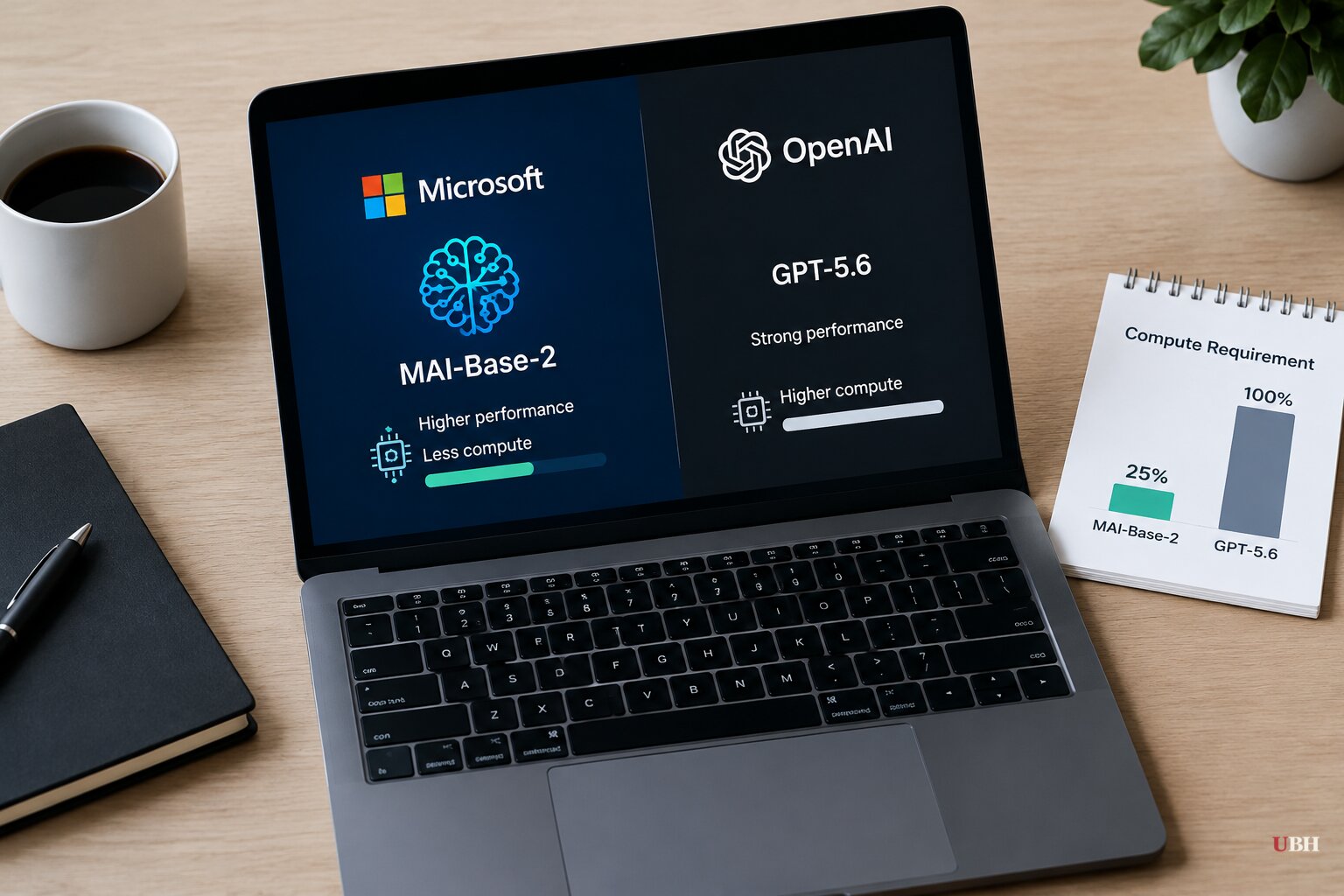
Microsoft says it built a better base model than OpenAI's for a fraction of the cost. The company it's talking about is its own partner.
Mustafa Suleyman, CEO of Microsoft AI, made the claim to employees at a town hall on Thursday, Oct. 15, hours after Microsoft announced a new model called MAI-Base-2.
"We now have a stronger pre-trained base model than the model that currently powers GPT 5.6 Sol," Suleyman said. "And in fact, we used one-quarter of the compute that OpenAI used to train their model."
What Suleyman claimed
Pre-training is the first stage of building an AI model, when it learns patterns from huge volumes of text, images and other data. It is also the most expensive stage, because it eats enormous amounts of computing power. If Microsoft really can get the same or better results for a quarter of the hardware, the savings would be large.
Suleyman said Microsoft privately tested MAI-Base-2 against OpenAI models, including one nicknamed "Spud" that powers GPT-5.6. He said Microsoft's model scored better on tests measuring how well AI understands and predicts patterns in information.
Those comparisons rest on technical information Microsoft holds about OpenAI's models, Suleyman said. "Privately and confidentially, we've also compared it to the OpenAI models," he told staff.
He also took a shot at China. Suleyman said MAI-Base-2 used "12 times less computation than was used for DeepSeek, for example, on compute efficiency." He did not say which DeepSeek model he meant. A public Microsoft blog post describes the pre-training as far more efficient than DeepSeek-V4-Pro-Base.
What has not been shown
The numbers come from Microsoft. The OpenAI comparison was run privately, using data Suleyman says Microsoft has access to. No outside party has published results confirming it.
The comparison is also between pre-trained base models. That is one stage of development, not a head-to-head of finished products like ChatGPT or Copilot.
Microsoft declined to comment. OpenAI did not respond to a request for comment.
A partner doing the comparing
Microsoft is not an outside rival here. It has invested billions in OpenAI, and Business Insider estimates its stake is likely worth more than $100 billion. StartupFortune puts the value of its stake in OpenAI Group PBC at roughly $135 billion.
Microsoft also sells OpenAI models to Azure cloud customers and uses them in products such as Copilot.
The relationship has been loosening for about a year. In March, Microsoft created a combined team for its commercial and consumer Copilot products. Suleyman was reassigned to build AI models in the company's superintelligence unit.
StartupFortune reports that earlier this year the two companies scrapped the contract clause tied to OpenAI declaring artificial general intelligence, and that Microsoft holds rights to OpenAI's technology through 2032. Neither company's filing on those terms was among the material cited here, so treat that account as that outlet's.
Why it matters for Microsoft's balance sheet
Training cost is the number that decides who makes money in this business. A company that can match a rival's model at a quarter of the compute needs far less spending on chips and data centers to stay competitive.
It also gives Microsoft more room to depend less on a supplier it does not control. Suleyman has pushed that idea publicly for months, according to StartupFortune, arguing Microsoft does not need to outspend OpenAI to out-build it.
The DeepSeek comparison is a different kind of claim. DeepSeek is a Chinese lab, and its efficiency claims rattled markets last year. Microsoft is now saying an American model got there with a twelfth of the compute. That is a testable claim, and it will take outside benchmarks to test it.
Microsoft's market value was about $4.01 trillion as of Oct. 15, according to Public.com data. The company is scheduled to report fiscal first-quarter earnings on Oct. 28. Public.com lists the consensus earnings-per-share estimate at $4.72, which is an analyst estimate, not a result.
The open question is whether Microsoft publishes enough detail on MAI-Base-2 for independent researchers to check the compute figures and the OpenAI comparison. So far, only the blog post and Suleyman's town hall remarks are on the table, and OpenAI has said nothing.
Sources used for this briefing
7 links from 6 independent newsrooms (syndicated copies of the same report count once)
These are the sources it draws on, linked so you can verify.


