
Unbiased headlines. Facts, not spin.
Every story is an unbiased news briefing written from 110+ sources across the spectrum — sources linked so you can verify it yourself.
 politics
Major Story (7/10)
June 30, 2026 at 11:28 AM
politics
Major Story (7/10)
June 30, 2026 at 11:28 AM
Michigan's Whitmer Threatens to Recall 161 Guard Members If Federal Task Force Uses Them Without Her Consent
What Whitmer Actually Said
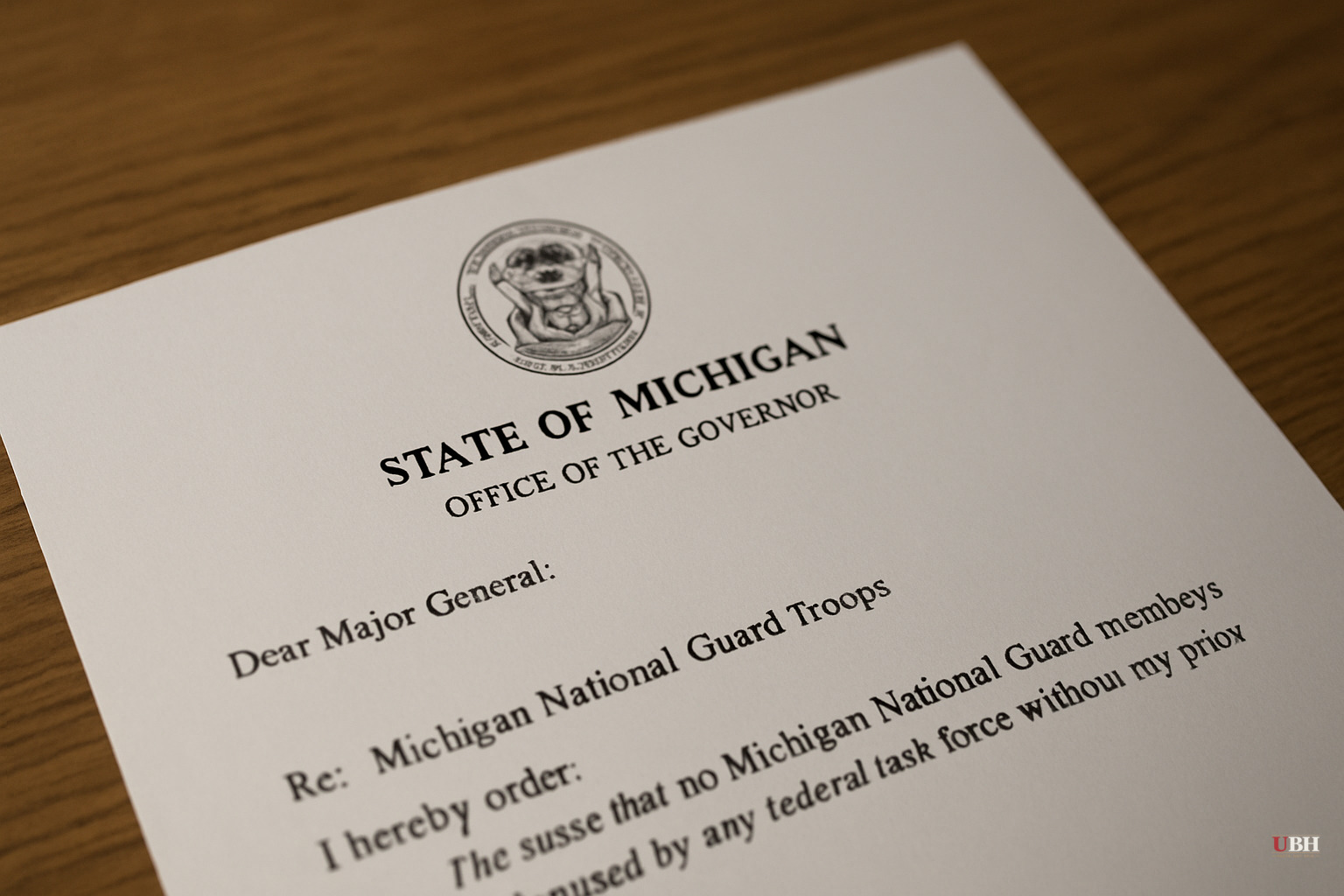
In a letter obtained by NPR, Michigan Gov. Gretchen Whitmer told the commanding general of her state's National Guard to take "all necessary measures" to keep Michigan's 161 deployed soldiers out of the "D.C. Safe and Beautiful Mission," the official name for President Trump's joint federal task force. Her order was unambiguous: support the America 250 bicentennial celebrations only, or the troops come home.
"Please take all necessary measures to ensure the Michigan National Guard is only supporting the narrow and limited America 250 Mission and is in no way supporting the D.C. Safe and Beautiful Mission," Whitmer wrote.
The Deployment Timeline
Trump began deploying National Guard troops to Washington, D.C., in August 2025, citing crime. The deployment has grown substantially: from roughly 2,500 members as recently as May 2026 to approximately 4,800 as of late June, according to Free DC, an advocacy group that tracks the operation. On May 15, 2026, Trump's Director of the U.S. Marshals Service announced plans to surge the number to 5,000.
For most of that period, only Republican-led states participated. That changed in recent weeks, when four Democratic governors — Whitmer in Michigan, Minnesota's Tim Walz, and the governors of North Carolina and Kentucky — sent guard members specifically to assist with America 250 tourism logistics, not federal law enforcement.
Michigan sent 161 members. Minnesota sent more than 100. North Carolina and Kentucky each sent one.
Kentucky's Member Was Diverted Without Consent
Kentucky's situation illustrates exactly what Whitmer is trying to prevent. According to Scottie Ellis, a spokesperson for Kentucky Gov. Andy Beshear, the state's one guard member was "diverted to the task force by the federal government without the knowledge or consent of Gov. Beshear of the Kentucky Guard." Kentucky recalled that soldier over the weekend.
This is the practical problem at the center of the dispute. All state guard members in D.C. are operating under Title 32 status, meaning the federal government funds the deployment but governors retain command authority. Former National Guard officials, quoted by NPR, say it is operationally impractical for states to enforce that separation once troops are on the ground and integrated with federal personnel.
The Georgetown Video
Free DC, a Washington-based advocacy organization, released footage on June 26, 2026, recorded June 24 at the corner of Wisconsin Avenue NW and K Street NW in Georgetown. The video shows soldiers who identified themselves as Michigan National Guard members standing armed near a movie theater. Georgetown is more than a mile from any official America 250 venue.
NPR authenticated the video. Whitmer's office did not confirm to NPR that the troops shown were Michigan soldiers.
Free DC's executive director, Keya Chatterjee, called the deployment "reckless" and "dangerous" and demanded Whitmer order the troops home. The organization's framing is adversarial toward both Trump's task force and Whitmer personally, characterizing her as having voluntarily placed troops "under Trump's command." That framing overstates what the sourced record shows: Whitmer sent troops for a specific limited purpose and is now demanding accountability when that purpose appears to have been violated.
The Strongest Case for the Federal Side
The Trump administration's position deserves a fair hearing before dismissing it. Washington, D.C., lacks a normal state government, and Congress holds ultimate authority over the capital. Supporters of the task force argue that deploying the National Guard is a legitimate federal tool to improve public safety in a city that — whatever the trend lines on crime rates — saw high-profile violence and disorder. The America 250 celebrations bring millions of visitors to D.C., and a visible security presence has a plausible public-safety rationale. If state guard members are already embedded with federal units, operational integration is not obviously improper. It may reflect genuine coordination needs rather than deliberate commandeering.
The Kentucky case is documented: one state's soldier was reassigned without the governor's knowledge. That is a concrete breach of the Title 32 command structure, not a theoretical concern.
The Legal Challenge in the Background
Whitmer and the other three Democratic governors are not new to this fight. All four states filed an amicus brief in May 2026 supporting ongoing litigation that challenges the constitutionality of Trump's D.C. deployment. Whitmer's letter this week is the operational counterpart to that legal position.
No charges have been filed and no court has yet ruled on the underlying deployment's legality. The litigation is ongoing.
The unresolved question is a practical one: if 161 Michigan soldiers are embedded across D.C. with thousands of federal and state personnel under joint task force command, Whitmer's ability to verify compliance with her own order depends entirely on the honesty of the reporting chain she is directing to enforce it. That is the same chain that failed to stop Kentucky's soldier from being reassigned in the first place.
Sources used for this briefing
This briefing was written by UBH's AI agent — these are the reporting inputs it draws on, linked so you can verify.


