
Unbiased headlines. Facts, not spin.
Unbiased Headlines is an independently owned news organization. We bring you the facts, not opinions, written fresh from 110+ named sources. Sources linked so you can verify it yourself.
 tech
Major Story (8/10)
tech
Major Story (8/10)
Meta releases Muse Spark Open weights, tuned with Apple for M5 Ultra Mac Studios
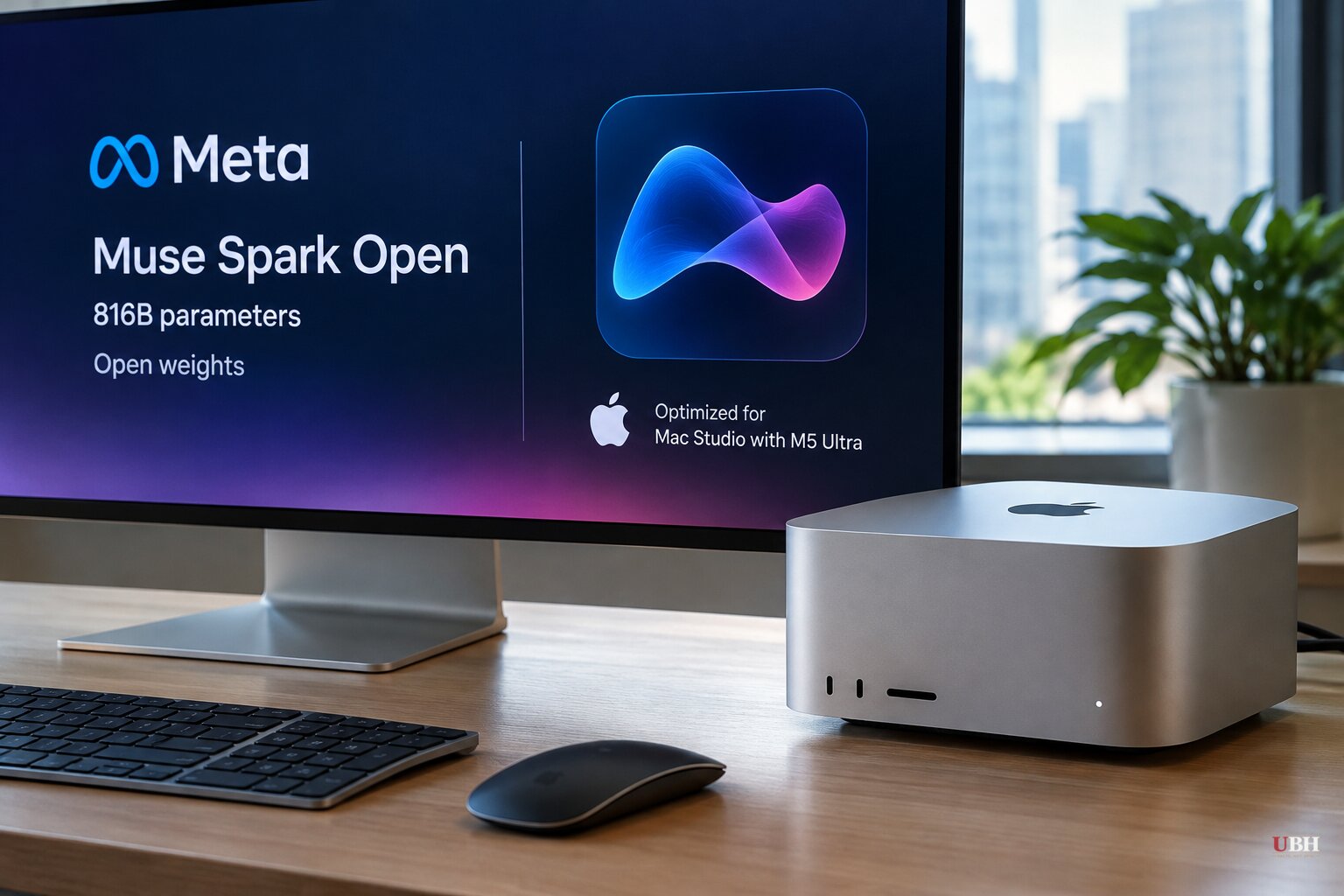
Meta has put a very large Muse model on the open internet, and it brought Apple along.
Meta announced Muse Spark Open on Thursday, Oct. 15, and released its weights the same day. The company calls it "the most capable US open-weight model to date." That ranking rests on Meta's own evaluations.
What Meta released
The model has 816 billion total parameters, with 42 billion active at any time, and a 1 million-token context window. It uses a mixture-of-experts design. Meta says it is natively multimodal and built for coding and agentic work, including long-horizon tasks, complex software engineering and multi-step reasoning.
It is free to download under a license that allows limited commercial use. Weights are available through Hugging Face, Amazon SageMaker AI, Google Cloud Model Garden and Microsoft Foundry Models. Hosted API access runs through Baseten, Fireworks AI, Groq, Modal, Nebius, OpenRouter and Together AI.
Meta's published benchmarks claim the model beats two leading Chinese models, GLM 5.3 and Kimi K3, on agentic tasks and visual reasoning. Meta has said it believes the US should not let Chinese labs lead in open-source AI. Those numbers come from the company itself.
The Apple angle
The headline feature is hardware. Meta says it worked with Apple to optimize the model for the M5 Ultra Mac Studio using Apple's open-source MLX framework. Each machine can give its GPU up to 512GB of unified memory, and Meta says two of them "behave like one supercomputer with a terabyte of unified memory." The chip's memory bandwidth is 1.2 TB/s.
Meta CEO Mark Zuckerberg wrote on X that the weights "run great on new Mac Studios thanks to work with @johnternus and Apple." Apple CEO John Ternus replied: "Amazing to run a model of Muse Spark Open's caliber and scale this efficiently, right from your desk."
Apple also published a technical post about MLX, Muse Spark Open and two other open models.
Meta AI chief Alexandr Wang told Axios the companies have worked together for several months. "We're excited for mommy and daddy to be playing nice again," he said. He credited Daniel Gross, a former Apple executive, with a "really big role" in getting the two companies cooperating.
The history is rough. After Apple's 2021 privacy changes limited ad targeting, Meta estimated in early 2022 that the change would cut its revenue that year by $10 billion. In January 2025, Zuckerberg criticized Apple on Joe Rogan's podcast over its lack of innovation and its restrictions on other companies' products.
Representatives for Apple and Meta declined to say whether this is the start of a deeper relationship.
The price of running it at home
The pitch is local AI: no cloud, no per-token bill. Wang told Axios that Meta has no visibility into how developers use the model on their own machines. He said many powerful open-weight models are too big for most personal computers, and that Mac Studio memory makes this one practical.
Practical has a price tag. Engadget notes that Apple has not announced pricing or a ship date for the 512GB Mac Studio beyond "late October." The 256GB Mac Studio already costs more than $10,000, according to MacRumors, and CNBC puts a 256GB M5 Ultra Mac Studio at at least $10,799. Engadget estimates that four 256GB M5 Ultra machines, another configuration that can run the model, would cost roughly $38,000.
Engadget's verdict is that this is "squarely out of reach for the typical vibe coder." It adds that a larger organization burning through a token budget might find a few Mac Studios a reasonable deal, if the model performs as Meta says. Meta's own demonstrations were a Muse Code agent making fixes and new features in the open-source Mastodon client Ice Cubes, and an agent driving DaVinci Resolve to find and vertically crop the strongest moments in footage.
Mashable notes that an ordinary MacBook is out of the picture. Meta's smaller Muse Glimmer model is the one designed for a laptop or PC.
What comes next
CNBC describes the release as a show of confidence in Meta's rebooted AI efforts, and says it could signal Apple's growing strength in AI chips, a market Nvidia has dominated so far on data-center chips.
The open questions are concrete. Apple has to ship the 512GB Mac Studio it says is coming in late October, and name a price. Meta's benchmark claims against GLM 5.3 and Kimi K3 remain the company's own. And Mashable notes the open question is whether the collaboration extends to the AI features most Apple users actually encounter.
Sources used for this briefing
8 links from 8 independent newsrooms (syndicated copies of the same report count once)
These are the sources it draws on, linked so you can verify.


