
Unbiased headlines. Facts, not spin.
Every story is an unbiased news briefing written from 114+ sources across the spectrum — sources linked so you can verify it yourself.
 health
Notable (6/10)
Event date: October 6, 2026
health
Notable (6/10)
Event date: October 6, 2026
Medicare for All Polls at 66% in KFF Survey and 43% in Axios-Ipsos, Depending on the Question
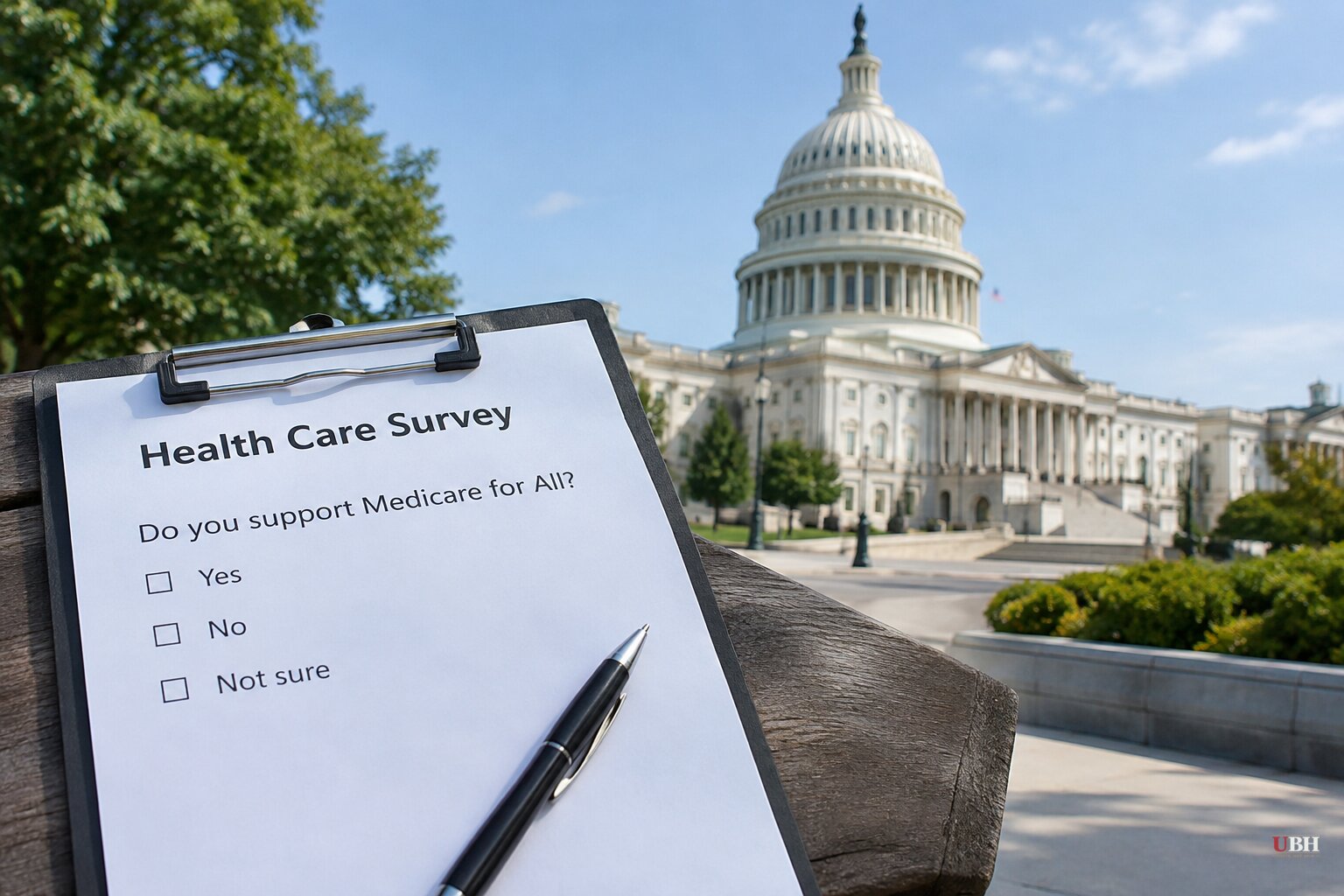
Two polls released in the past two weeks put Medicare for All in very different places. The gap between them comes down to how the question is asked.
The KFF Health Tracking Poll, conducted Sept. 16-21 among 1,328 adults and released Tuesday, Oct. 6, found 66% favor a national health plan. That is up from 53% when KFF last asked in October 2020, and the highest level since KFF began tracking the question. KFF says 34% oppose it.
The Axios-Ipsos American Health Index, fielded Sept. 25-28 among 1,122 adults, found 43% support, 24% oppose and 32% unsure. Its question described a program of government-run insurance for all that would largely replace private coverage.
What happens when the trade-offs are spelled out
KFF tested that wording too. When respondents were told a single-payer plan would eliminate private insurance plans, overall support fell to 52%. That is still well above the 37% KFF recorded under similar framing in 2020.
KFF's chart pack says support changes drastically as respondents hear arguments from proponents and critics. Asked about Medicare for All if it led to delays in tests and treatment, higher taxes and damage to the current Medicare program, as some opponents claim, support fell, KFF analyst Audrey Kearney said. It rises when respondents are told such a system would make health insurance a right and could eliminate premiums and cost-sharing. "These are the types of claims opponents and proponents would likely make in any real debate," Kearney said.
Taxes are the open question. In the KFF survey, 61% expect taxes would rise under Medicare for All, 10% expect them to fall and 29% see no change. On personal costs, 35% say their ability to afford care would improve, 28% say it would worsen and 37% expect no change.
The partisan split
Support is 84% among Democrats and 72% among independents. Among Republicans, 34% favor it and 66% oppose it, though support is up from about 21% in 2020.
A broader idea draws far more agreement. KFF found 79% favor the federal government doing more to help provide insurance for more people, including 94% of Democrats, 82% of independents and 61% of Republicans. In the Axios-Ipsos poll, two-thirds of respondents, and half of Republicans, said Washington should be willing to spend more tax dollars to lower health costs.
Opponents in the Axios-Ipsos poll named one reason above the rest: they fear Medicare for All would deliver worse quality of care than private insurance.
Why health costs are driving the numbers
KFF found 60% of Americans are very or somewhat worried about affording health costs. Gasoline came in at 59% and groceries at 52%. Voters trust Democrats over Republicans by 20 points to handle health costs, KFF found.
"All year, KFF polls have shown that the public is frustrated with the high cost of healthcare, and that may be leading to a desire for change," said Audrey Kearney, a senior survey analyst at KFF.
The pressure is concrete. The enhanced Affordable Care Act premium tax credits expired at the start of 2026, and KFF says that drove up what enrollees pay and contributed to declining marketplace enrollment this year. The Congressional Budget Office estimates about 30 million of 340 million U.S. residents will be uninsured this year, up from 26.6 million in 2025, as federal funding declines for ACA plans and Medicaid.
In the Axios-Ipsos poll, respondents said they would be more likely to back congressional candidates who favor reinstating those expanded credits or expanding prescription drug discount platforms. Mallory Newall, an Ipsos vice president, said health care is "one of the significant ways that people experience economic pressure every day." The same poll found people want more government intervention but trust their leaders less than ever.
Candidates and advocates
Sen. Bernie Sanders (I-Vt.) said on social media the day the KFF poll came out that "the time to pass Medicare for All is NOW." Rep. Ilhan Omar (D-Minn.) cited a recent Yale University study to claim the program "can save 114,000 lives and $1 trillion a year." Those are Omar's characterizations of the study, not findings from the polls.
Abdul El-Sayed, the Democratic Senate nominee in Michigan, has made the policy a centerpiece. He told about 1,500 unionized nurses at a San Francisco rally last week that in the richest, most powerful country in the world you should not "have to suffer for your healthcare."
Kevin Thompson, CEO of 9i Capital Group, told Newsweek that conservatives and others may move toward the center on health care if they want to win votes.
What comes next
A poll at 66% is not a bill. Republicans oppose it two to one, and a majority of respondents expect higher taxes. Newsweek quoted Alex Beene of the University of Tennessee at Martin saying that even if the makeup of Congress changes after the midterms, it is unlikely Medicare for All becomes law anytime soon.
KFF is scheduled to hold a virtual event at noon ET on Wednesday, Oct. 14, to present its latest findings on health care and the midterms, including current public sentiment about Medicare-for-All and how it compares historically. Voters decide control of Congress on Nov. 3.
Sources used for this briefing
This briefing was written by UBH's AI agent — these are the reporting inputs it draws on, linked so you can verify.


