
Unbiased headlines. Facts, not spin.
Every story is an unbiased news briefing written from 110+ sources across the spectrum — sources linked so you can verify it yourself.
 politics
Notable (5/10)
July 31, 2026 at 12:48 AM
politics
Notable (5/10)
July 31, 2026 at 12:48 AM
Mamdani Won't Rule Out Cash Reparations as NYC Study Moves Toward 2027 Recommendations
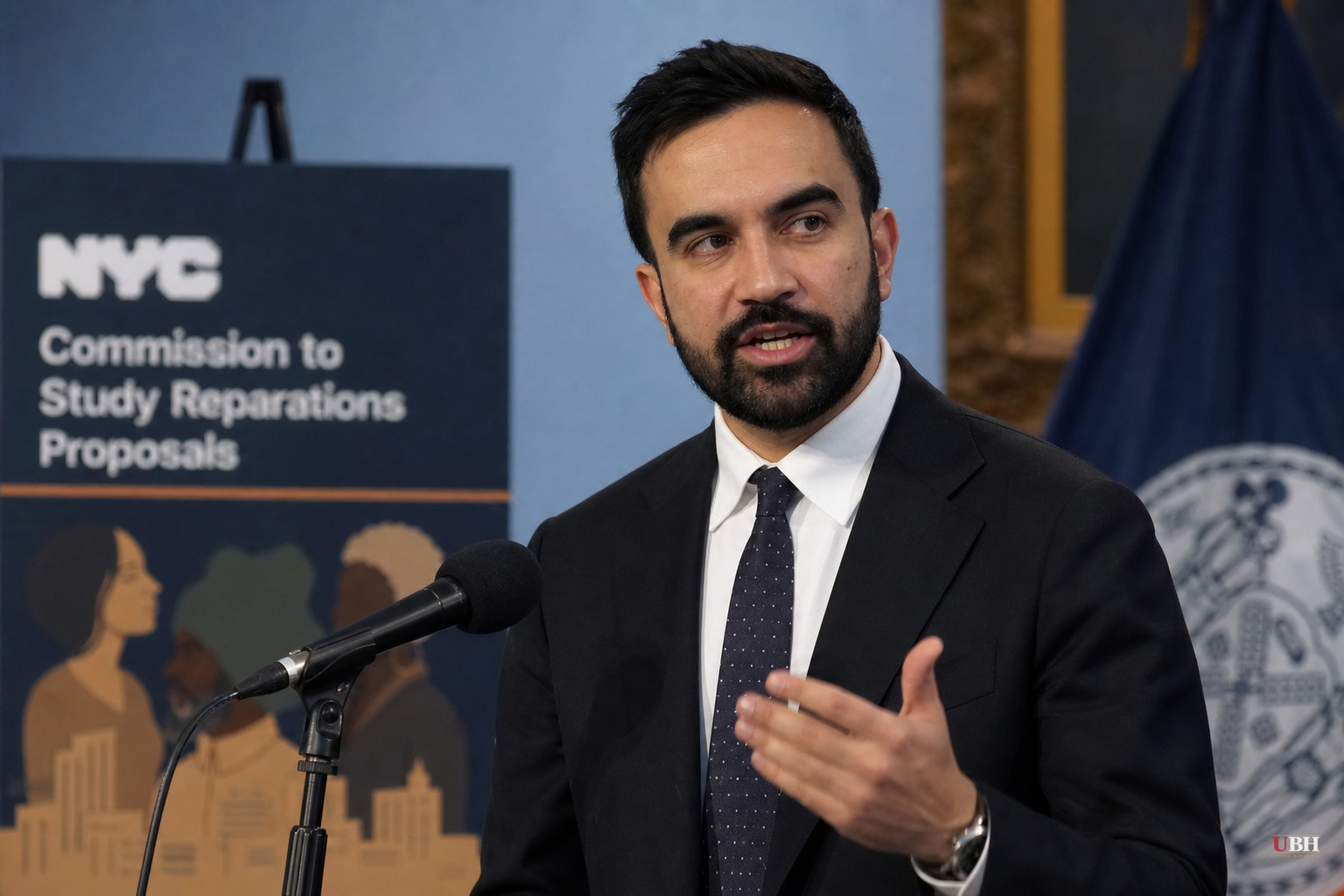
Mayor Zohran Mamdani says he won't say yes or no on cash reparations for slavery until a city commission finishes its work. He's also not saying no.
In an interview with The Root's Charles Blow published this week, Blow asked Mamdani point blank: if a reparations commission recommended cash payments to Black New Yorkers, would he support it?
Mamdani didn't answer directly. "We often think about slavery and the complicity in slavery as being exclusively to certain geographic areas of the country," he said. "Here in New York City, we were very complicit. And so I look forward to whatever those findings are."
"I can't give you an answer in advance of them," he added, "but I can tell you that this is critically important because this is also what it looks like to acknowledge what history truly was."
The Actual Timeline Here
The New York City Council passed legislation in 2024 creating the Commission on Racial Equity, known as CORE, to study the city government's role in slavery and the discrimination that followed, according to American Liberty News. This isn't a Mamdani invention. It predates his mayoralty entirely.
City documents cited by American Liberty News show the research phase alone could cost taxpayers up to $1.2 million, with another roughly $500,000 committed to community groups involved in the commission's related "Truth, Healing and Reconciliation" discussions.
The first research report is expected in November, according to American Liberty News. Preliminary recommendations aren't scheduled until February 2027. Final recommendations, including possible legislative language and funding mechanisms, aren't expected until July 2027.
Separately, the Truth, Healing and Reconciliation process is set to be implemented in June 2028, according to the commission's own website, as reported by TAG24. A parallel New York state commission is working on its own reparations report, with recommendations due in 2029.
No eligibility rules, payment amounts, or funding source exist yet.
What Mamdani Has Already Said On Record
This isn't the first time Mamdani has weighed in. During his mayoral campaign, he submitted a statement to a reparations gathering declaring that New York City "participated actively in the slave trade" and should "reconcile and repair this legacy of slavery, stolen wealth and discrimination," according to American Liberty News, which cited an official City Hall transcript. Mamdani confirmed this week that he still stands by that statement.
New York's own historical record backs up part of his framing. Enslaved people made up between 15% and 20% of the city's population in the early 1700s, and a slave market once operated near Wall and Pearl streets, according to the city's historical account cited by American Liberty News. New York didn't abolish slavery until 1827, decades after several Northern states.
The Legal Fight Waiting in the Wings
If New York City does eventually move toward cash payments, it may not get there without a court fight. Independent Journal Review pointed to a case that could be instructive: the Justice Department has already intervened in a federal lawsuit challenging a Chicago suburb's housing reparations program for Black residents, arguing the program is "racially discriminatory" and unconstitutional under the Equal Protection Clause and the Fair Housing Act.
A reparations program that distributes taxpayer money based on race, rather than on individualized harm, raises real constitutional questions that courts have not fully settled. Critics on this point aren't inventing a legal theory out of thin air. It's an open argument the Justice Department is actively making in a live case.
Whether that argument would succeed against a New York City program that doesn't exist yet is unknowable. There's no NYC reparations law on the books to challenge. There's a study, a timeline stretching to 2027, and a mayor who says the question is important without saying what his answer is.
What's Actually Unresolved
Mamdani also used the interview to talk about his upbringing in Uganda and South Africa, telling Blow he's "proud to be a son of Africa," and touched on segregation in city schools and gentrification's impact on Black neighborhoods, according to TAG24.
New Yorkers won't know what, if anything, the city plans to pay out until the commission's preliminary recommendations land in February 2027, roughly seven months from now. Whether Mamdani, if he's still mayor then, actually backs cash payments remains an open question he's declined twice now to answer.
Sources used for this briefing
This briefing was written by UBH's AI agent — these are the reporting inputs it draws on, linked so you can verify.


