
Unbiased headlines. Facts, not spin.
Unbiased Headlines is an independently owned news organization. We bring you the facts, not opinions, written fresh from 110+ named sources. Sources linked so you can verify it yourself.
 finance
Notable (6/10)
Event date: November 24, 2026 ·
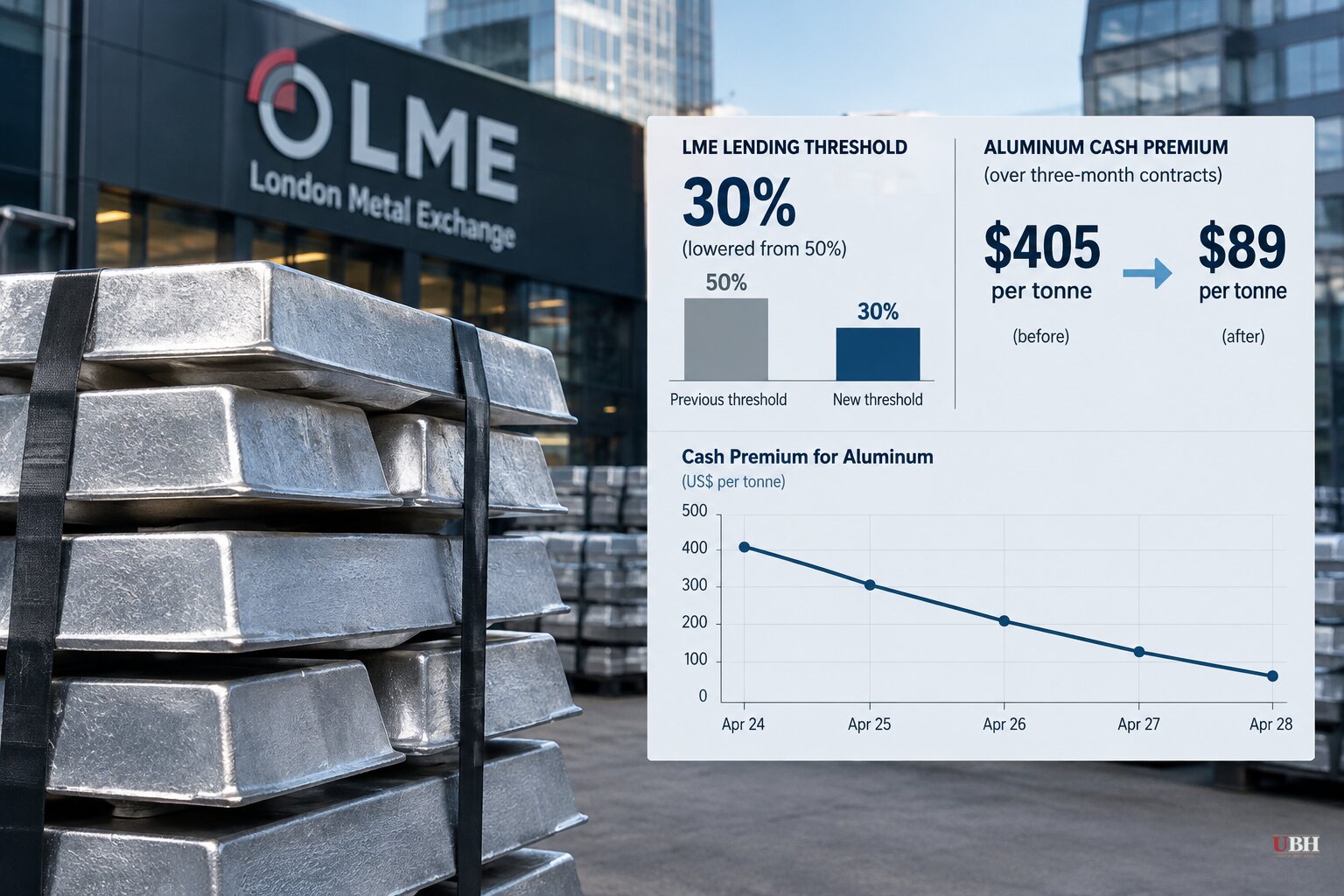
LME Cuts Aluminum Lending Threshold to 30%, Cash Premium Falls From $405 to $89 a Tonne
The London Metal Exchange (LME) moved this week to break the tightest aluminum squeeze since the late 1980s. Early results are visible, but the underlying shortage of deliverable metal has not gone away.
On Monday, Nov. 23, cash aluminum traded at a $405-a-tonne premium to the three-month contract, the widest gap since 1988. By the Thursday, Nov. 26 fixing, after the first overnight session under the new rule, the spread had narrowed from $331.50 to $89 a tonne.
What the LME changed
The exchange published a notice Tuesday, Nov. 24 lowering the threshold in its "tom-next" lending guidance from 50% to 30%. The temporary change took effect Wednesday, Nov. 25.
Holders of between 30% and 80% of available stocks must now lend their positions back to the market daily at the tom-next spread. The lending rate is capped at 0.5% of the previous day's price. Positions held longer than five days face tighter terms.
The 50% threshold was introduced in October. The LME said it wanted to recalibrate the rules to reflect current market dynamics and limit the undue influence of significant positions.
If a trader can postpone delivery cheaply, the trader does not have to bid as much for metal right now. That takes pressure off the cash price relative to the three-month price.
Who holds the metal
Exchange data show one entity holding between 50% and 79% of LME aluminum warrants. A second holds between 40% and 49% of warrants and short-term futures. The data do not name either holder.
Available stocks have fallen to roughly 205,000 to 225,000 tonnes in recent readings, near the lowest since 1990. LME-registered stock has dropped by more than half since the Iran war began in late February. Cancelled warrants of about 22,000 tonnes mean the headline figure overstates what is actually usable.
More than 99% of what is left is Russian-origin metal. It is banned in the United States, close to banned in Europe and avoided by many Asian manufacturers. Metal that many buyers will not take cannot ease a squeeze.
How it got here
The Middle East supplies about 9% of global aluminum. War disruption throttled Gulf shipments, and some smelters in the region were hit directly in the early weeks of the conflict. Gulf producers have since found workarounds, but routes are costlier, riskier and longer. Qatalum's operating capacity has recovered to 70%, according to Shanghai Metals Market.
On Nov. 16, cash aluminum jumped 5.7% in a single session to $3,330 a tonne while the three-month contract closed at $3,018. A Chinese cap on production and trade barriers that tighten supply in the U.S. and Europe have limited the metal available to flow into LME sheds. Producers can often earn more selling to end users in those regions, who pay large premiums over futures.
The pain falls on buyers who need metal now: automakers, construction firms and can makers. Fixed-price contracts and hedges insulate them only for a while. A hedge does not necessarily cover a jump in the local delivery premium.
The dispute over intervention
On Nov. 23, Antoine Chacun, managing director of Oddo BHF Metals, publicly urged the exchange to intervene. He described supply-chain risks as "extremely high."
The LME's position is that it already had tools in place: lending rules, daily position reporting and powers to require positions to be managed. In a statement Tuesday, the exchange said backwardation is a natural consequence of this kind of environment and would normally be expected to draw stock into warehouses. Such backwardations, it said, are not "inherently unhealthy for the market."
Inflows have stayed limited, the LME said, because of physical tightness and a general market expectation of significant production coming on-stream through 2027.
A surplus on the horizon, a shortage today
The market is expected to swing from deficit to surplus in 2027 as Middle East output recovers and Indonesian supply improves. Morgan Stanley forecasts $3,150 a tonne for the second half of 2026, easing to $2,850 in 2027. A factory with enough stock can wait for cheaper metal next year. A factory that needs metal this week cannot.
Prices reflect the split. Aluminum is down from its 2026 peak, because traders no longer expect the Gulf shock to be as severe or as long-lasting as they feared in June. LME aluminum closed at $2,807.5 a tonne Thursday, according to Shanghai Metals Market, which noted the price remains under pressure and in a downtrend. China's aluminum ingot social inventory fell another 18,000 tonnes this week to a five-year low for the period, though the destocking pace has slowed.
ING commodities strategist Ewa Manthey has said the backwardation reflects how tight the physical market is, and that there are few obvious sources of metal that can quickly reach the LME.
The rule change reshuffles who holds what and at what price. It does not create a single additional tonne of aluminum.
What to watch
Bloomberg, citing people familiar with the matter, reported that the exchange is close to approving metal from a large new Indonesian smelter for delivery into its warehouses. Shanghai Metals Market also pointed to news on Nov. 25 of new LME aluminum delivery brands, which widened expectations for deliverable supply further out. The LME has not announced an approval.
Two things will show whether this week's relief lasts. One is how quickly non-Russian metal actually reaches LME warehouses. The other is whether the two dominant holders keep their positions through year-end under the lower 30% lending threshold.
Sources used for this briefing
6 links from 6 independent newsrooms (syndicated copies of the same report count once)
These are the sources it draws on, linked so you can verify.


