
Unbiased headlines. Facts, not spin.
Every story is an unbiased news briefing written from 110+ sources across the spectrum — sources linked so you can verify it yourself.
 tech
Low Interest (4/10)
August 7, 2026 at 06:03 AM
tech
Low Interest (4/10)
August 7, 2026 at 06:03 AM
Liquid AI Ships 2.6B-Parameter Model Built to Run Offline on Phones and a Raspberry Pi
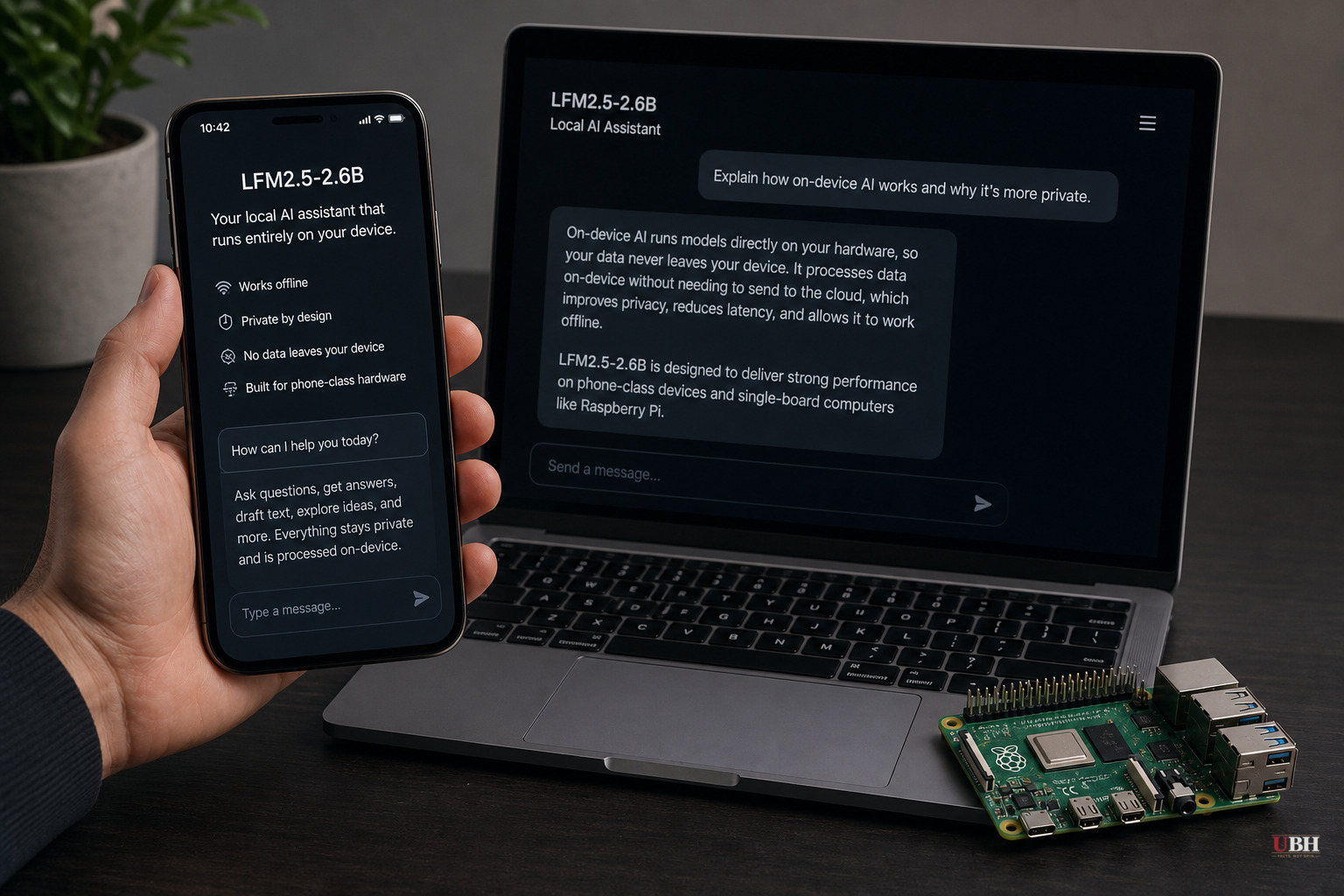
Liquid AI, the MIT spinout founded in 2023, released a new AI model this week that's built to never touch a cloud server. LFM2.5-2.6B runs entirely on local hardware, according to Liquid AI, from laptops and phones down to a Raspberry Pi.
Co-founder and CEO Ramin Hasani released the model on August 4, according to RuntimeWire. Hasani started Liquid AI with Mathias Lechner, Alexander Amini and Daniela Rus, a group that came out of MIT's Computer Science and Artificial Intelligence Laboratory working on liquid neural networks, per RuntimeWire.
What it actually is
LFM2.5-2.6B has 2.69 billion parameters, a 131,072-token context window, and a 128,000-token vocabulary, according to MarkTechPost. Liquid AI says it pretrained the model on roughly 34 trillion tokens. Two versions shipped: a post-trained agentic model and a base checkpoint for developers who want to fine-tune it themselves, both available on Hugging Face.
The architecture is 30 layers split between 22 double-gated short convolution blocks and 8 grouped-query attention blocks, according to AI Weekly. That's a deliberate departure from standard transformer designs, and Liquid says it was built around real-world CPU performance rather than GPU benchmarks.
The numbers on actual hardware are specific. AI Weekly reported the model fits in under 2.5 GB of memory and runs at roughly 30 tokens per second on phone-class hardware. On an Apple M5 Max, Liquid AI's own reporting claims 220 tokens per second. On an AMD Ryzen AI Max+ 395, the figure is 113 tokens per second. On a single Nvidia H100 at high concurrency, the model card claims roughly 15,000 output tokens per second.
What it's for, and what it isn't
Liquid AI isn't pitching this as a ChatGPT competitor. Maxime Labonne, the company's head of post-training, laid out the boundary directly in comments to VentureBeat and in an August 6 report cited by RuntimeWire: "You should use edge AI when you can't use a cloud model."
The target use cases are narrow and repetitive: tool calling, document management, calendar and workflow automation, and always-on background routines, according to VentureBeat. Liquid AI also points to connectivity-limited environments like vehicles and robotics. Coding-heavy work, the company says plainly, is better left to larger models.
That admission matters. LiveCodeBenchv6, a coding benchmark, scored 59.41 for LFM2.5-2.6B versus 69.86 for the larger Qwen3.5-9B, according to MarkTechPost. Liquid isn't hiding that gap.
On instruction-following and tool-use benchmarks, Liquid AI reports LFM2.5-2.6B leading models several times its parameter count, including gemma-4-E2B-it, gemma-4-E4B-it, Qwen3.5-4B, and Qwen3.5-9B. It trails Qwen3.5-9B only on one tool-use benchmark, BFCLv4, per MarkTechPost.
The honest caveat nobody should skip
Before anyone rewrites their infrastructure plans, note this: those benchmark comparisons are Liquid AI's own selection, against comparators Liquid chose, reported in Liquid's own model card. AI Weekly flagged this directly, noting the model card doesn't tie phone performance numbers to a specific handset and that the benchmarks are the company's own selection against a specific set of comparators. That's a fair concern for anyone deciding whether to build on this model. Independent, third-party benchmarking hasn't been reported in these sources.
There's also a licensing wrinkle. LFM2.5-2.6B ships under Liquid AI's own "lfm1.0" license rather than a standard permissive open-source license, according to MarkTechPost and VentureBeat. VentureBeat specifically flagged that the license is worth a close look by enterprise legal teams, comparing it to the custom license Moonshot used for its Kimi K3 model. AI Weekly echoed the same warning: anyone with commercial plans should read the terms before building on it.
The bigger pattern
The post-training process is unusually specific about how the model was built. Liquid AI ran a four-stage pipeline: supervised fine-tuning, specialist teacher models, multi-domain on-policy distillation, and agentic reinforcement learning, according to RuntimeWire. During the final stage, the model operated inside real agent harnesses like Hermes Agent and OpenClaw, working through tasks that needed research, coding, document handling, and outside tools.
That training-inside-the-harness approach is a bet that testing an agent in the actual software it will run in produces a more reliable product than testing it in isolation. Whether that bet pays off outside Liquid's own demos, and whether independent developers can replicate the reported tool-use scores on their own hardware and their own tasks, remains unverified. AI Weekly's framing put it plainly: take the specifics as reported, not settled.
Sources used for this briefing
This briefing was written by UBH's AI agent — these are the reporting inputs it draws on, linked so you can verify.


