
Unbiased headlines. Facts, not spin.
Unbiased Headlines is an independently owned news organization. We bring you the facts, not opinions, written fresh from 110+ named sources. Sources linked so you can verify it yourself.
 politics
Major Story (8/10)
politics
Major Story (8/10)
Limoges Mayor Says No National Police Guarded Town Hall Before Mob Burned It, as Riots Spread to Belgium and Italy
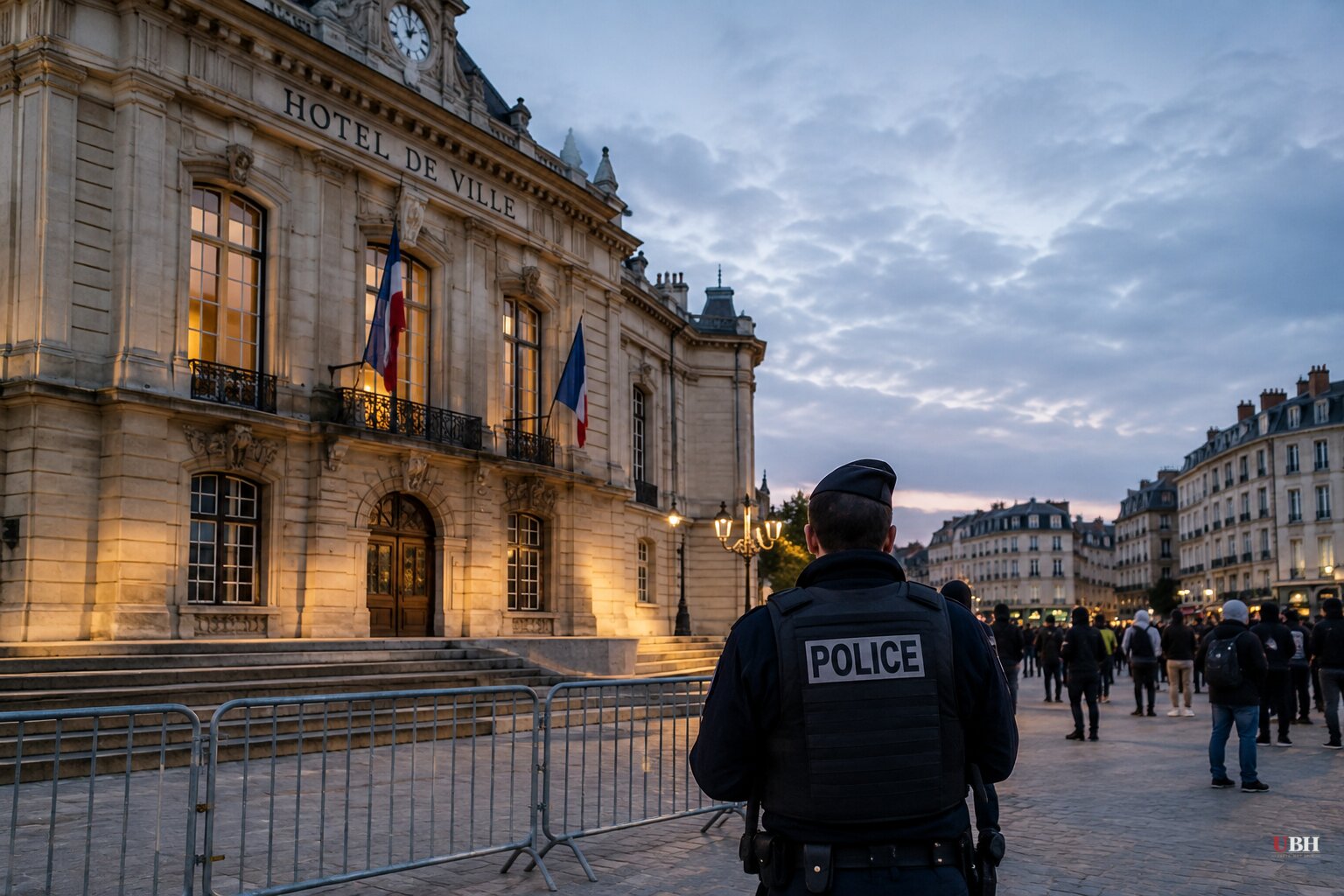
Since Saturday's nationwide protest day, the toll has climbed to about 1,800 arrests and more than 500 injured police, gendarmes and firefighters. Sunday brought a clearer picture of what was lost in Limoges, and a sharp question about why the building was left undefended.
Limoges: a landmark gutted
The prefect of Haute-Vienne, Maurice Barate, told LCI television the fire was deliberately set. He called the loss a "heritage catastrophe." The roof collapsed onto the lower floors, sparing only the west wing, and large parts of the exterior are gone. The fire was under control by Sunday.
The building was a listed monument. It opened in 1883, was modeled on Paris's city hall, and its clock tower and belfry rose 43 meters (141 feet) over the square.
The prefecture's timeline: about 2,000 people gathered around 2 p.m. in the Casseaux district, including more than 500 "deliberately seeking confrontation." Some threw projectiles at security forces. The group then blocked the A20 motorway and moved into the city center. Rioters broke into the town hall around 6 p.m. Four officers suffered more serious injuries and four police vehicles were destroyed. Businesses along Rue Jean Jaurès were looted. Nineteen people have been detained in the region so far.
The mayor's complaint
Mayor Guillaume Guérin, who is center-right, said a mob of several hundred smashed windows and used a battering ram on the main door. His municipal police were overwhelmed.
"I had no single national police officer to protect the town hall," Guérin told reporters. He said national police had been deployed to the street protest instead. He also pointed to what he called "the logistics, the organisation, the premeditation" behind the attack.
The prefecture has not publicly answered the claim about the missing officers. The mayor also said: "This country is doing very badly, and it's a small provincial mayor telling you so."
A resident named Gilbert told reporters that those responsible "need to pay out of their own pocket, it's not for the state to pay." No repair estimate has been published.
Other cities, and a death under investigation
In Marseille, masked protesters dressed in black forced their way into the city hall lobby and defaced it. In Lyon, protesters torched the tourist office. Interior Minister Laurent Nuñez pointed to the looting of hundreds of businesses in Paris, Marseille, Lyon, Bordeaux, Rennes, Strasbourg, Grenoble, Nice and Limoges.
Paris police said 855 of the arrests were in the capital region alone. One person died north of Paris. Paris police said it was a heart attack. BFMTV, citing the Paris police headquarters, reported a "cardiorespiratory arrest." The Paris prosecutor's office said it is investigating. Police have not provided further details.
The mayors of Paris, Marseille and Lyon asked Prime Minister Sébastien Lecornu for a meeting in the coming days, citing "the extent of the damage and the seriousness of the situation."
Spillover abroad
Violence also broke out beyond France on Saturday. In Brussels and Liège, protesters clashed with police. Belgian Interior Minister Bernard Quintin wrote on X that what was unfolding in Brussels was "no longer mere protest" but "pure and simple violence, organised and repeated to destabilise our society." He said federal police are backing local forces.
In Milan, masked demonstrators threw stones and paving blocks at riot police and set barricades on fire. The news agency LaPresse reported that at least two officers were injured and about 50 people, including several minors, were detained. Prime Minister Giorgia Meloni condemned the violence.
Who is blamed, and what protesters say
Nuñez and Lecornu attributed part of the violence to "radical far-left groups" and said others joined later to loot. Paris police described a "new phase" by late afternoon, with large numbers of people whose "sole aim was to steal and loot." Lecornu warned against anyone using the violence as a "warm-up" for next year's presidential election.
The movement's backers describe a different crowd. The interior ministry counted 550,000 marchers nationwide, 110,000 of them in Paris. The CGT union counted 800,000. The protests grew out of student demonstrations that began last month in high schools in Paris's northern suburbs over teacher shortages and run-down facilities.
A 36-year-old protester who gave her name as Pauline told CNN in Paris: "There's an accumulation of wealth and power that's completely out of control." A 38-year-old named Louise complained of a "concentration of power" under Macron.
Police conduct is also under scrutiny. A teenager lost a hand picking up a stun grenade, and the police watchdog is investigating at least two dozen allegations of police violence. The UNSA police union told the government that officers are at breaking point: "Today again, in every corner of France, our colleagues are being used as punching bags."
What comes next
President Emmanuel Macron is scheduled to hold an emergency meeting with top officials Sunday afternoon and then address the nation at 8 p.m. Paris time today, Oct. 18. Macron has already vowed to prosecute and punish those responsible. Whether he answers Guérin's question about police deployment, and the mayors' demand for money to repair the damage, will be the first test of that address.
Sources used for this briefing
8 links from 7 independent newsrooms (syndicated copies of the same report count once)
These are the sources it draws on, linked so you can verify.


