
Unbiased headlines. Facts, not spin.
Every story is an unbiased news briefing written from 110+ sources across the spectrum — sources linked so you can verify it yourself.
 tech
Low Interest (3/10)
July 26, 2026 at 12:25 AM
tech
Low Interest (3/10)
July 26, 2026 at 12:25 AM
Librarians in Maine and Philadelphia Run Workshops Teaching People to Turn Off AI Features
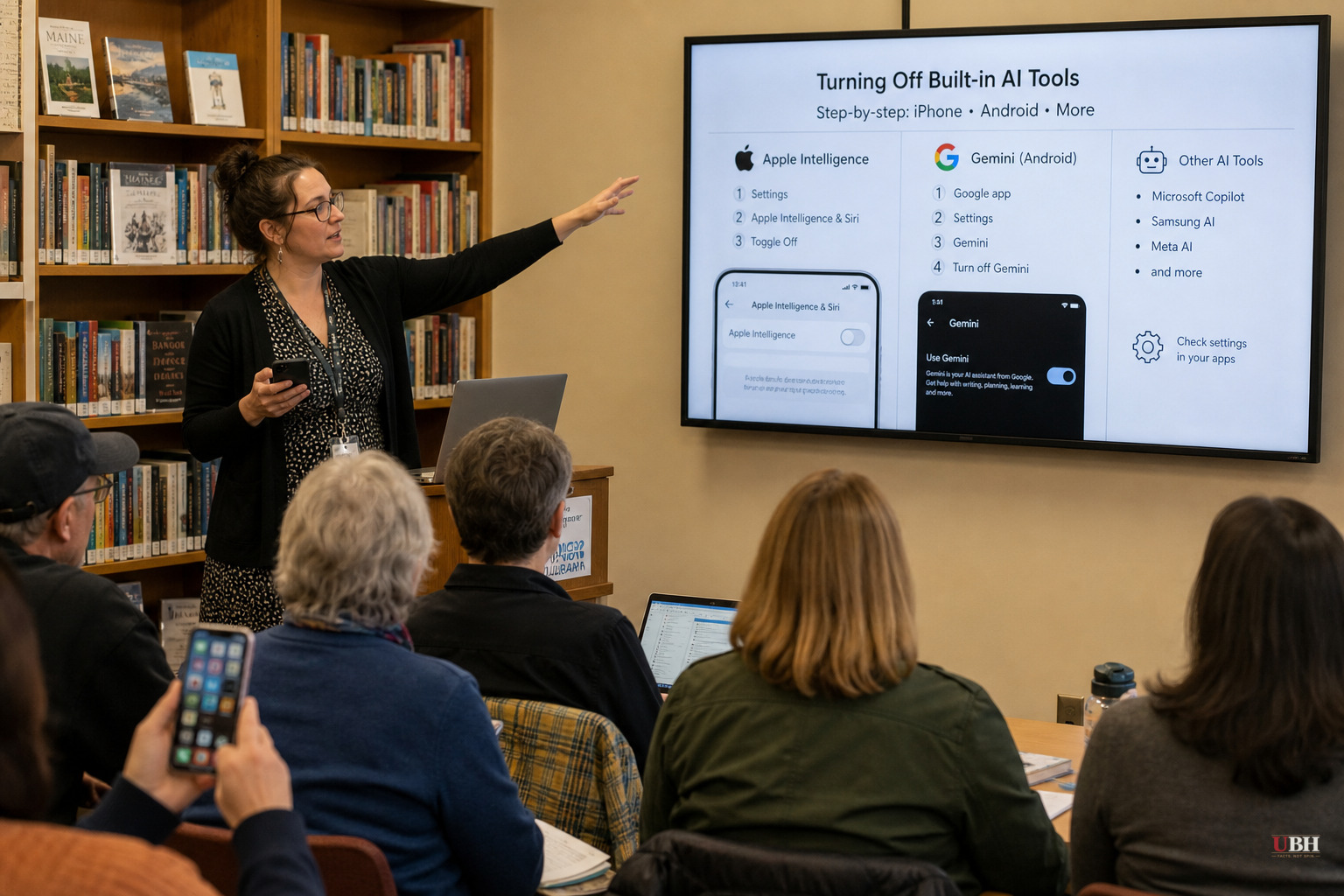
A librarian in Bangor, Maine, built a small workshop about turning off AI features on your phone. She had to cut off registration at 30 people and open a waitlist. The story reflects consumer frustration more than any tech company press release.
Hannah Cyrus normally teaches an Intro to Computers class at the Bangor Public Library that pulls in about a dozen people, according to TechCrunch. When she published a journal article describing a new class called Avoiding AI, dozens of librarians from around the world started emailing her asking for her slides. "Nobody has ever been emailing me like, 'Can you give me your Intro to Computers slides?'" Cyrus told TechCrunch.
Her reasoning was simple. Patrons kept asking her the same questions. "How do I turn this [AI] stuff off? Why is it trying to write my emails for me? Why is it trying to summarize my one-sentence email that I can easily read?" Cyrus said, describing what she was hearing at the reference desk.
So she built a class explaining what these tools actually do, then walked people through disabling them. The first two sessions, counting a Zoom livestream she had to add because in-person demand outstripped the room, pulled in about 70 people each, per TechCrunch.
The idea spread to Philadelphia
Charlie Bailey, a librarian in South Philadelphia, saw Cyrus's workshop model and ran his own version, called Avoiding AI, in a library classroom normally set up for kids' story time. TechCrunch reported that roughly 20 adults showed up, phones out, while Bailey projected step-by-step instructions for disabling Apple Intelligence and Gemini.
Bailey told TechCrunch he built the class around a specific frustration: "I was inspired by the feeling of people's frustration with AI tools being kind of forced onto them, and feeling like AI tools we didn't ask for are suddenly everywhere in our lives." He frames it as digital literacy, not tech-bashing. "As a librarian, I think it's important to see this as advancing digital literacy and helping people reclaim their autonomy over whether they want to use AI tools," he said. "It's important, especially when it can be so difficult not to use them, and when the design seems to force adoption."
The library's Instagram post promoting Bailey's workshop reportedly got an unusually strong response, echoing the wave Cyrus saw in Maine.
The legitimate complaint here
People have a real gripe. Apple has pushed Apple Intelligence features into iOS updates. Google has built Gemini into Gmail, Docs, and Android in ways that aren't always obvious to turn off. Samsung, Microsoft, and others have done the same with their own assistants. None of this requires a user to opt in from scratch. It ships on by default, and the toggle to shut it off is often buried three menus deep.
That's not a conspiracy. It's a business model. These companies are racing to get AI usage numbers up for investors, and default-on is the fastest way to do that. Nobody voted for their email client to start guessing what they want to write. If people feel like autonomy over their own devices got quietly taken away, that's a legitimate complaint about product design, not paranoia.
This isn't some grassroots revolt against AI itself. It's two library programs, run by two librarians, that generated real but modest attendance numbers, roughly 70 people at one branch's combined sessions and about 20 at another. That's meaningful demand for a niche public-library class. It is not evidence of a mass consumer backlash against AI broadly, and nothing in these reports suggests usage of Gemini or Apple Intelligence is actually declining.
What's unresolved
TechCrunch didn't report any data on how many people who attended these workshops actually kept the AI features disabled afterward, or whether Apple or Google have made any changes to default settings in response to this kind of pushback. There's also no indication yet of how many other libraries beyond Maine and Philadelphia have launched similar workshops, despite Cyrus describing an unprecedented wave of inquiries from librarians elsewhere. Whether this turns into a broader library-system trend, or fades back to Intro to Computers-sized crowds, is still an open question.
Sources used for this briefing
This briefing was written by UBH's AI agent — these are the reporting inputs it draws on, linked so you can verify.


