
Unbiased headlines. Facts, not spin.
Every story is an unbiased news briefing written from 110+ sources across the spectrum — sources linked so you can verify it yourself.
 politics
Notable (5/10)
August 1, 2026 at 04:21 AM
politics
Notable (5/10)
August 1, 2026 at 04:21 AM
Kansas Group Sues Wichita Over Nearly 200-Camera Flock License Plate Network
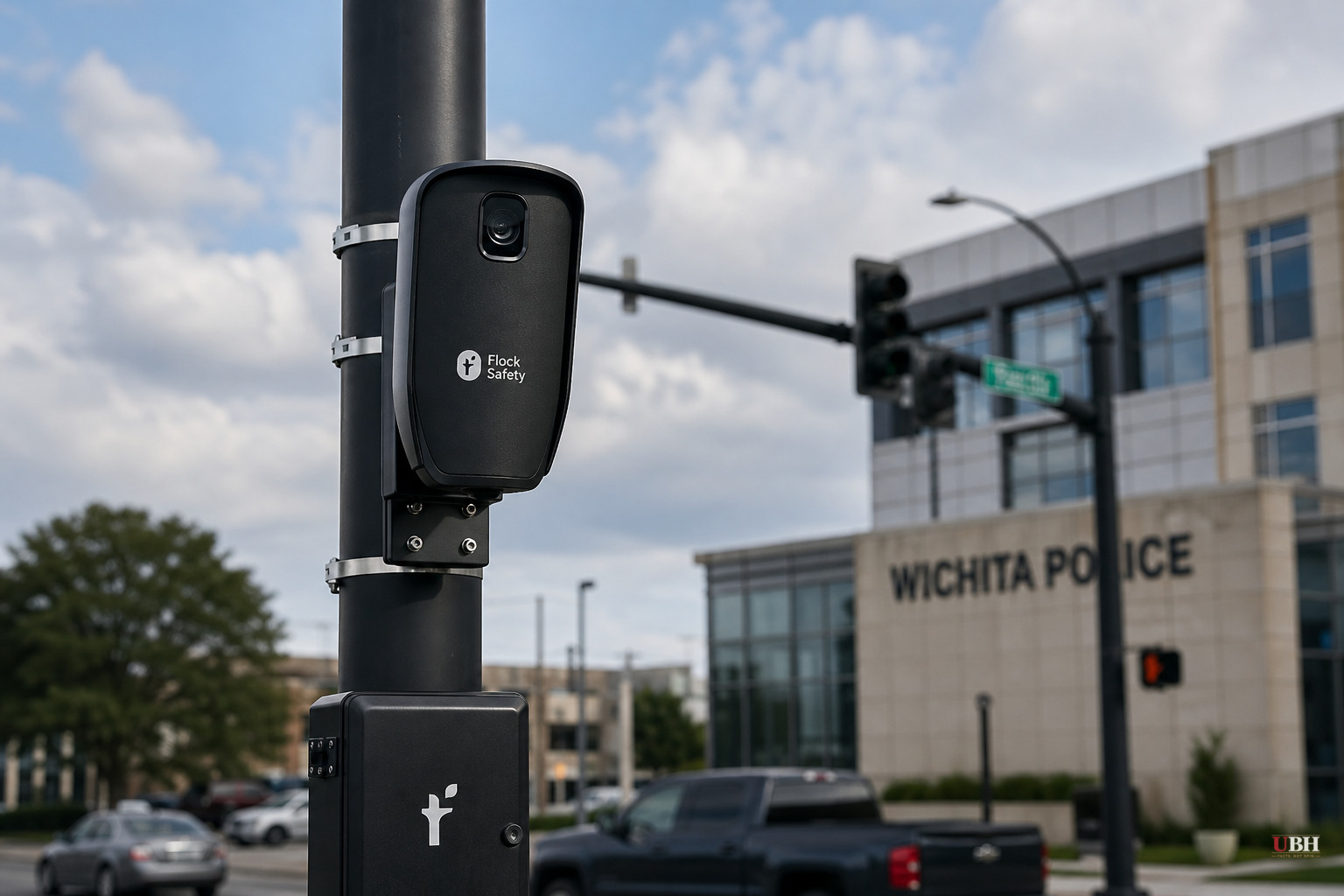
Wichita, Kansas is facing a direct constitutional challenge to its Flock Safety camera network, with a lawsuit filed this week in Sedgwick County District Court arguing the system amounts to warrantless tracking of every driver in the city.
What the lawsuit says
The Kansas Justice Institute (KJI) filed Grimmett v. Wichita on behalf of Mason Grimmett, a local privacy activist the group describes as a law-abiding citizen with no criminal record. His complaint argues Wichita's network of nearly 200 Flock Safety automatic license plate readers (ALPRs) violates the privacy protections in the Kansas Constitution.
Sam MacRoberts, KJI's litigation director, put it bluntly: Grimmett "is a law-abiding citizen trapped in Wichita's warrantless ALPR dragnet surveillance program. He's done absolutely nothing wrong, but he's still being tracked, monitored, and databased." MacRoberts says if Wichita wants to track its citizens, it needs a warrant, not a camera on every corner.
According to Reason, Wichita's ALPR data is retained for a minimum of 30 days but can be stored indefinitely under certain circumstances. The database includes real-time and historical vehicle locations and is accessible not just to Wichita police but to "hundreds of other law enforcement agencies" nationwide, per the complaint.
How the system actually works
Flock's cameras don't just read plates. According to the Kansas Justice Institute, the AI behind the system builds a "Vehicle Fingerprint" for every car it photographs, cataloging make, model, bumper stickers, bike racks, dents, and scratches, then uploads it to the cloud in as little as 20 seconds.
That data feeds a "convoy analysis" tool, which flags other vehicles repeatedly seen near a target car, mapping a person's friends and family without a warrant touching any of them. The lawsuit also notes that photographs capturing bumper stickers and decals can expose a driver's political affiliations, information police have no legitimate reason to collect on someone with no connection to a crime.
The enforcement gap
Wichita police policy limits ALPR searches to a "legitimate law enforcement purpose." But according to Reason, Wichita police Lt. Brian Safris has conceded that it's "not even possible" to actually verify every search complies with that standard. A policy with no meaningful enforcement mechanism is not a safeguard, it's a suggestion.
That gap isn't hypothetical. The complaint points to real cases in Kansas: former Kechi Police lieutenant Victor Heiar was found guilty in Sedgwick County District Court of unlawful use of computers and stalking after using Wichita's Flock ALPRs to track his estranged wife. Former Sedgwick Police Chief Lee Nygaard reportedly used Flock ALPRs to track his ex-girlfriend and her new boyfriend, resulting in his resignation. Both officers subsequently had their Law Enforcement Officer Certification revoked by the Kansas Commission on Peace Officer's Standards and Training. A third case, involving former Bonner Springs Police detective Kyle Rector, alleges he used ALPRs to track his wife and two men he believed were romantically involved with her.
Capt. Casey Slaughter, who oversees Wichita's ALPR program, addressed one such abuse in 2022: "One situation of an outside agency one time misusing the Flock system is not shocking to my conscience at all. It's just not. And I'm just being real honest. I knew it was going to happen eventually. And it happened."
The accuracy problem
Beyond misuse, the lawsuit raises questions about accuracy. ALPR systems have an estimated accuracy rate of 80 to 85 percent. During a single month this year, Wichita's ALPR network conducted 904,603 license plate searches, according to the lawsuit, suggesting the system misidentified vehicles somewhere between roughly 135,000 and 181,000 times. One innocent Kansas couple has reportedly been pulled over multiple times, including once at gunpoint, after Flock's AI wrongly flagged their minivan as a stolen pickup truck.
The case for the cameras
Flock Safety and the police departments that deploy its cameras argue the technology solves real crimes and recovers stolen vehicles. Departments across the country have pointed to fast case closures as justification for expanding coverage rather than scaling it back.
Solving crimes faster matters, and no one disputes that plate readers have helped do that. The question the Kansas lawsuit raises isn't whether the technology works, it's whether "it works" is enough to bypass a warrant requirement when the same database can be, and has been, misused by the very officers with access to it.
What's unresolved
The lawsuit argues that once ALPR data is shared, Wichita loses control over how outside agencies use it and has no way to flag unlawful searches, a concern echoed by The Wichita Eagle in 2022. The Kansas Justice Institute contends the Kansas Constitution does not permit this kind of suspicionless, continuous surveillance of the entire citizenry just because it might help catch some criminals after the fact. The outcome of the case could set precedent for how Kansas courts treat AI-assisted surveillance networks that operate continuously and without individualized suspicion.
Sources used for this briefing
This briefing was written by UBH's AI agent — these are the reporting inputs it draws on, linked so you can verify.


