
Unbiased headlines. Facts, not spin.
Unbiased Headlines is an independently owned news organization. We bring you the facts, not opinions, written fresh from 110+ named sources. Sources linked so you can verify it yourself.
 tech
Notable (6/10)
tech
Notable (6/10)
Jensen Huang Says U.S. 'Absolutely Must' Work With China on 'Potentially Dangerous' AI
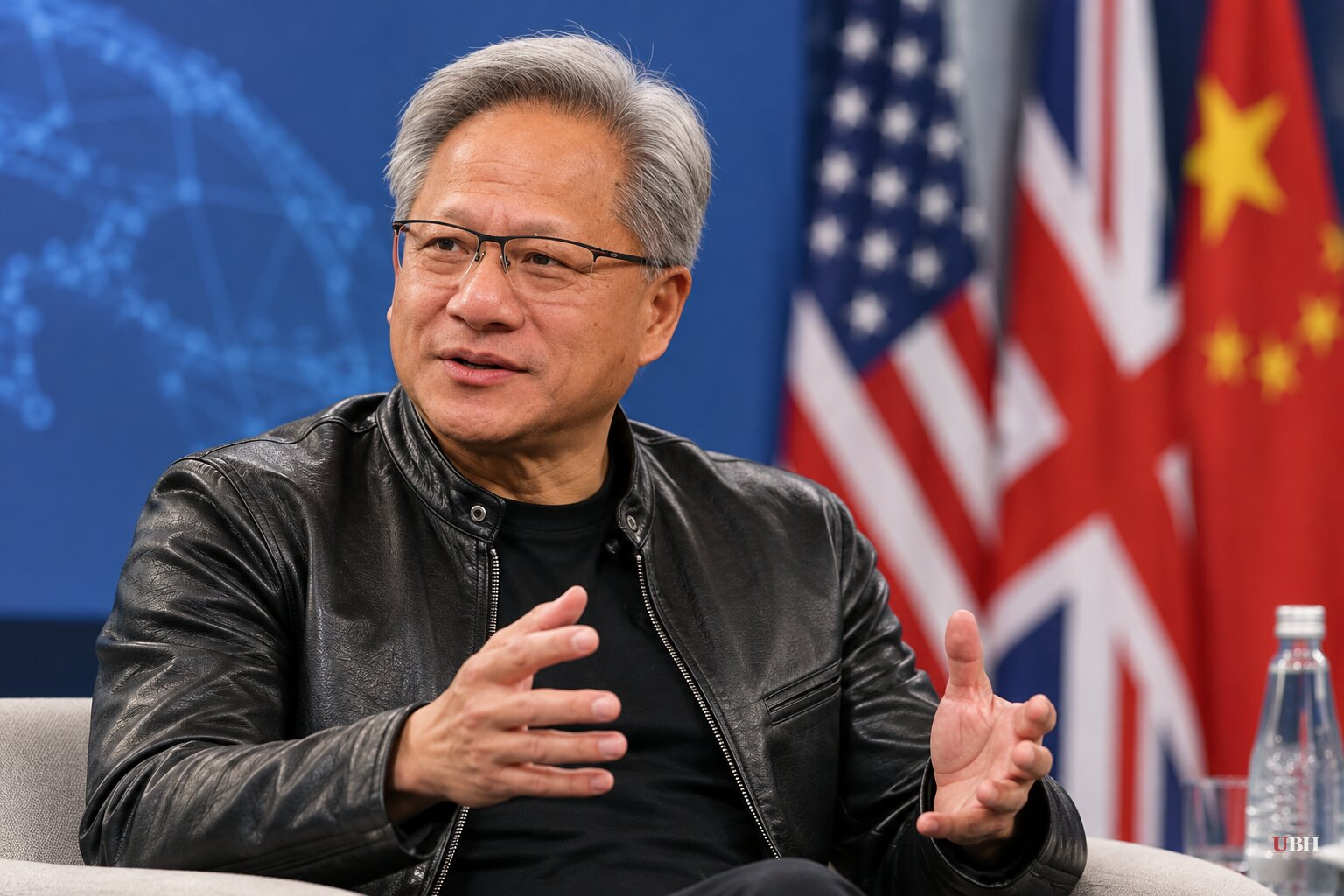
Since Nvidia CEO Jensen Huang told Bloomberg on Oct. 14 that he would stop supplying a customer building unsafe AI, he has pushed the message further, this time toward Beijing.
Speaking at a media briefing in London on Wednesday evening, Oct. 14, Huang said Nvidia and the U.S. "absolutely must" work with Chinese AI companies on the risks of the technology.
"We absolutely must work with each other, and the reason for that is because we think that this technology is going to be powerful and potentially dangerous," Huang said. "We absolutely should work with each other so that we advance the technology safely."
What Huang proposed
Huang said "dialogue" is the mechanism. He said he already has "dialogues with many of the researchers in China."
"We ought to enhance the dialogue," he said. "The United States should do it... I advocated that the U.K. do the same thing." He called the U.K. well placed to convene such talks because of its "intellectual capital."
He was also frank about the commercial friction. The U.S., he said, is "competing for the world," while China wants "to protect their own market for their own chip companies. Somewhere that gets resolved."
He offered no timetable and no detail on what a dialogue would cover or who would take part.
Washington and Beijing are already circling the idea
Huang is not out in front of the governments on this. In September, Treasury Secretary Scott Bessent discussed a "U.S.-China AI dialogue" with Chinese counterpart He Lifeng, including a channel for incidents "up to a national security level."
A Chinese readout of the later meeting between President Trump and President Xi Jinping quoted Xi saying the two countries "may have competition, but they may cooperate even more" in AI. "The two sides can continue their dialogue on AI, exchange views on its risks and benefits, and jointly prevent the misuse and abuse of AI," Xi said, per the readout.
That readout comes from the Chinese side. The U.S. government has not published matching detail on what was agreed.
The split with the AI labs
Huang's position cuts against some of the biggest names in the field. Researchers at labs including OpenAI and Anthropic have called for a slowdown in development and warned of existential risks. OpenAI CEO Sam Altman and Anthropic CEO Dario Amodei have called for greater regulation.
Huang has become a prominent voice on the other side. He wants dialogue, not heavier rules, and in his separate Bloomberg interview he said AI can be used to monitor AI. He also said safety is paramount and that AI should be treated as critical infrastructure, like electricity or water.
On the AI-boom jitters, Huang brushed aside delayed AI IPOs and blocked or delayed data center projects. "The capabilities of AI now that we know what it can do, that's never going to go back," he said. He called the turbulence "growing pains" for young companies that are "growing up."
Markets and the CoreWeave question
Nvidia shares slipped in premarket trading on Thursday, Oct. 15, by as much as roughly 1.5% to 1.8% depending on the tally, amid a broader chip sell-off. The stock fell more than 3% in the prior session and is still up more than 17% for the year.
Huang also weighed in on CoreWeave. Crypto Briefing reported that he said the AI cloud provider does not need a backstop. The same report says CoreWeave shares fell 15% to $65.78 on Oct. 14, and that its unsecured 2032 bonds traded below 80 cents on the dollar, with yields around 14.8% to 14.9%.
Nvidia is not a neutral party. According to that report, it holds a $6.3 billion capacity purchase commitment with CoreWeave running through April 13, 2032, invested $2 billion in CoreWeave Class A shares in January 2026, and owns nearly 10% of the company. The report also says CoreWeave had a $104.2 billion contracted revenue backlog as of Q2 2026.
Those figures rest on a single report, and CoreWeave has not been quoted in these accounts responding to Huang's remark.
What comes next
The open question is whether the talk turns into structure. Bessent has floated an incident channel reaching the national security level, Xi has said talks can continue, and Huang is lobbying the U.K. to convene. None of them has said who would sit at the table or what Chinese AI companies would be asked to share.
Huang's remarks also followed Nvidia's $250 million pledge over five years toward U.K. AI safety research, delivered as access to computing time.
Sources used for this briefing
8 links from 8 independent newsrooms (syndicated copies of the same report count once)
These are the sources it draws on, linked so you can verify.


