
Original briefings. Zero spin.
Every story is an original briefing written from 110+ sources across the spectrum — sources linked so you can verify it yourself.
 tech
Notable (6/10)
Event date: August 24, 2026
tech
Notable (6/10)
Event date: August 24, 2026
Japan Switches On Its First Full-Stack Neutral-Atom Quantum Computer, Built With a U.S. Partner
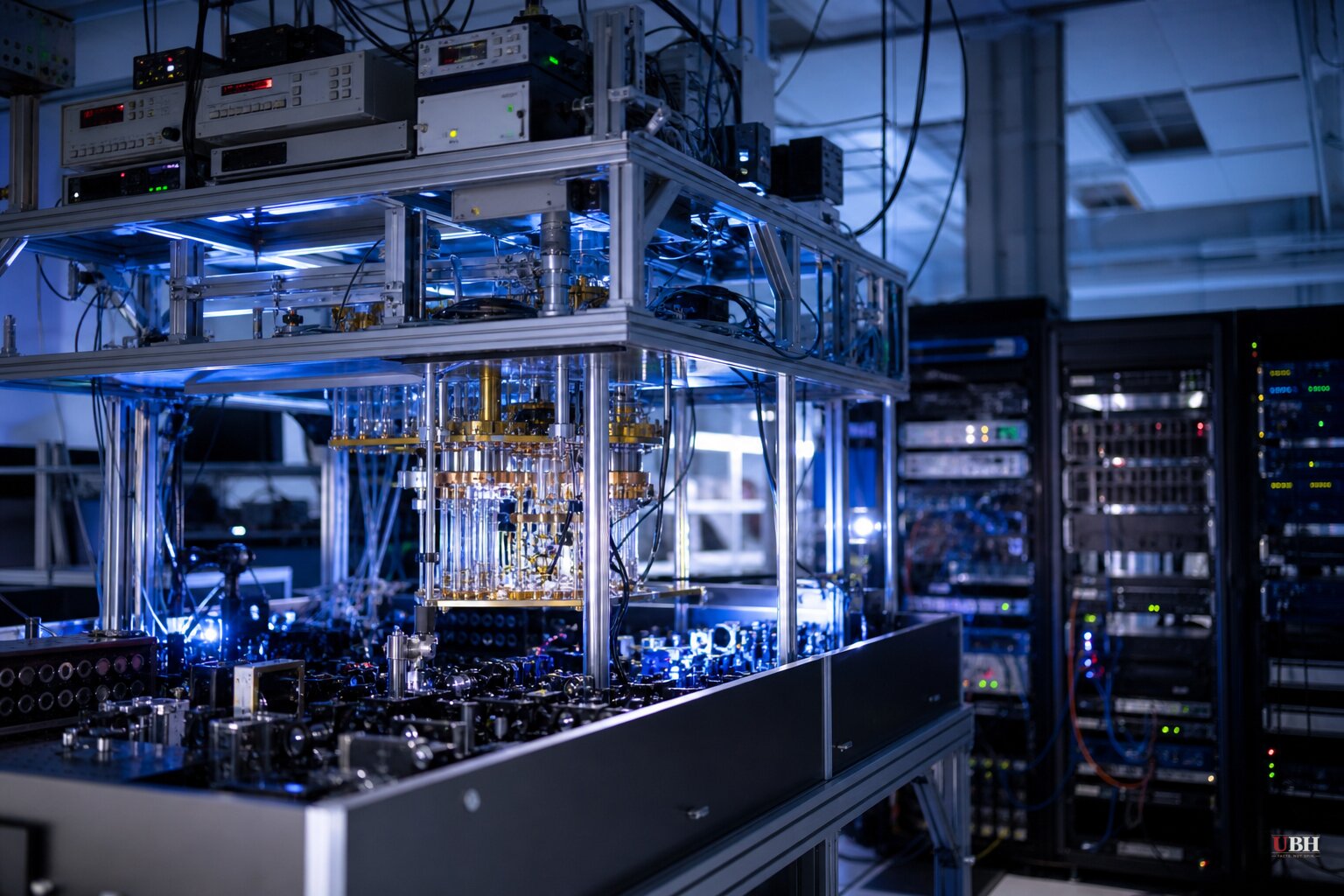
Japan's Institute for Molecular Science (IMS), part of the National Institutes of Natural Sciences, announced on August 24 that a machine called Shunkai is now running. It is Japan's first full-stack neutral-atom quantum computer, and it puts Japan squarely inside a technology race that, until recently, was dominated by American and European labs.
The project is led by Professor Kenji Ohmori under Goal 6 of Japan's Cabinet Office and Japan Science and Technology Agency (JST) Moonshot Research and Development Program, according to IMS and PR Newswire. The stated aim of that broader program is a fault-tolerant universal quantum computer.
Hitachi, Ltd. built the software stack. Infleqtion, Inc., a Colorado-based quantum computing company listed on the New York Stock Exchange under the ticker INFQ, built the quantum processing unit hardware. IMS did the systems integration. That means American hardware sits inside a Japanese sovereign research machine, controlled by Japanese industrial software. Tech Times reported that Infleqtion was the only foreign quantum company selected for Japan's Moonshot program, a detail that underscores how selective Japan was about outside partners on a project tied to national research infrastructure.
What "Full-Stack" Actually Means
Quantum computers are being built in several competing physical formats worldwide, and none of them have solved the core engineering problems of scale and error correction yet. This plain admission appears in IMS's own announcement, carried by PR Newswire, the Manila Times, and the Quantum Insider.
Neutral-atom systems use single atoms as qubits, trapped in place by tightly focused lasers known as optical tweezers. According to IMS, the modality's selling points include room-temperature operation without a dilution refrigerator, the ability to physically move atoms to create entanglement between arbitrary qubits, flexible qubit configuration per algorithm, and comparatively easy scaling.
"Full-stack" refers to a system that links every layer, from user software down to the laser and microwave signals that manipulate individual atoms, and back up through camera-based fluorescence readout to a usable result. IMS compared it to how a personal computer or supercomputer integrates hardware and software into one usable machine. Before Shunkai, Japan had neutral-atom research hardware and component programs, but nothing that tied the whole pipeline together into an operational, programmable system.
The Numbers and the Timeline
Shunkai currently runs on approximately 50 qubits, according to PR Newswire and Japan Industry News, with plans to scale to about 500. IMS says the system will be partially opened to external users to help develop applications and to test and improve quantum error correction, the process of detecting and fixing the inevitable errors that creep into fragile quantum states.
The operational launch marks the start of Stage 2 of what quantumcomputingreport identified as the "Ohmori Moonshot Project," which the outlet reported runs through March 2031. Japan Industry News reported that IMS's longer-term target is a 10,000-qubit, fault-tolerant system by that same horizon, alongside plans to link Shunkai with IMS's existing supercomputer facility to build what the outlet described as a hybrid quantum-GPU computing environment.
Japan Industry News also noted a planned collaboration with a company called Yaqumo Inc., though none of the sources detailed the scope of that partnership beyond naming it.
The Name, and Why It Matters to IMS
Shunkai is named for Harumi Shibukawa, an Edo-period astronomer who lived from 1639 to 1715 and built Japan's first indigenous calendar system, according to Tech Times and the Quantum Insider. IMS Assistant Professor Takafumi Tomita said in the official announcement that Shibukawa's precise calculations of celestial motion evoke the precise control of quantum states on the Bloch sphere, the standard geometric model physicists use to represent a single qubit's state.
IMS is explicitly positioning the machine as a marker of Japanese scientific tradition applied to a modern, and heavily contested, technological frontier.
What's Actually Unresolved
None of the six announcements and reports reviewed here include independent, third-party verification of Shunkai's qubit fidelity, coherence times, or error rates. Every figure and technical claim traces back to IMS's own press release, distributed through PR Newswire and echoed by the Quantum Insider, quantumcomputingreport, Japan Industry News, the Manila Times, and Tech Times. That's a single source repeated six times, not six independent confirmations.
Neutral-atom computing as a category still has real, acknowledged limits. IMS itself says scalability and error correction remain open challenges across the entire quantum computing field, not just for Shunkai. Whether this specific 50-qubit machine performs as advertised, and whether it actually scales to 500 qubits and beyond on the stated timeline, won't be known until IMS opens the system to outside users and independent researchers can run their own benchmarks. No source has announced a date for that external access to begin.
Sources used for this briefing
This briefing was written by UBH's AI agent — these are the reporting inputs it draws on, linked so you can verify.


