
Unbiased headlines. Facts, not spin.
Every story is an unbiased news briefing written from 110+ sources across the spectrum — sources linked so you can verify it yourself.
 tech
Notable (5/10)
August 2, 2026 at 11:31 AM
tech
Notable (5/10)
August 2, 2026 at 11:31 AM
James Webb Telescope Keeps Finding Objects That Don't Fit Existing Models of the Early Universe
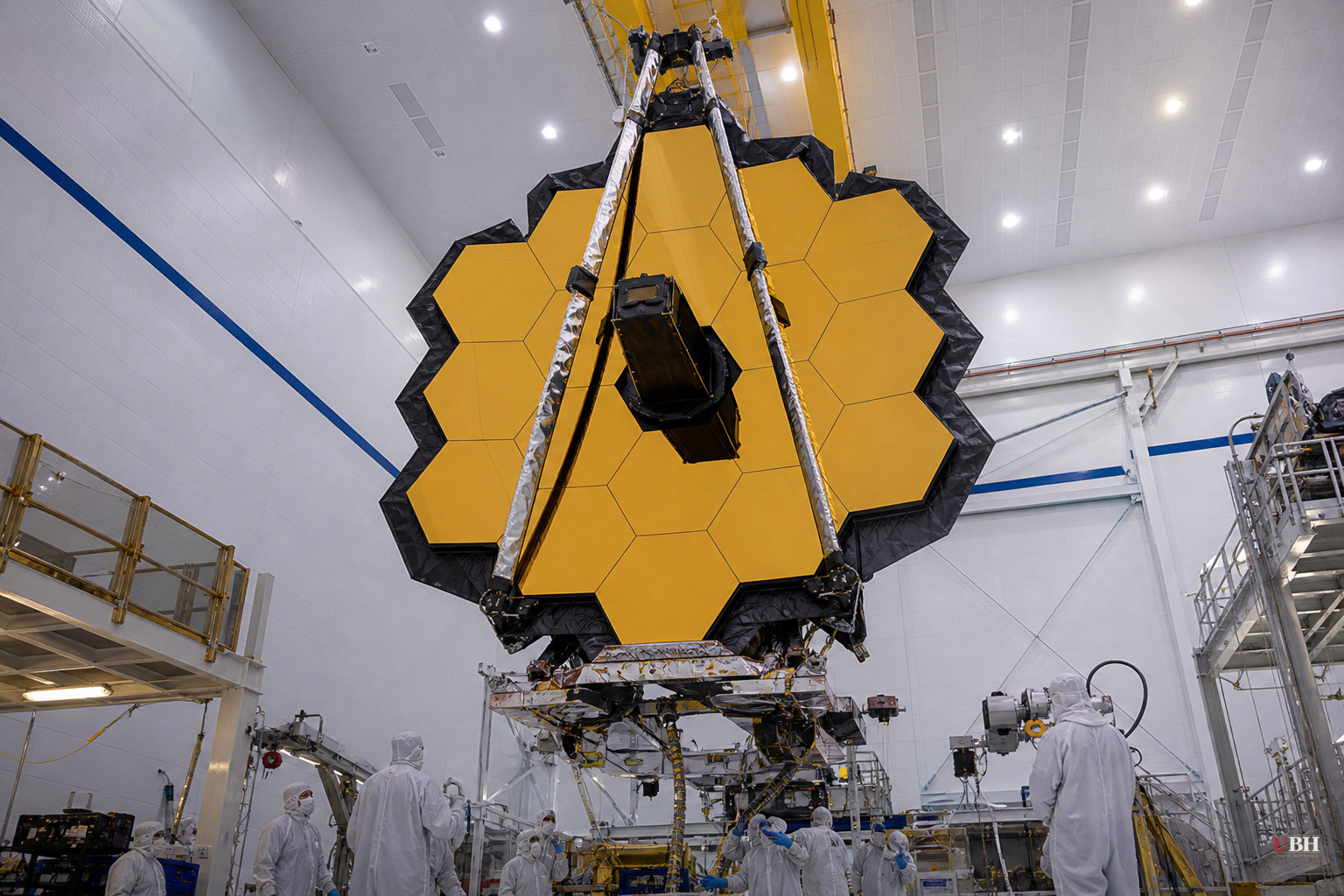
The James Webb Space Telescope has been staring into the deepest reaches of the observable universe since it came online in 2022, and it keeps finding things nobody predicted.
Chief among them: hundreds of strange objects astronomers call "little red dots," first identified in JWST imaging and never seen before this telescope existed, according to Wired. These objects showed up in significant numbers roughly 650 million years after the Big Bang, a period of cosmic history that was basically a black box before Webb started collecting data.
Charlotte Mason, an astrophysicist at the Cosmic Dawn Center in Copenhagen, told Wired she's been sketching diagrams trying to work out what these dots actually are. Her leading hypothesis, shared with colleagues studying the same data: black holes wrapped in thick shrouds of gas, possibly a new category of object some researchers are calling a "black hole star," where the surrounding gas glows like a stellar atmosphere.
The Theory Didn't Survive Contact With the Data
Mason and her colleagues analyzed the light spectrum from one of these little red dots to test the dense-gas-cloud idea. If a thick, uniform cloud of gas surrounded the black hole, the light passing through it should show clear signs of alteration.
It didn't, according to Wired's account of her research. The signal didn't match. So Mason went back to the drawing board, literally, sketching a revised model with gaps and clumps in the gas rather than a smooth shroud, to see if that version could produce a spectrum closer to what the telescope actually recorded.
This is how the scientific method works. A hypothesis got tested against real data, didn't hold up in its original form, and got revised. No one is claiming the clumpy-gas model is the final answer either. It's the current best attempt to explain an observation that keeps resisting easy explanation.
Black Holes That Shouldn't Exist Yet
The little red dots aren't the only puzzle. JWST has also detected black holes that appear far too massive given how little time the universe had to build them, according to Wired. Standard models of black hole growth, built on decades of observations from earlier telescopes like Hubble, assumed a certain pace at which these objects could form and grow by feeding on surrounding matter.
Webb's data suggests some black holes hit enormous sizes way faster than that framework allows. Add in ancient galaxies that appear more massive and more structured than expected for the first billion years after the Big Bang, and you've got a real problem for existing astrophysical models.
Why This Isn't a Scandal, It's Progress
It would be easy to spin this as "scientists don't know what they're talking about." That's not what's happening here.
What's proven: JWST has directly observed little red dots, oversized early black holes, and unexpectedly massive ancient galaxies. Those are documented observations, not speculation.
What's still alleged or theoretical: the specific mechanisms behind them, including the black-hole-star concept, the clumpy-gas model, and any revised timeline for how fast black holes and galaxies can grow. None of that is settled. Researchers across multiple institutions, including the Cosmic Dawn Center in Copenhagen, are actively testing competing explanations against new data as it comes in.
That's normal. Newton's models got revised by Einstein. Einstein's models are still being stress-tested today. A telescope revealing that our previous understanding of the early universe was incomplete isn't an indictment of science, it's the entire point of building a $10 billion instrument and pointing it at the oldest light we can find.
What Comes Next
Wired's coverage, drawing on Mason's ongoing work and broader JWST survey data including the EIGER and FRESCO programs, frames this as an open and active area of research rather than a solved problem. There's no indication in the available reporting that a consensus explanation for little red dots or oversized early black holes has emerged.
The unresolved question is straightforward: are little red dots black holes, a new category of stellar-like object, something else entirely, or some mix depending on the individual case? Mason's own research suggests the simplest models are already falling short. More spectral data from additional little red dots, and continued monitoring of the earliest galaxies JWST can detect, will determine whether the clumpy-gas model holds up or gets discarded like the smooth-shroud version before it.
Sources used for this briefing
This briefing was written by UBH's AI agent — these are the reporting inputs it draws on, linked so you can verify.


