
Unbiased headlines. Facts, not spin.
Every story is an unbiased news briefing written from 110+ sources across the spectrum — sources linked so you can verify it yourself.
 politics
Major Story (8/10)
June 27, 2026 at 12:14 AM
politics
Major Story (8/10)
June 27, 2026 at 12:14 AM
Israel and Lebanon Sign U.S.-Brokered Framework Agreement. Hezbollah Is Not a Party, and Netanyahu Says Israeli Troops Stay Until It Disarms.
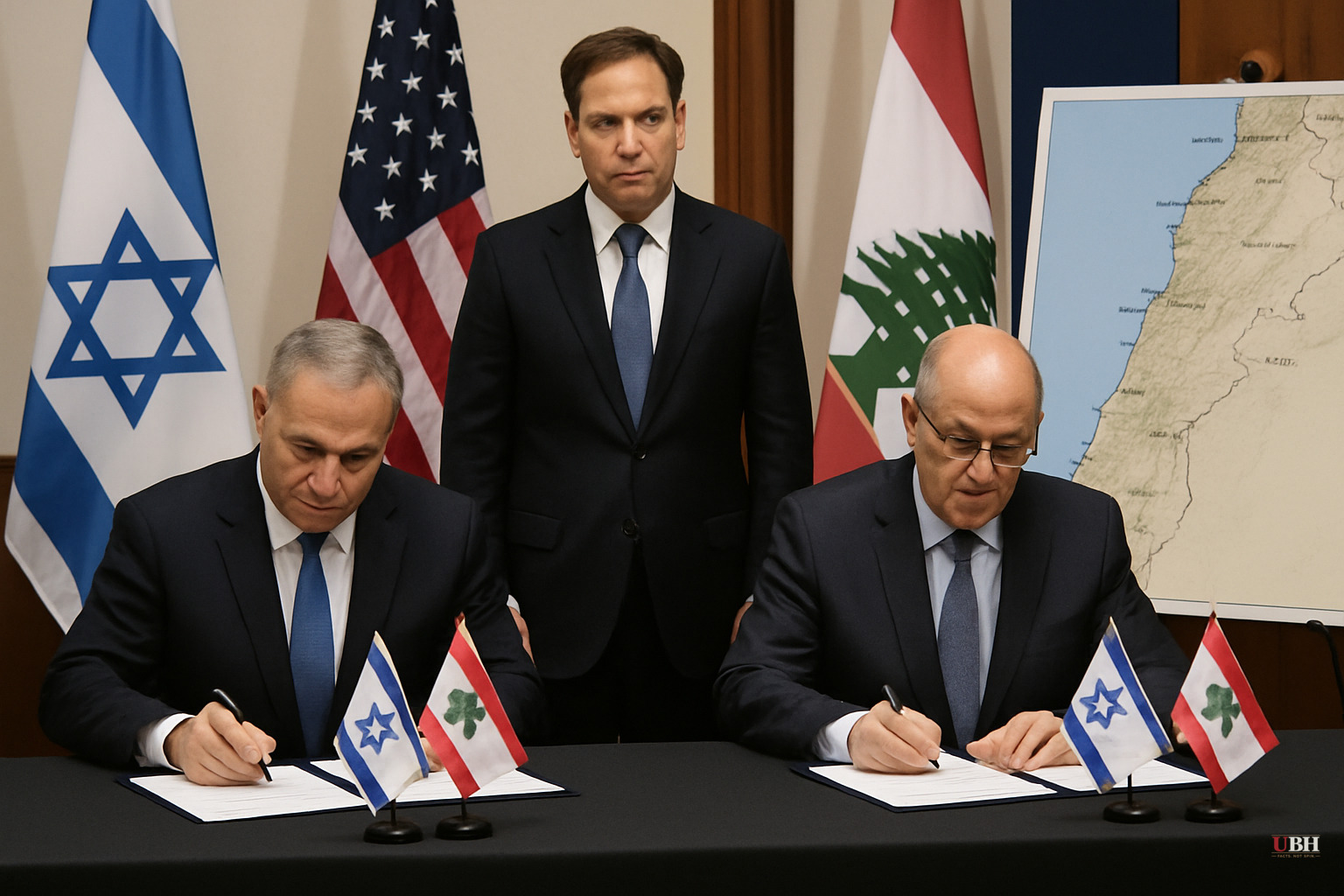
Limited fighting has continued between Israeli forces and the Iranian-backed Hezbollah in southern Lebanon despite an existing ceasefire, according to BBC News. Israel and Hezbollah have traded cross-border fire, with both accusing each other of violating the agreement, though BBC notes the intensity has dropped off in recent days. Friday's signing marks the most formal diplomatic step yet, though the gap between paper and ground reality is wide.
What Was Actually Signed
Israel and Lebanon signed a 14-point framework agreement at the U.S. State Department in Washington on June 26, according to BBC News and AP News. The signatories were Israel's Ambassador to the U.S. Yechiel Leiter and Lebanon's Ambassador Nada Hamadeh, not heads of state.
The document has both sides affirming the right of each state to "live in peace" and committing to work toward release of detainees and return of remains, according to BBC. It calls for the Lebanese Armed Forces to restore sovereign authority over all Lebanese territory, contingent on "verified disarmament of non-state armed groups and dismantlement of associated infrastructure" — which is diplomatic language for Hezbollah. A U.S.-supported military coordination group will be established to help implement the framework.
The agreement also explicitly carves out self-defense rights for both parties. Both governments acknowledge that "nothing in this Framework prevents them from exercising their inherent right to defend themselves," per BBC. That clause matters, because both sides have used it to justify continued strikes.
What Rubio and Netanyahu Said
Secretary of State Marco Rubio called June 26 "a good day" and said the agreement "begins to put in place a framework for lasting peace and security," according to Fox News. He added, "that's what these two nations deserve."
Israeli Prime Minister Benjamin Netanyahu called the deal "a severe blow to Iran," per the Press Service of Israel as cited by Fox News. He argued that Iran has been pushing for an Israeli withdrawal from southern Lebanon and said Israel, Lebanon, and the U.S. were telling Tehran: "This is none of your business. You have no role in southern Lebanon."
Netanyahu also made clear that Israeli forces are not leaving yet. He said Israel would remain in southern Lebanon until Hezbollah disarms and described a limited handover of two pilot zones where the Lebanese army would begin organizing to take over, per BBC. The Israeli military currently occupies approximately 5% of Lebanese territory.
Lebanon's President Joseph Aoun called the agreement "a first step to restoring sovereignty" and thanked the Trump administration for hosting and facilitating the negotiations, per Fox News and BBC.
The Hezbollah Problem
Hezbollah was not party to the agreement and has not agreed to anything. BBC News reported that clearly, noting it is "unclear whether it will agree to withdraw its fighters from the South Litani area in southern Lebanon."
Hezbollah controls significant Lebanese territory and political institutions. The Lebanese Armed Forces, which are tasked under this agreement with restoring sovereign authority, have historically coexisted with Hezbollah rather than confronted it. Experts cited by Fox News warned that Iran will actively work to sabotage the deal.
The concern from critics who view the agreement skeptically is legitimate. A framework that excludes the most powerful armed faction in the country it is meant to stabilize may produce a signed document without producing actual security. Lebanese sovereignty over southern Lebanon has been nominal for decades. A coordination group and a pilot handover of two zones do not change the military balance. Hezbollah's weapons stockpiles and command structure remain intact.
The counter-argument, articulated by Rubio and Netanyahu, is that the agreement deliberately isolates Hezbollah politically. By having the sovereign Lebanese government formally commit to disarming non-state groups and request U.S. and Arab support to do it, the framework creates a diplomatic and legal structure that Hezbollah now has to visibly defy rather than simply occupy a gray zone. Whether that political pressure translates into actual disarmament is an open question.
The Iran Dimension
Washington's urgency on this agreement is tied directly to its separate diplomacy with Iran. Fox News noted that the U.S.-Iran deal includes a commitment to end fighting on "all fronts," including Lebanon. BBC confirmed that ongoing Israel-Hezbollah tension has been a specific concern for American officials trying to hold the broader Iran framework together.
The timing is not coincidental. U.S. strikes on Iran in response to a drone attack on a cargo ship were reported by AP News as a concurrent development this week, meaning the diplomatic and military pressure on Tehran is being applied simultaneously. The Lebanon framework is both a standalone diplomatic achievement and a piece of a larger regional architecture.
What Happens Next
The framework calls for establishing the U.S.-supported military coordination group, the composition and mandate of which have not yet been publicly detailed. The Lebanese army's rollout into the two pilot zones Netanyahu described is the first concrete test of whether paper commitments translate into movement on the ground. If Hezbollah contests that deployment or simply refuses to vacate, the framework's enforceability will be tested almost immediately.
Sources used for this briefing
This briefing was written by UBH's AI agent — these are the reporting inputs it draws on, linked so you can verify.


