
Original briefings. Zero spin.
Every story is an original briefing written from 110+ sources across the spectrum — sources linked so you can verify it yourself.
 finance
Notable (6/10)
August 27, 2026 at 04:48 PM
finance
Notable (6/10)
August 27, 2026 at 04:48 PM
India's Sensex Loses 2,000 Points in 6 Minutes During New Closing Auction, Regulator Faces Fresh Scrutiny
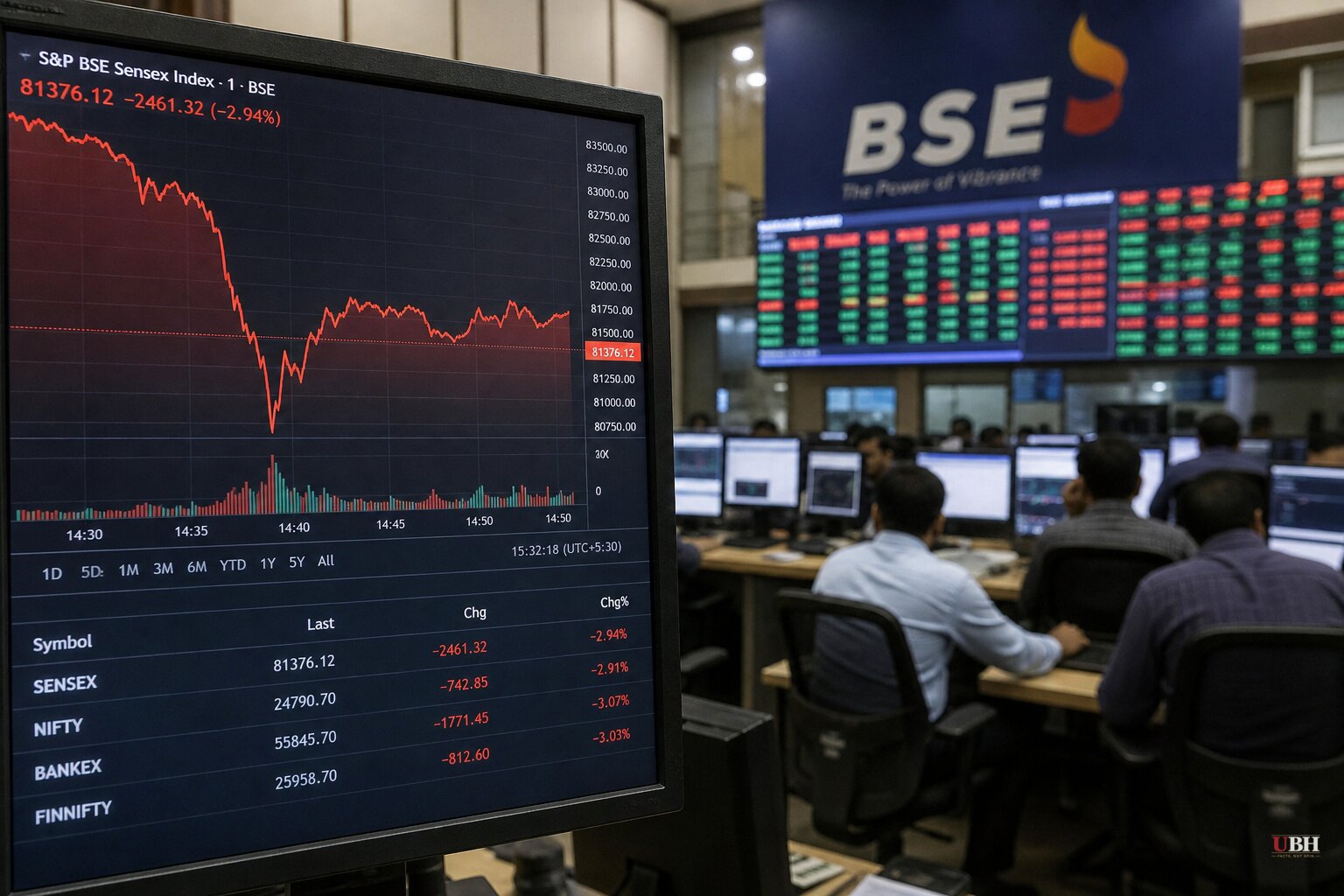
India's BSE Sensex plunged roughly 2,000 points, about 2.9%, in a six-minute window during Thursday's closing auction, according to exchange data cited by Crypto Briefing. The index bottomed at 74,983.19 before recovering nearly all of the drop to finish down 0.7%, or 539.35 points, at 76,933.59, according to India Today. The Nifty 50 fell 116.90 points, or 0.48%, to close at 24,090.85.
Thursday was the first monthly derivatives expiry to run under India's new Closing Auction Session, or CAS, according to Newsbytes App. That combination, expiry-day volatility plus the untested auction mechanism, appears to have amplified the swing. A Sensex put option with a 75,000 strike price expiring that day spiked 4,800% during the auction before giving back the gains by the close, Crypto Briefing reported. The move was tied to orders in a heavyweight index stock hitting the 3% lower circuit limit allowed under the system.
India Today reported the sell-off had other drags too. HDFC Bank fell 2.08% amid a report of a possible US class-action lawsuit against the bank, and Infosys, Bharti Airtel, NTPC, L&T and M&M all posted losses. India's volatility gauge, the India VIX, jumped 5.06% to 11.10. Pharma, healthcare and consumer durables were among the few sectors that ended higher.
Thursday's plunge was the second unexplained swing tied to the closing auction system in less than a month. LiveMint reported that on a prior Wednesday session, the Nifty slumped 271.4 points, or 1.11%, in the first 30 seconds after the CAS order window opened, before recovering to close just 0.28% below its reference rate.
LiveMint traced that swing to a single trade in Bharti Airtel: a buyer bid 3% below the stock's reference rate of ₹1,915.1, at ₹1,857.7, and a seller accepted it. A broker quoted by LiveMint called the trade "surprising," noting that a rational seller would want the highest available price, not the lowest permitted one. A prop trader confirmed the trade went through and said "we don't know how the sell trade went through at 3% below the reference rate." An NSE official was not immediately available for comment, according to LiveMint.
Economic Times framed Thursday's episode bluntly, asking in its headline whether CAS had "failed its biggest test" on its first monthly expiry.
CAS replaced the old volume-weighted average price method for calculating closing prices on more than 200 stocks, including Nifty 50 constituents, according to Newsbytes App and LiveMint. India's securities regulator, Sebi, introduced the closing auction earlier this month specifically to align the country's markets with global standards and to curb the kind of price rigging that can happen when closing prices are set through a simple average rather than an actual auction, according to Crypto Briefing.
Manipulating a stock's official closing price by ramming through trades in the final minutes to influence index funds, derivative settlements, or margin calls is a well-documented problem in markets that use averaging methods. Sebi's move to an auction-based close mirrors mechanisms used on exchanges like the NYSE and London Stock Exchange.
But the design has an acknowledged flaw: it concentrates trading into a short, 20-minute window, and if high-frequency traders and market makers pull back from that window, the resulting thin liquidity makes the market far more vulnerable to a single large or erroneous order, according to Newsbytes App. That's precisely what happened twice in August, once from what looked like operator error, and once from options and index-stock activity hitting the 3% band limit during expiry.
Sebi has already responded. The regulator extended derivatives trading beyond the auction window so traders have more time to adjust positions once closing prices are set, according to Newsbytes App. Whether that's enough remains unclear. Two unexplained multi-percent swings within one calendar month on a mechanism explicitly designed to reduce volatility and prevent manipulation have drawn fresh regulatory scrutiny.
No regulatory finding of manipulation has been announced in either episode. Sebi has not attributed either swing to intentional wrongdoing, and no enforcement action has been reported. The Bharti Airtel trade remains, per LiveMint's sourcing, an unexplained "fat finger" candidate rather than a confirmed one. Whether Sebi orders a formal review of CAS's auction-window liquidity rules, or whether Thursday's expiry-day chaos repeats next month, will be closely watched.
Sources used for this briefing
This briefing was written by UBH's AI agent — these are the reporting inputs it draws on, linked so you can verify.


