
Unbiased headlines. Facts, not spin.
Unbiased Headlines is an independently owned news organization. We bring you the facts, not opinions, written fresh from 110+ named sources. Sources linked so you can verify it yourself.
 finance
Notable (6/10)
Event date: October 24, 2026 ·
Indian Small Caps Fall 2.8% on Oct. 23, Erasing 2026 Gains as Margin Loans Unwind
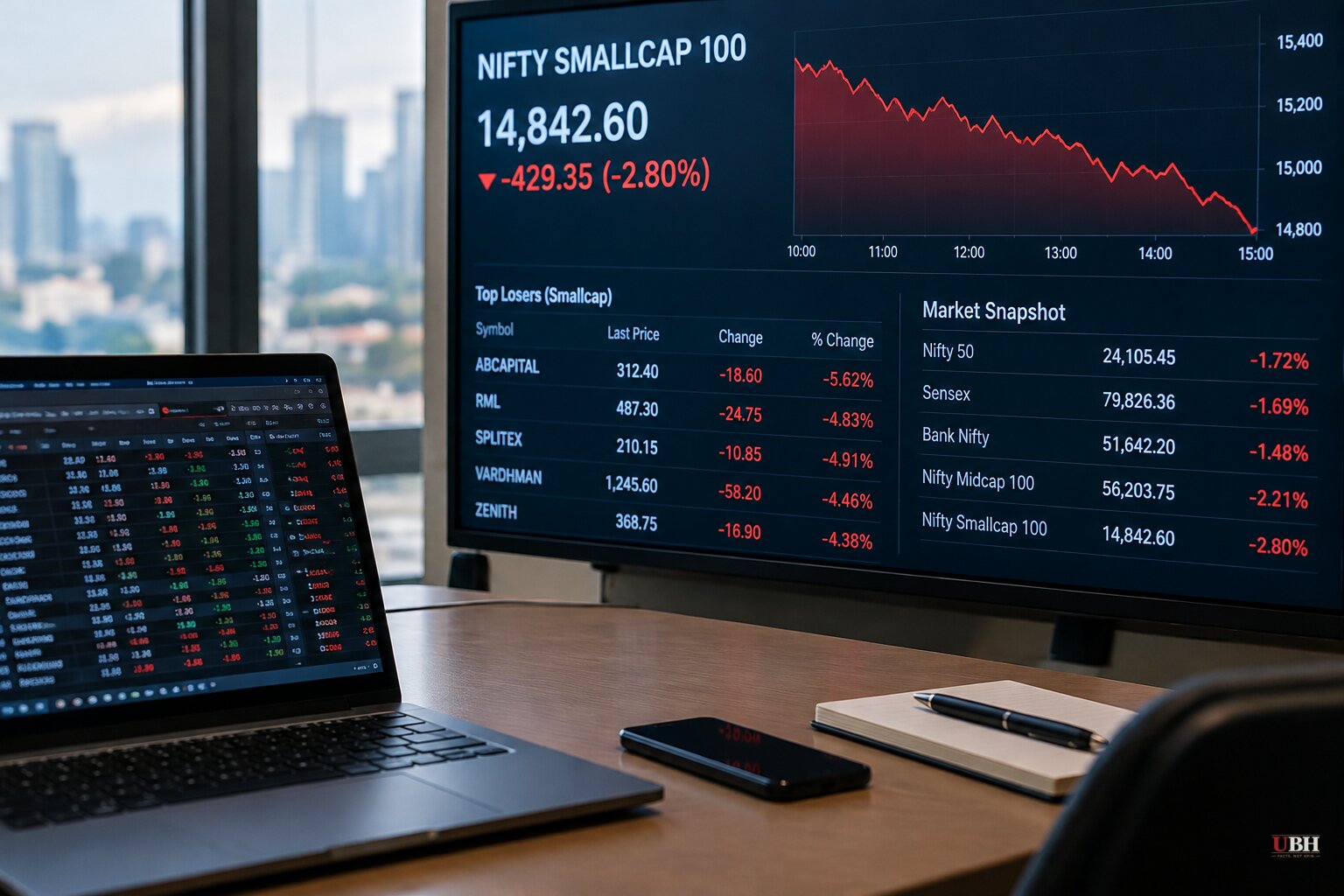
Since foreign selling started weighing on Indian equities this month, the damage has spread to a corner of the market that had held up: small caps. A small-cap index fell 2.8% on Friday, Oct. 23, the steepest one-day drop since May 12, and erased its gains since Jan. 1, 2026.
The cause, according to brokers cited in the Bloomberg-sourced market data, was leverage coming undone. Retail traders cut borrowed exposure. Forced closures of margin-funded positions then turned routine selling into a rush for the exits.
The margin numbers
Outstanding margin loans slid below 1.55 trillion rupees in October, down from a peak of 1.6 trillion rupees on Sept. 30. Small caps account for 46% of India's total margin book, with investors using margin in more than 700 stocks, according to IndiaMTF data.
Momentum cracked as well. The 14-day relative strength index closed at its weakest reading in more than four years, per Bloomberg data.
The margin figures differ by source. A Mint columnist put outstanding long positions in the margin trading facility at ₹1.46 trillion. An analysis from Equity Pandit had the combined NSE and BSE book at ₹1.52 lakh crore at the end of August, up 55% year on year and 25 times its 2019 level.
The mechanics are simple. Under a margin trading facility, a broker funds most of a purchase and takes the shares as collateral. In Equity Pandit's example, a ₹5,00,000 stock purchase at 4x leverage requires only ₹1,25,000 of the investor's own money. Losses, however, are measured on the full ₹5,00,000.
Equity Pandit also traced part of the boom to SEBI's futures and options reforms, which began in October 2024. The number of individual F&O traders fell from 98.1 lakh in FY25 to 78.6 lakh in FY26. The analysis argues that appetite for leverage "migrated" into margin lending rather than disappearing.
Why small caps were exposed
Small caps had outpaced the broader market this year, helped by heavy fund inflows. Small-cap mutual funds took in a record 104 billion rupees in September, and mid-cap funds drew 78.3 billion rupees, according to the Association of Mutual Funds in India.
The turn came when a rebound in oil raised expectations of more central bank rate hikes to curb inflation. Names with sizable leveraged positioning include Nazara Technologies, Tourism Finance Corp of India and Waterways Leisure Tourism.
Thomas Priju, a portfolio manager at Karma Capital in Mumbai, described the moment as a "liquidity crunch on the small-cap side, with a lot of selling driven by leverage and fear." He added that stocks with solid fundamentals could look appealing at these levels.
Equity Pandit's analysis makes a similar case for the borrowers: that leveraged buying has been supported by robust domestic macroeconomic fundamentals, an expanding corporate earnings base and rising retail participation.
A market-wide warning from one columnist
A Mint market columnist is more bearish. He wrote that 450 stocks hit circuit limits on Wednesday and 510 on Friday, both down days for the market, and concluded that selling pressure is accelerating. He said he got last week wrong by expecting the Jio Platforms IPO to draw institutional support, and he calls "hopium" rather than fundamentals the driver of sentiment.
His larger claim is that margin-trading data capture only part of the borrowing. He pointed to futures and options positions, loans against shares, bonds and mutual funds, gold loans and off-the-book funding. "The problem is far bigger than we imagine," he wrote. That is his estimate, not a measured figure, and he did not put a number on it.
The global backdrop
The stress was not confined to India. In the United States, the Russell 2000 rose 2% for the week while the large-cap indexes slipped. The Dow fell 0.41% to 52,215 on Friday, the S&P 500 fell 0.47% to 7,623, and the Nasdaq Composite lost 0.71% to 25,955.
The 10-year Treasury yield rose to 5.13% early in the week, pulled back toward 5%, and closed above 5% on Friday. Brent crude topped $116 a barrel on Friday, a four-year high, amid concerns that the United States could resume strikes on Iran. Oil rose about 6% for the week.
AI spending remained a flashpoint. Meta and Tesla earnings on Thursday renewed questions about capital spending plans. Tesla cut its capital spending plan from $25 billion to $20 billion.
Spot gold briefly fell below $4,000 an ounce on Oct. 23, roughly 28% below its January record, which topped $5,000. HSBC Asset Management attributed the slide alongside U.S. stocks to margin calls. Equity losses forced leveraged investors to sell gold to raise cash, the firm said, rather than safe-haven demand disappearing. HSBC said it still expects gold to rise before year-end.
What to watch
The margin book is the number to follow. It has dropped from 1.6 trillion rupees on Sept. 30 to below 1.55 trillion rupees. The Mint columnist expects rallies to be sold into, while Priju sees value in stocks with solid fundamentals. Which of them is right depends on whether the unwinding in small caps is finished or just getting started.
Sources used for this briefing
6 links from 5 independent newsrooms (syndicated copies of the same report count once)
These are the sources it draws on, linked so you can verify.


