
Unbiased headlines. Facts, not spin.
Unbiased Headlines is an independently owned news organization. We bring you the facts, not opinions, written fresh from 110+ named sources. Sources linked so you can verify it yourself.
 finance
Major Story (7/10)
Event date: October 23, 2026 ·
Goldman Calls Yen a Better Hedge Against an AI Selloff as Gold Drops Below $4,000
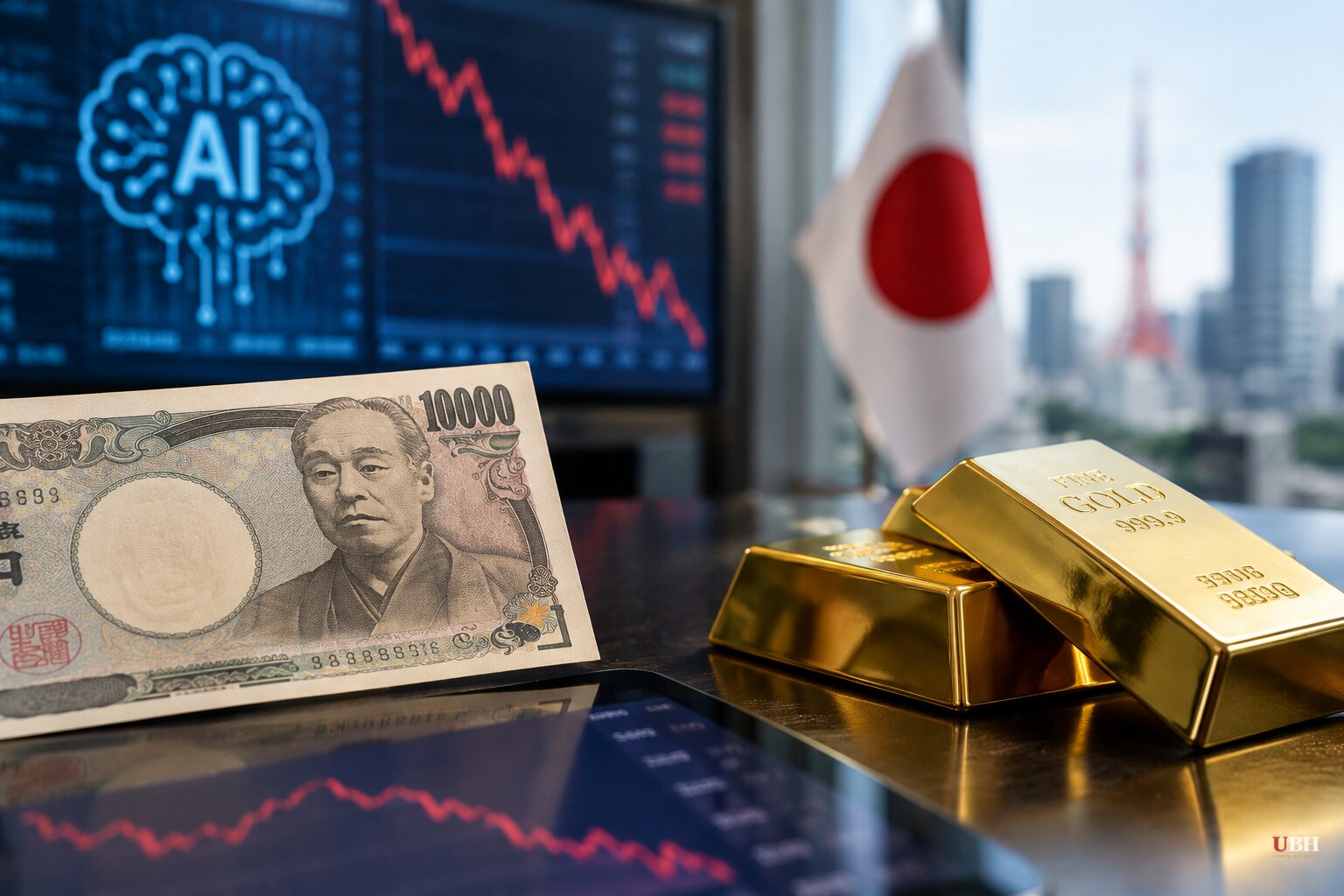
Goldman Sachs strategists say the yen is now a better hedge against an AI-driven market shock than it has been in years. The pitch arrived in a week when the traditional safe haven, gold, did the opposite of what its reputation promises.
In a note dated Oct. 23, strategists including Kamakshya Trivedi wrote that "the yen now looks like a more attractive hedge for procyclical portfolios than it has been over recent years, despite the global backdrop still arguing for further JPY weakness." Their reasoning is that changes in Japan's policy backdrop reduce the risk of a sharp yen drop when global yields rise.
The yen's case
Goldman FICC trader Jonathon Chryssafis laid out the cross-asset logic in his "10 Charts We're Talking About" note. Japanese savings have flowed overseas for decades, much of it into U.S. bonds and stocks. If investors cut their expectations for U.S. growth, that flow could reverse and push the yen higher.
Chryssafis described a "trying couple of weeks for the AI complex." His note cites disappointing megacap earnings, Tesla cutting capital spending, Meta's AI spending pushing its credit default swaps to a record, and underwhelming guidance from Lam Research.
Goldman's prime brokerage data show global information technology stocks just saw their largest two-week net selling in more than a decade, a 3.3 standard deviation move. Hedge fund short leverage is near the 99th percentile of its five-year range.
The yen responded. It rose to its strongest level in more than a month, hit a one-year high against the euro, and the dollar slipped below the 157.50 level against the yen, briefly touching about 156.9. Goldman puts the yen's undervaluation at roughly 40%.
The financing question
Goldman's credit strategists are growing more cautious on investment-grade tech debt. They warn that high-yield borrowers financing AI infrastructure could diverge sharply.
The scale is large. As of Oct. 13, U.S. dollar project financing issuance in 2026 had reached about $105 billion, mostly for data centers and computing infrastructure. Goldman says that is roughly four times the pre-AI-boom peak.
Goldman's argument is that contracted demand for computing power does not guarantee the companies involved can pay to deliver it. As financing and energy costs rise, investors are getting pickier about projects that depend on a few customers.
Gold sells off
Gold fell below $4,000 an ounce on Friday, Oct. 23, touching $3,986.50, a more than three-month low. It lost 4% on the week. In January it had topped $5,400.
The move came as the 10-year Treasury yield dropped back below 5% on Thursday for the first time in a month. Falling yields normally help gold, which pays no interest. Berenberg analysts called gold's decline against a risk-off backdrop a "notable divergence." They said the last time gold was this weak while Treasury yields fell sharply was December 2008.
Analysts cited in market commentary attribute the slide to fading speculative appeal after last year's run and to rising expectations of interest rate hikes. The risk-off mood this week also drew on French budget deficit worries and persistent tension in the Middle East.
The counterargument on gold
Gold's backers have not given up. The World Gold Council's Joseph Cavatoni argues that AI buildout is a new source of demand. Technology demand for gold rose 2% from a year earlier to 80.4 metric tons in the second quarter, and electronics demand climbed 4% to 68.3 tons.
Cavatoni said companies that pioneer a gold-based technology often look for cheaper substitutes like tungsten, but "what we're finding in this case is they're not." He called the AI sector "less sensitive to price" and said demand is "likely" to keep growing alongside it.
Central banks are also still buying. The World Gold Council says they bought a net 62 tons in July and August. China added 20 tons in August, its 22nd straight month of purchases, and has bought 80 tons this year. Poland bought 98 tons in the first eight months. Russia and Jordan were net sellers in August.
Goldman projects central banks will average 50 tons a month this year, against 17 tons a month before 2022. It forecasts gold at $4,900 an ounce by year-end. Rick Kanda of The Gold Bullion Company said sustained central bank demand could help set a long-term floor, though he said it is not the main driver of price. Rising rates amid the war-driven energy shock could cap gains.
What is unresolved
Goldman is not calling a bubble burst. Its own note says the global backdrop still argues for a weaker yen, and the hedge case rests on Japan's policy changes holding.
The gap between gold and Goldman's year-end target is now about $900 an ounce with roughly two months left in 2026. U.S. markets reopen Monday, and the open will show whether the tech selloff, the Treasury bid and the yen's rise carry into a new week.
Sources used for this briefing
7 links from 7 independent newsrooms (syndicated copies of the same report count once)
These are the sources it draws on, linked so you can verify.


