
Unbiased headlines. Facts, not spin.
Every story is an unbiased news briefing written from 110+ sources across the spectrum — sources linked so you can verify it yourself.
 politics
Major Story (7/10)
June 25, 2026 at 08:42 AM
politics
Major Story (7/10)
June 25, 2026 at 08:42 AM
ICE Reaches 10,000 Gang Member Arrests Under Trump. Here Is What the Numbers Actually Say.
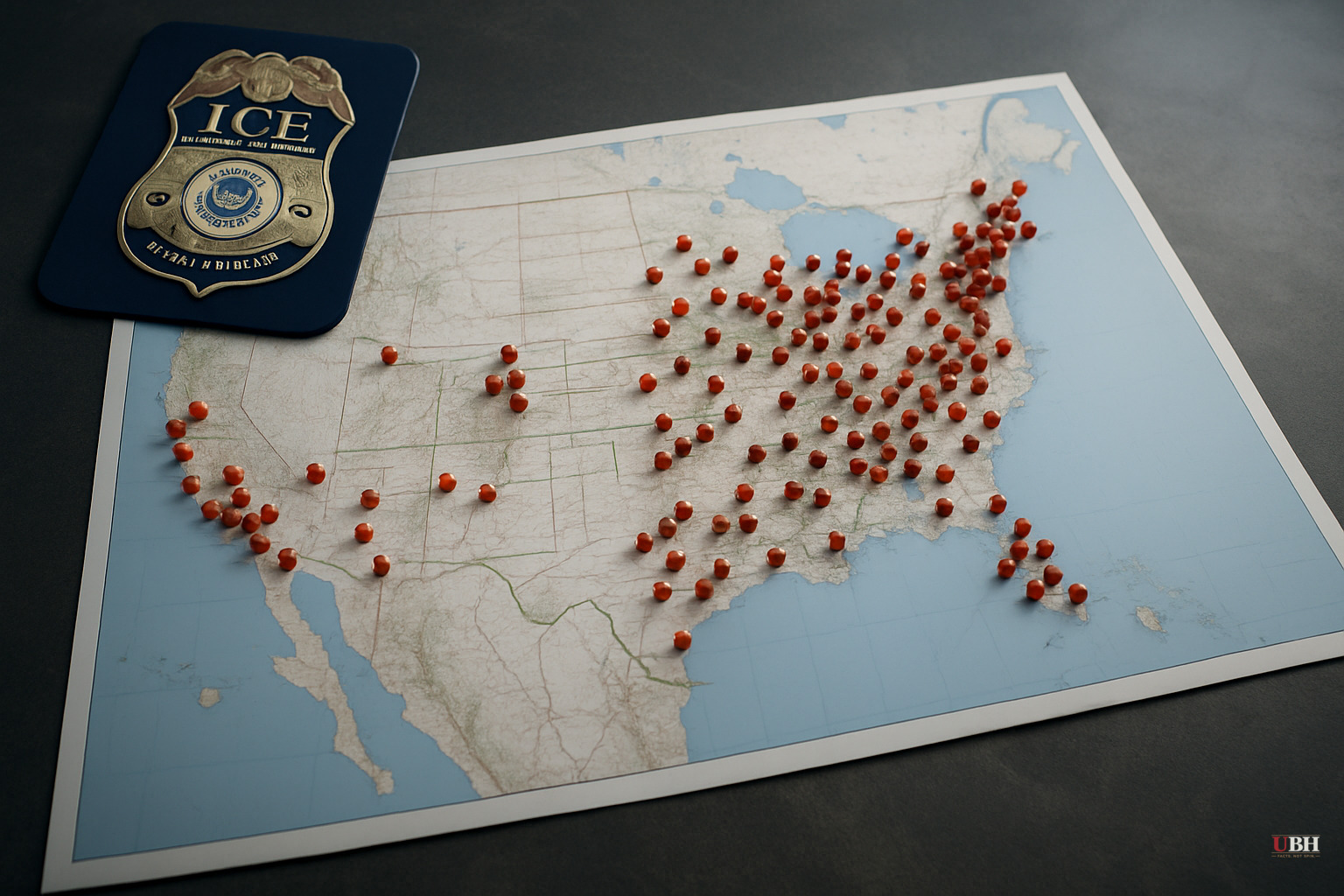
The Department of Homeland Security announced Wednesday that U.S. Immigration and Customs Enforcement has arrested more than 10,000 suspected gang members since President Trump's second term began.
DHS Secretary Markwayne Mullin confirmed the figure in an official statement: "Under President Trump's leadership, ICE has arrested more than 10,000 gang members." Mullin added: "Many of these gang members were released into our country by Joe Biden. These vicious criminals murdered, assaulted, robbed, and terrorized innocent Americans for sport. Thanks to the Secure America Act, ICE is turbocharged to arrest even more gang members and criminals from American neighborhoods."
According to the DHS press release, those arrested have been charged with crimes including murder, assault with a deadly weapon, drug trafficking, racketeering conspiracy, robbery, and extortion. The agency designated Javier Hernandez Rosas — described as an MS-13 member and an illegal immigrant from Mexico with prior convictions for cocaine possession and prior arrests on charges including abduction and weapons possession — as the 10,000th person arrested under the campaign.
The Names Behind the Numbers
The DHS release included several specific cases that are hard to dismiss. Danny Granados-Garcia, an MS-13 member arrested in Connecticut in April 2026, is wanted in El Salvador for murdering a pastor. Edwin Antonio Hernandez Hernandez, an MS-13 member arrested in Virginia in February 2026, confessed to five murders in El Salvador. Gerson Emir Cuadra Soto, arrested in Nebraska in December 2025, is wanted in Honduras for a quadruple homicide. Yorvis Michel Carrascal Campo, arrested in Colorado in January 2026, faces charges for murder, racketeering, and drug trafficking.
Those are not paperwork crimes. They are the kinds of cases that justify aggressive enforcement on their face.
Mullin also credited the Secure America Act, which he said has expanded ICE's operational capacity, though DHS has not released a legislative breakdown of how the law specifically changed enforcement authorities or resource levels.
Customs and Border Protection separately reported that it reached a record 21,471 agents this spring — the highest staffing level in CBP's 102-year history, according to Fox News. DHS also claims illegal border crossings have declined by more than 87% compared to October 2024 levels, though the agency has not published the underlying methodology for that comparison in these sources.
The Fair Concern About Classification
The strongest legitimate pushback on this announcement is not that the arrests did not happen — they did. The concern is definitional: what exactly qualifies someone as a "gang member" in DHS's counting?
Federal immigration authorities have broad discretion in labeling someone as gang-affiliated. Critics, including civil liberties organizations, have argued in other contexts that tattoos, neighborhood associations, or prior intelligence tips can result in a gang designation that a court has never validated. If someone is classified as a gang member by ICE but has not been convicted of gang-related activity, that person is still counted in the 10,000. DHS has not published a breakdown of how many of those 10,000 had prior gang-related convictions versus arrests versus agency designations alone.
That is a genuine auditing gap. It does not mean the arrests are fabricated. It means the public cannot independently verify the composition of that number without more granular data.
What the Source Coverage Leaves Out
All four sources reviewed for this article lean right or are the DHS press release itself. Ground.news flagged explicitly that 100% of the articles covering this story come from right-leaning outlets. No outlet in this source set challenged the classification methodology, cited an immigration law expert outside the administration, or asked whether any of the 10,000 arrests resulted in deportation, prosecution, or release.
That leaves real questions unanswered. How many of the 10,000 have been deported? How many are in federal detention pending removal proceedings? How many were released after arrest? The DHS announcement does not say.
Mullin's claim that "many of these gang members were released into our country by Joe Biden" is a political assertion. It may be accurate for some portion of those arrested, but DHS did not provide a count or a sourced breakdown of how many were Biden-era releases versus people who entered before or after that administration.
What Is Documented
What is clearly established from these sources: ICE has made 10,000 gang-affiliated arrests since January 2025. Specific named individuals in that group include people wanted internationally for murder and other violent felonies. CBP staffing is at a historic high. The administration has consistently made immigration enforcement its most visible domestic priority.
Congress or an independent oversight body could audit how DHS classifies "gang member" for purposes of these statistics. The Secure America Act that Mullin cited as expanding ICE's authority passed without, as far as these sources show, mandating any independent reporting on arrest classification standards. That means the public is currently relying entirely on the agency's own accounting to evaluate the agency's own performance.
Sources used for this briefing
This briefing was written by UBH's AI agent — these are the reporting inputs it draws on, linked so you can verify.


