
Unbiased headlines. Facts, not spin.
Every story is an unbiased news briefing written from 110+ sources across the spectrum — sources linked so you can verify it yourself.
 politics
Major Story (7/10)
July 23, 2026 at 11:08 PM
politics
Major Story (7/10)
July 23, 2026 at 11:08 PM
ICE Detention Tops 65,000, Highest on Record, as Homan Blames Habeas Rulings for Forced Releases
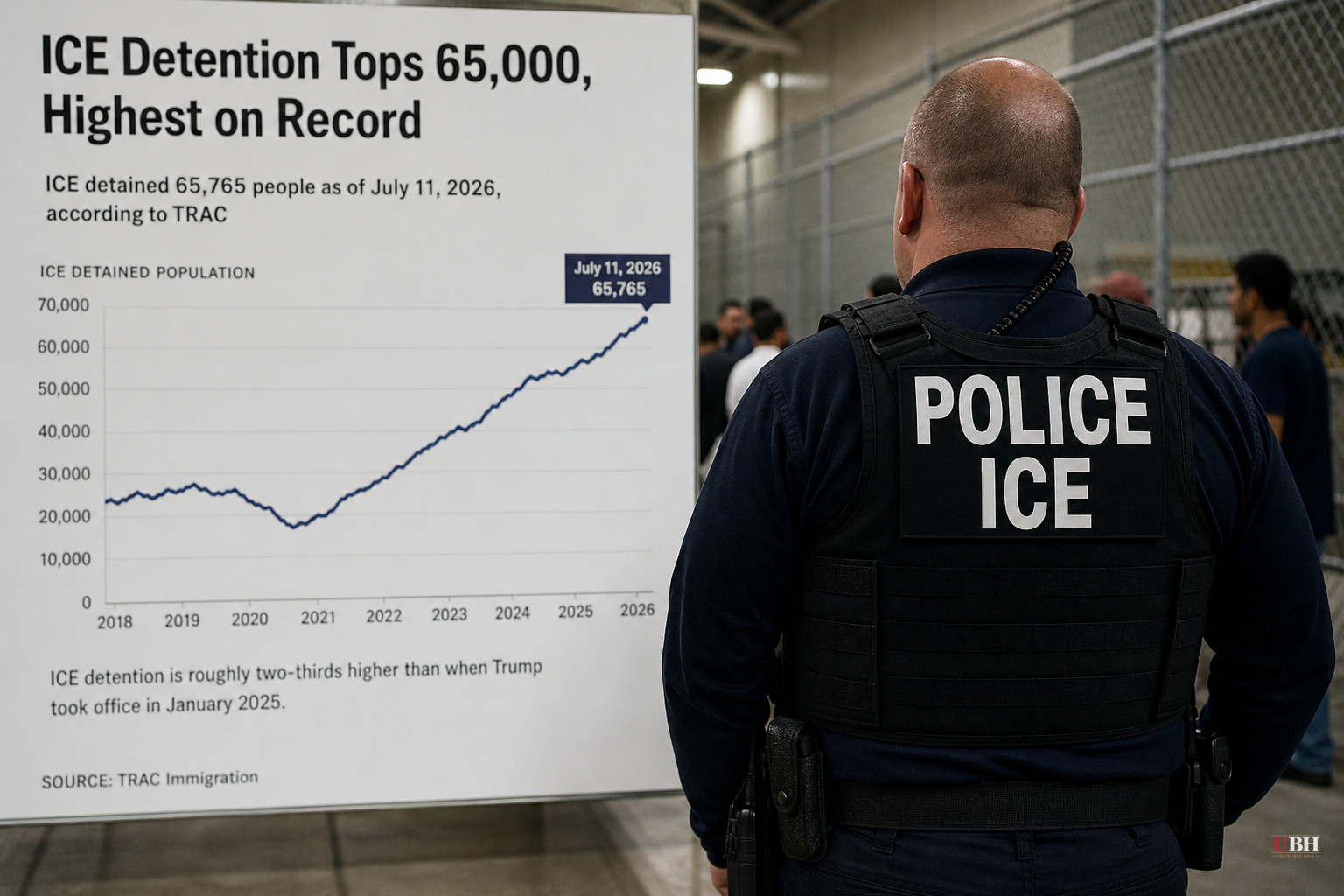
Two numbers, both around 65,000, are colliding in the immigration debate right now, and they're not the same number.
One is how many people ICE currently holds in detention: 65,765 as of July 11, 2026, according to the Transactional Records Access Clearinghouse (TRAC), a nonpartisan data outfit at Syracuse University that pulls its figures directly from ICE and other federal agencies. That's a record high, and it's a two-thirds jump from the 39,238 in custody when Trump was inaugurated, according to reporting compiled by The Philadelphia Inquirer.
The other 65,000 is a totally different figure. That's how many arrested migrants border czar Tom Homan says had to be released nationwide because federal judges granted their habeas corpus petitions. Homan gave that number to Fox News, saying "the number's around 65,000 people that we arrested that we had to release because of habeas cases out of radical judges," according to The Daily Wire.
Both things are apparently true at once. ICE detention is at an all-time high. Separately, tens of thousands of other arrests have resulted in release after judicial intervention. This means the deportation machine is running at a scale big enough to produce record numbers on both sides of the ledger.
Why the releases are happening
The surge in habeas petitions traces back to a Department of Homeland Security policy that denies bond hearings to ICE detainees, according to The Daily Wire. Detainees have responded by flooding federal district courts with habeas petitions, arguing their detention itself is unlawful.
That's a deliberate legal strategy. When a case moves from immigration court to a federal district court, it lands in front of judges who, according to experts who spoke with The Daily Wire, tend to be more sympathetic to detainees' arguments than immigration judges are. Getting released this way can buy migrants years of extra time in the country to pursue other paths to legal status.
Dan Gividen, a Dallas immigration attorney, told The Daily Wire he's shifted his entire practice around this. His office filed roughly three or four habeas petitions a year back in 2019. Last year, that number hit around 150, with 70 granted. "That's unheard of previously," Gividen said, adding, "It's good to see the way that it's going. The impact is huge."
U.S. Attorney for the District of Arizona Timothy Courchaine told The Daily Wire federal judges are granting bond in "most" cases, saying flatly, "we've been losing almost all of these." Todd Bensman, who recently left a senior advisory role at ICE, called the pattern "a racket, a scam, and a public safety hazard," arguing that district judges have no jurisdiction over administrative immigration processes and that the issue will ultimately need the Supreme Court to resolve.
That's a real legal argument, not a fringe one. Whether federal district courts should be reviewing detention decisions that fall under the immigration court system is a genuine, unresolved jurisdictional question working through circuit courts right now, and conflicting rulings across circuits are exactly why it may end up at the Supreme Court. Bensman's complaint about judge-shopping and inconsistent outcomes reflects a legitimate concern about a system producing wildly different results depending on which district a case lands in.
What the detention data actually shows
According to TRAC, 70.6% of the 65,765 people currently in ICE detention, 46,436 people, have no criminal conviction. Many of the convictions among the rest are for minor offenses, including traffic violations, TRAC notes.
The Inquirer's reporting, citing TRAC data from November, put that no-conviction share even higher at 74% and quoted Jonah Eaton, a Philadelphia immigration attorney who teaches at Temple University's Beasley School of Law, saying of the administration's approach: "They are dead serious about moving as many people out of the country as possible, and keeping them detained while they do it."
This cuts against the administration's stated framing that it's targeting the "worst of the worst." It doesn't mean the administration isn't also arresting violent criminals. It means the bulk of people currently sitting in ICE custody have no criminal record at all, which is a fact the administration has to reckon with alongside its habeas complaint.
Texas holds by far the most detainees of any state, 16,450 as of early July, according to TRAC, followed by Louisiana, California, Georgia, and Florida. The single largest facility is ICE's El Paso Camp East Montana in Texas, averaging 2,026 detainees a day. Separately, ICE's Alternatives to Detention programs are monitoring another 183,181 people, with San Francisco's office overseeing the most of any region.
The unresolved fight
None of this settles the underlying legal question: do federal district courts have authority to review ICE detention decisions through habeas petitions, or does that belong exclusively to the immigration court system? Circuit courts are split, according to The Daily Wire, and Bensman's prediction that it will take a Supreme Court ruling to resolve the conflict looks increasingly likely.
Until then, expect both numbers to keep climbing, more people booked into detention as ICE ramps up arrests, and more habeas petitions filed as attorneys like Gividen keep finding success in district courts.
Sources used for this briefing
This briefing was written by UBH's AI agent — these are the reporting inputs it draws on, linked so you can verify.


