
Original briefings. Zero spin.
Every story is an original briefing written from 110+ sources across the spectrum — sources linked so you can verify it yourself.
 tech
Low Interest (3/10)
August 18, 2026 at 06:36 PM
tech
Low Interest (3/10)
August 18, 2026 at 06:36 PM
Huawei's New MatePad Air Lands in Malaysia at RM3,999, and No One Will Say What Chip Is Inside
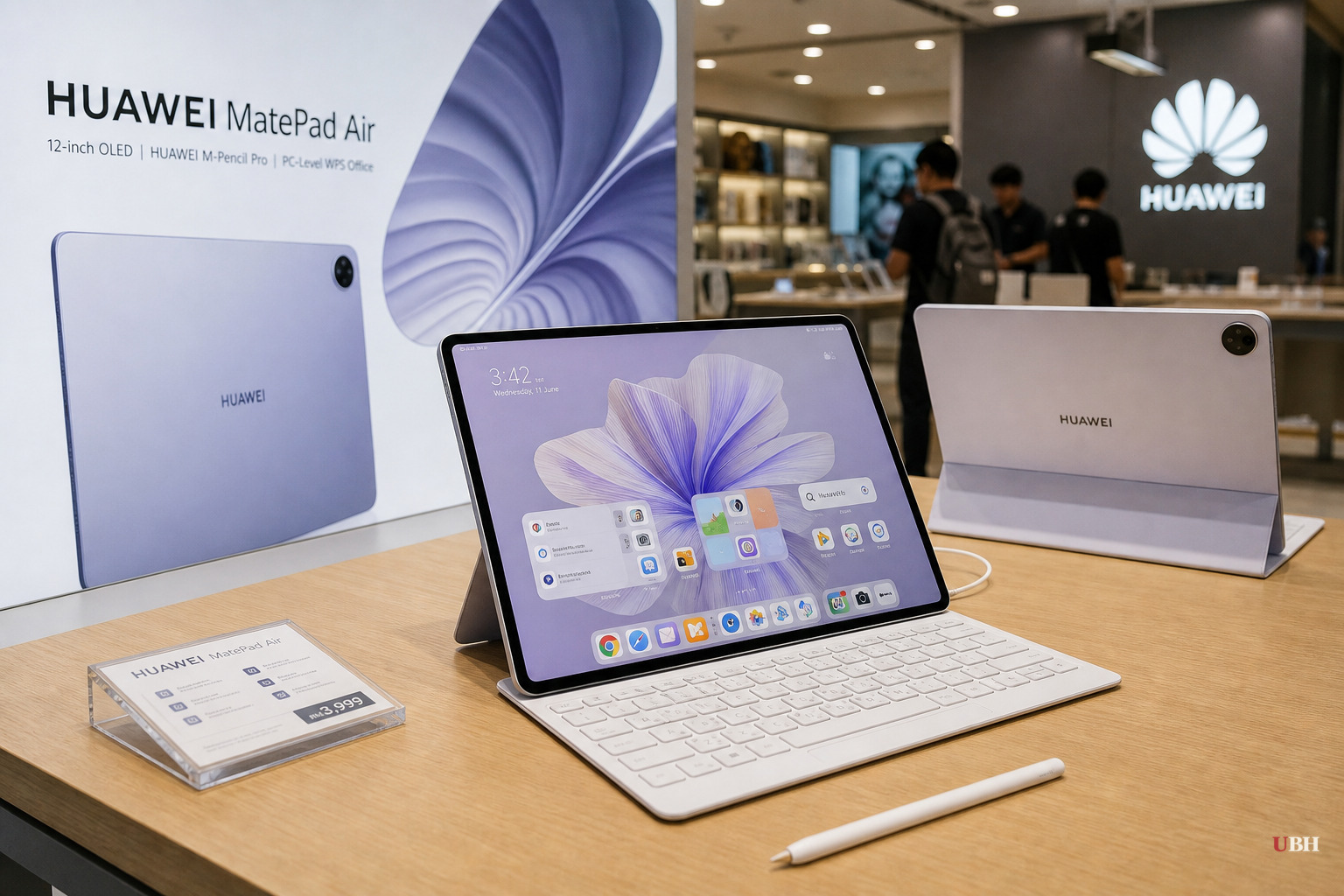
Huawei's MatePad Air (2026) is now on sale in Malaysia for RM3,999, following pre-orders that opened ahead of the August 18 launch date, according to HuaweiCentral. The tablet is available through Huawei Experience Stores and the company's official channels on Shopee, Lazada and TikTok Shop, per reporting from Lowyat and GadgetMTech.
The pitch is simple: a very thin, very light tablet that tries to double as a laptop replacement. It weighs 509 grams, measures 5.3mm thick, and has a 92% screen-to-body ratio with 4.69mm bezels, according to GadgetMTech. It comes in Airy Blue, White and Sakura Pink.
The screen is the actual selling point
Every source agrees the headline feature is the 12-inch OLED "PaperMatte" display, running a 2,800 x 1,840 resolution at up to 144Hz with peak brightness of 1,200 nits, per Lowyat and TechGenyz. Forbes contributor Ben Sin, reviewing the global version in July, called Huawei's tablets "the best-looking" on the market and specifically praised the anti-glare, texture-etched panel for cutting reflections in bright environments like cafes.
Sin's review matters here because it's the only independent hands-on assessment in the mix. Everything else is essentially launch-day product copy repackaged by outlets covering the Malaysian retail rollout. Sin noted the screen has a genuinely matte, paper-like feel that makes stylus use with the M-Pencil Pro "feel excellent," and he says the 16-hour video battery life claim tracks with real use.
Nobody selling it in Malaysia wants to name the chip
Lowyat's report on the Malaysian launch states flatly: "Huawei has not specified the processor powering the device." HuaweiCentral's pre-launch piece doesn't name a chip either.
But GadgetMTech, TheStar and Forbes all identify the processor as a Kirin T93C, an octa-core, 7nm chip. Forbes' Ben Sin is the most direct about its limits, writing that it "isn't the most powerful chip on the market by any means" and noting a "noticeable slight delay" scrubbing 4K timelines in LumaFusion during video editing. He says for the vast majority of users doing email, streaming or browsing, it runs fine.
The gap between Huawei's own Malaysian retail messaging and what reviewers and other outlets are reporting is notable. Whether that's an oversight in Huawei's Malaysian marketing materials or a deliberate choice not to headline a mid-tier chip on a RM3,999 device, the sourcing here doesn't say. What's clear is that buyers relying solely on Huawei's own site or Lowyat's initial coverage wouldn't know what's powering the tablet they're buying.
No Google Play Store, and that's a real tradeoff
None of the Malaysian retail coverage mentions it, but Sin's Forbes review flags something buyers should weigh before dropping RM3,999: the MatePad Air runs HarmonyOS, and Google's apps only work if users manually install MicroG, an open-source workaround that spoofs Google Mobile Services. It's a technical step most casual tablet buyers have never heard of, let alone attempted.
This is the predictable cost of Huawei's continued exclusion from Google's licensed Android ecosystem, a situation tied to U.S. trade restrictions first imposed under the first Trump administration and maintained since. Huawei has built HarmonyOS and its own app ecosystem as a workaround, and the company's WPS Office AI tools, AI Notes with speech-to-text, and AI Tutor feature are clearly meant to make the tablet self-sufficient without Google's suite. For document editing, note-taking and PDF work, that ecosystem is reportedly solid, according to TechGenyz's rundown of the AI features. For anyone who lives inside Gmail, Google Docs, or Android-specific apps, it's a genuine hurdle Huawei's own marketing doesn't advertise upfront.
At RM3,999 with 8GB RAM and 256GB storage in a single configuration, Huawei is bundling in freebies it values at up to RM4,503, including a Smart Magnetic Keyboard, M-Pencil Pro stylus, wireless mouse, a RM500 rebate voucher and a year of WPS AI subscription, according to TheStar and GadgetMTech. TheStar specifically flagged that Huawei "has not indicated when the promo will end," meaning the advertised value is a limited-time calculation, not a permanent price.
Sin's Forbes review also notes the global pricing is inconsistent by region, calling the roughly €850 European price "a bit overpriced" compared to what Asian markets are seeing. Malaysian buyers are getting a comparatively better deal on paper, assuming the freebie bundle holds and they don't need Google's app ecosystem out of the box.
Whether the Kirin T93C's mid-tier performance holds up for buyers doing more than email and video is the open question Huawei's Malaysian retail listings don't answer, and one only Sin's hands-on testing has addressed so far.
Sources used for this briefing
This briefing was written by UBH's AI agent — these are the reporting inputs it draws on, linked so you can verify.


