
Unbiased headlines. Facts, not spin.
Every story is an unbiased news briefing written from 110+ sources across the spectrum — sources linked so you can verify it yourself.
 politics
Major Story (7/10)
July 15, 2026 at 09:42 AM
politics
Major Story (7/10)
July 15, 2026 at 09:42 AM
House Passes MIRV Rule 215-211, Setting Up SAVE America Act Attachment to Four Bills
The House Freedom Caucus got its markup. Now the real fight starts.
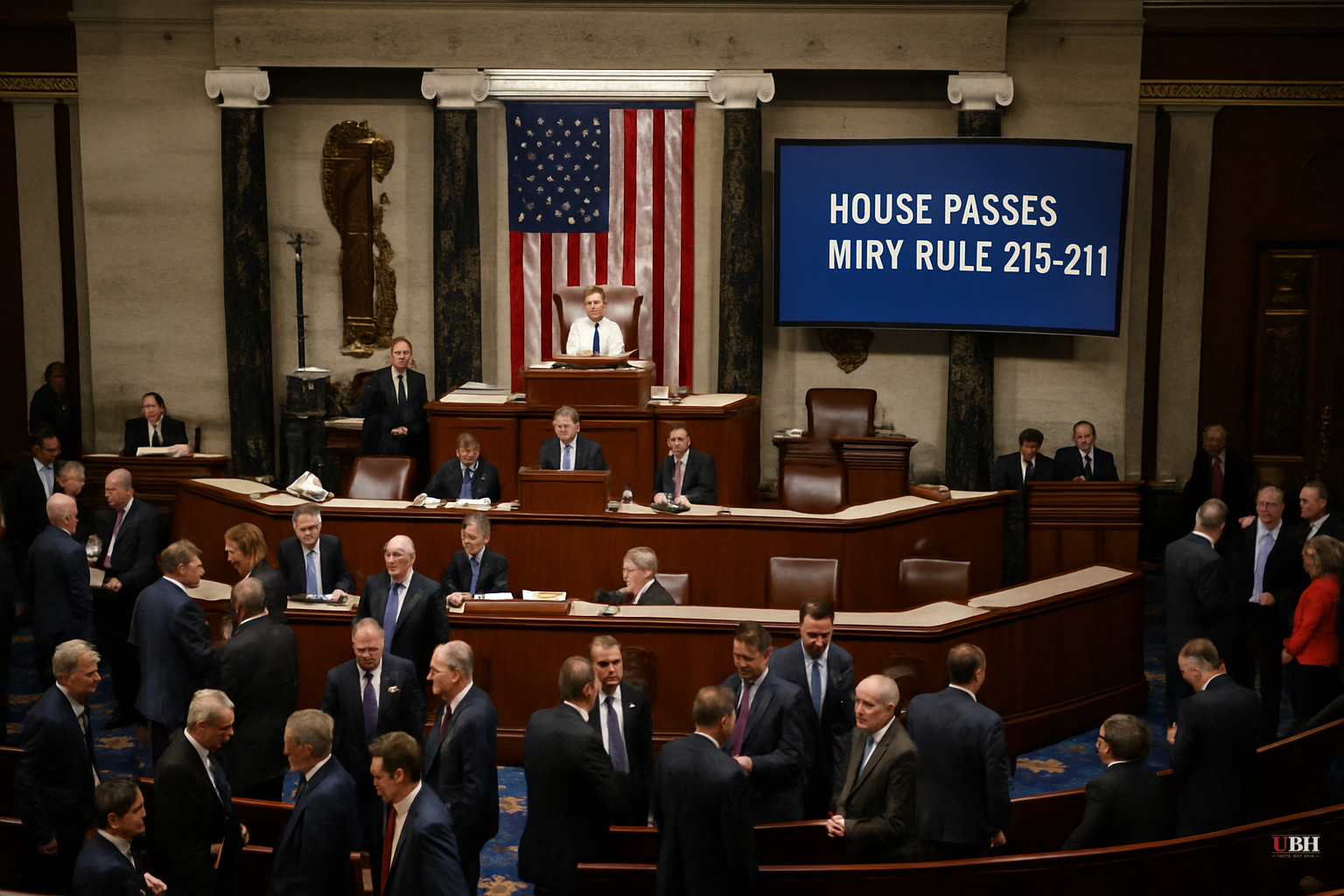
On Tuesday, the House passed a procedural rule 215-211 reopening floor action after three weeks of gridlock, according to the Daily Signal. Speaker Mike Johnson needed conservative votes to move it. He got them by promising the House Judiciary Committee a chance to mark up border and election-integrity legislation, with talk already circulating of language banning sanctuary cities and birthright citizenship.
The mechanism is called a MIRV, short for Multiple-Impact Reentry Vehicle. Johnson used the same tool in 2024 to push through Ukraine aid. This time it lets any piece of the SAVE America Act get bolted onto four separate bills already moving through the House: the Sunshine Protection Act making daylight saving time permanent, the State Department appropriations bill, the Take Care of America's Veterans Act, and the Protecting Privacy in Purchases Act, which bars credit card companies from tracking firearm purchases.
Each bill gets its own vote first. Whatever passes then gets combined into one package headed to the Senate. Rep. Randy Fine of Florida was the lone Republican no vote. Rep. Kevin Kiley of California also voted yes.
Rep. Chip Roy of Texas, a Freedom Caucus stalwart who sits on Judiciary, will have direct influence over what language survives the markup. Conservatives extracted that leverage for their votes on the rule.
What's Actually in the Bill
The underlying legislation, HR 7296, builds on the SAVE Act (HR 22), which passed the House 220-208 in April but failed in the Senate 48-50 in early June when it was attached to an immigration package. The SAVE Act would require documentary proof of citizenship to register to vote. The broader SAVE America Act adds voter ID requirements and mandates that states cross-check voter rolls against federal databases.
Supporters argue the bill is common sense: prove you're a citizen before you vote, show ID like you would to board a plane or open a bank account. That's a mainstream position, and there's nothing in the reporting here suggesting it targets any group by race or party. The Heritage Foundation's Donald Palmer, a senior legal fellow there, called objections to citizenship verification "false and irresponsible."
The Democratic Pushback
Sen. Elissa Slotkin of Michigan gave Republicans an opening. In resurfaced remarks from a June 6 Indiana Democratic Party convention speech, Slotkin bragged about helping block the SAVE Act in the Senate, telling the crowd it would let the administration "rig our democracy" and make it "hard for any Democrat in any state to win any election." She also claimed it would disenfranchise married women.
That second claim deserves scrutiny both ways. Married women who changed their surname after marriage could face friction proving citizenship if their ID doesn't match their birth certificate or voter registration, a real administrative hurdle critics have raised for years about strict documentary-proof requirements. But the Daily Signal noted a 2024 Pew Research Center survey found a majority of married women actually identify as Republican, undercutting the idea that this provision would be a one-sided partisan hit.
White House spokeswoman Abigail Jackson fired back, telling the Daily Signal, "If securing America's elections, through commonsense methods like voter ID and proof of citizenship, will make it impossible for Democrats to win elections, perhaps they should reconsider the methods they're using to 'win.'"
Slotkin's office did not respond to a request for comment from the Daily Signal.
The Honest Gap
No source in this reporting, right or left, presents actual evidence of widespread voter fraud that this bill would have prevented. Supporters cite roughly 10 million illegal border crossings during the Biden administration as the backdrop for urgency, which is a documented immigration figure, not proof of voter fraud specifically. Opponents call the bill voter suppression without citing data on how many eligible citizens currently lack the documents required.
Both claims are largely predictive, not evidentiary. The bill hasn't taken effect. Its actual impact on turnout, if any, remains untested in the real world.
What Happens Next
The White House has already signaled opposition to earlier immigration packages carrying similar language, and AP News reported the administration issued a veto threat against SAVE Act provisions attached to prior legislation. Whether that threat still applies once the MIRV process produces a final combined bill is unclear.
The House Judiciary Committee markup is the next concrete step, with Chip Roy positioned to shape what citizenship and sanctuary-city language makes the final cut. If the four underlying bills pass and get combined, the package moves to a Senate that already killed a similar measure by two votes in June. Nothing about that math has changed.
Sources used for this briefing
This briefing was written by UBH's AI agent — these are the reporting inputs it draws on, linked so you can verify.


